US’ nuclear rival upgrades Su-57 stealth jets with advanced missile detection system
The Russian air force appears to have taken receipt of a new batch of fifth-generation...
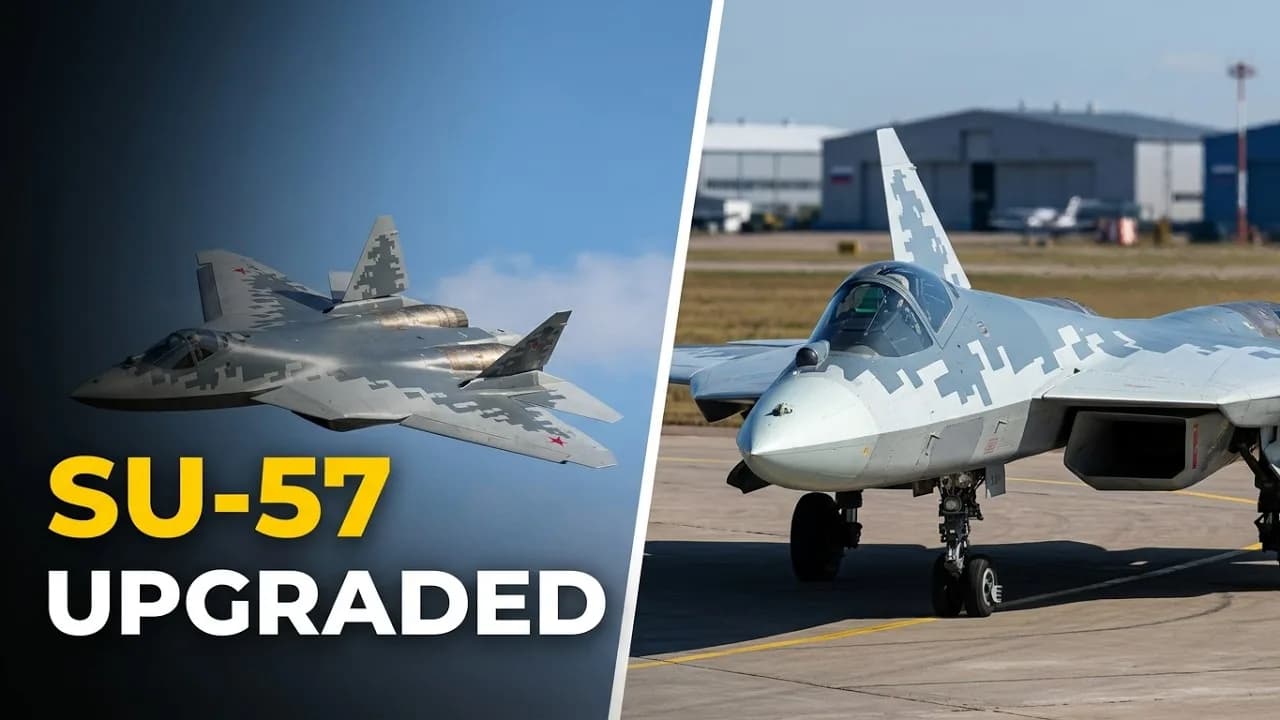
The Russian air force appears to have taken receipt of a new batch of fifth-generation Sukhoi Su-57 fighter jets. This is noteworthy in and of itself, but what is arguably more important is that this latest batch appears to have significant upgrades.
According to reports, the fighters appear to have significantly improved ways to detect and interfere with incoming missiles. Both are effectively complementary, with one acting as the aircraft’s eyes and the other as an active anti-missile defense.
The aircraft’s existing 101KS-U Missile Approach Warning System (MAWS) appears to have been upgraded with additional infrared sensors. These would complement the aircraft’s existing ultraviolet missile detection capabilities.
The other, the 101KS-O Directional Infrared Countermeasures (DIRCM) system, is an existing electronic warfare capability designed to interfere with the guidance systems of incoming heat-seeking missiles.
Most missiles today release electromagnetic radiation across various wavelengths when launched and in flight. This includes ultraviolet and infrared, with these wavelengths typically emitted from the missile’s rocket exhaust.
Su-57 gets new eyes
UV and IR both have their plusses and minuses, so using both enables the aircraft’s missile detection and countermeasure systems to effectively cross-check results. In theory, this should mean the aircraft will receive fewer false alarms and ultimately become more reliable.
But that is only part of the story; the system also needs to actively protect the aircraft too. This is where its DIRCM comes into play.
Conventionally, aircraft will release things like flares to attempt to throw off the scent from an incoming missile. But modern IR-seeking missiles are able to distinguish between the shape of an aircraft and a burning flare.
DIRCM takes a fundamentally different approach. Instead of presenting the missile with a false target, the laser interferes with its ability to interpret the infrared information it receives.
You can liken it to someone shining an extremely powerful light into a night-vision camera. The camera may still function physically, but its ability to produce useful information is compromised.
What is also interesting is that the technology is well established, but its incorporation into a fighter is slightly unusual. They are fairly common on things like transport aircraft and helicopters, but fitting them into the limited space of high-performance fighters is an engineering challenge in and of itself.
An improvement, but not foolproof
The Russian stealth jet’s integrated DIRCM turrets have been publicly documented for years, with Western defense publications highlighting them as an interesting feature as early as 2018.
The F-35, by comparison, already has a sophisticated infrared missile detection architecture, but it is not publicly known to possess an equivalent integrated laser-jamming turret. However, that does not necessarily make the Su-57’s overall defensive suite superior.
If confirmed, the upgrades could improve the Su-57’s protection against incoming missiles, although they would not make it immune to attack. For example, such systems will have little to no effect on active radar-guided or multimodal seeker missiles.
In this sense, DIRCM will act as another defensive layer, alongside stealth, electronic jamming, chaff, flares, and maneuverability.
Source: https://interestingengineering.com/military/us-nuclear-rival-upgrades-su-57-jets
Get the latest news delivered to your inbox.
Related articles