This 70-gram robotic butterfly ditches propellers to fly with flapping wings
A maker who goes by Max Imagination has built a 70-gram remote-controlled butterfly. The project...
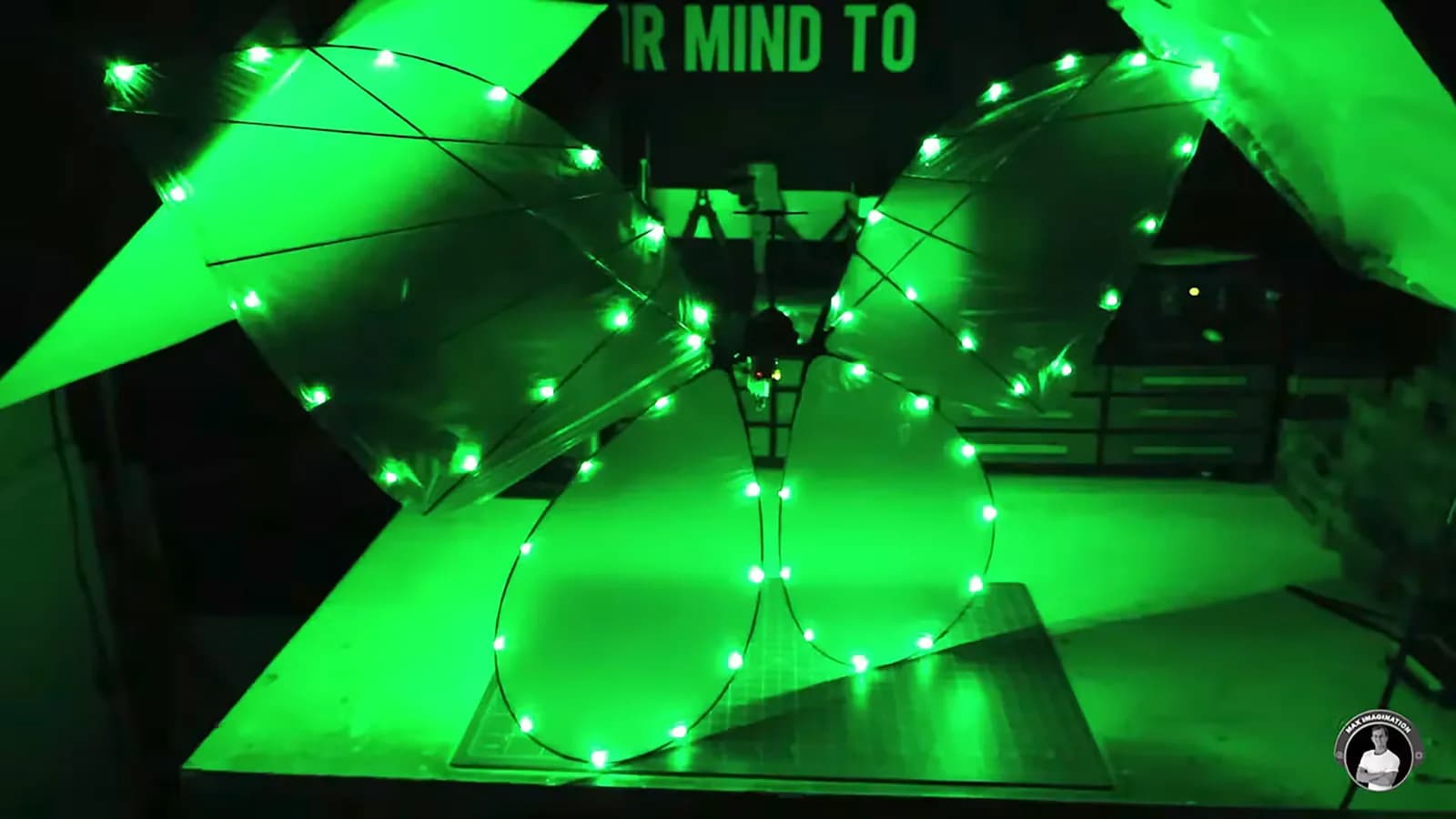
A maker who goes by Max Imagination has built a 70-gram remote-controlled butterfly. The project is called ESP-FLUTTER.
The butterfly flies by flapping two wings, each driver by its own servo, a small motor that turns to set angles, a Hackster report said. The wings are thin plastic from produce bags stretched over carbon-fiber frames, and 50 small LEDs light them for night flights.
ESP-FLUTTER is an ornithopter, an aircraft that gets lift and thrust from flapping wings instead of propellers. Many ornithopters use one motor and a mechanical linkage to move both wings. This design uses two independent servos, which Hackster said gives more control while keeping the mechanics simple.
A Seeed Studio XIAO ESP32C3, a small development board, handles the servo signals, wireless link, battery monitoring and LEDs. Max Imagination posted the firmware on GitHub and build files on Google Drive, so other builders can start from the same design.
Built to stay light
Most flying robots use spinning propellers, which is easier than flapping a pair of wings, according to the Hackster report. Weight is a major concern, so the whole aircraft stays at 70 grams with its battery, the video description says.
The 3D-printed frame is PETG plastic, with flexible TPU guards that protect the servos in crashes. Carbon-fiber rods give the wings structure without much weight. The wing film is thin plastic from produce bags, secured with flexible adhesive, and lightweight kite fabric is another option.
Hackster said the design uses no exotic materials or costly components. Power comes from a custom two-cell lithium-polymer battery pack. A pair of high-speed servos does the flapping, since ordinary hobby servos aren’t fast or powerful enough.
Max Imagination wired the 50 LEDs around the wings with extremely thin enameled copper wire, which adds about 1 gram to each wing. Hackster said two versions exist: a modular one built from easy-to-find parts and a compact one built around a custom four-layer circuit board, a flat panel that links the electronics.
Phone controls and limits
The pilot connects a phone to the butterfly’s own Wi-Fi network and opens a browser-based control page. An optional ExpressLRS receiver lets a standard radio transmitter fly it instead. The page adjusts flapping frequency, steering response, servo positions, and wing motion profiles.
A sine wave, which rises and falls smoothly, gives more natural-looking movement, while a triangle wave can produce more lift. Max Imagination found that about 4 hertz, or four flaps per second, works well at full throttle.
The maker’s YouTube description lists a longest flight of 1 minute, 9 seconds and a range of about 25 meters. Both figures are self-reported. No outside test or other builder’s results are cited, so real-world performance is unproven.
Independent flight times from builders using the GitHub files would show how practical the design is. Max Imagination said a controller setup video is coming.
Max Imagination posted the build video on Oct. 16, and Hackster reported on it.
Source: https://interestingengineering.com/innovation/robotic-butterfly-esp-flutter
Get the latest news delivered to your inbox.
Related articles