Ranked: Countries With the Most University Graduates
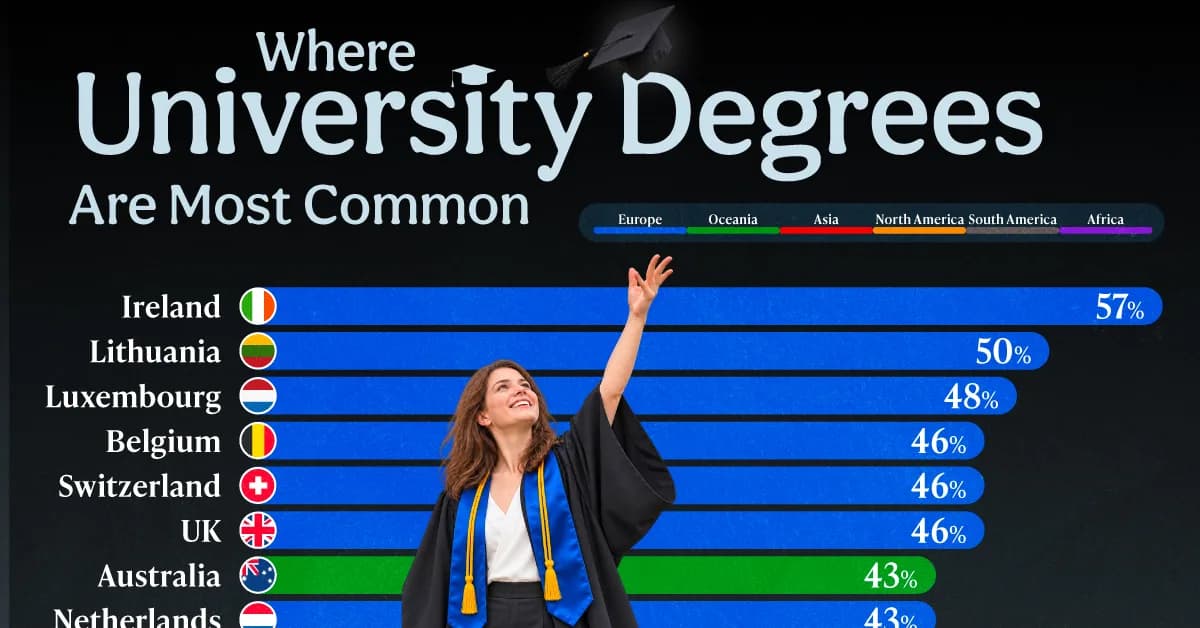
University degrees by country: Ireland leads, while European nations hold eight of the top 10 places for bachelor's degrees or higher.
Which Countries Have the Most University Graduates?
Key Takeaways
European countries account for eight of the top 10, with Ireland leading at 57% of adults holding a bachelor’s degree or higher.
The United States and Sweden are tied at 41%, while Canada follows at 39%.
The ranking excludes short-cycle tertiary qualifications, which significantly affects how countries such as Canada compare.
Which countries have the highest share of university graduates, and how do major economies compare?
This graphic ranks 43 countries by the estimated share of adults aged 25–64 who have attained at least a bachelor’s degree, revealing some surprising leaders.
The data come from the OECD’s Education at a Glance 2026, with 2020 figures for China taken from Education at a Glance 2022. Estimates combine the reported shares holding bachelor’s, master’s, and doctoral or equivalent qualifications; short-cycle tertiary programs are excluded.
Most figures are from 2025, while Chile uses 2024 data and Iceland and Indonesia use 2023 data.
Europe Dominates the Top of the Ranking
Across the OECD, 43% of adults aged 25–64 held some form of tertiary qualification in 2025. The OECD average for bachelor’s degrees or higher was roughly 35%.
Ireland sits comfortably in first place, seven percentage points ahead of Lithuania at 50%. Luxembourg follows at 48%, while Belgium, Switzerland, and the United Kingdom are tied at 46%, giving European countries all six leading positions.
CountryRegionBachelor’s degree or higher (%)
IrelandEurope57%
LithuaniaEurope50%
LuxembourgEurope48%
BelgiumEurope46%
SwitzerlandEurope46%
UKEurope46%
AustraliaOceania43%
NetherlandsEurope43%
South KoreaAsia43%
SwedenEurope41%
U.S.North America41%
DenmarkEurope40%
IsraelAsia40%
New ZealandOceania40%
CanadaNorth America39%
NorwayEurope39%
PolandEurope39%
EstoniaEurope38%
IcelandEurope38%
JapanAsia37%
BulgariaEurope36%
FinlandEurope36%
GermanyEurope35%
GreeceEurope35%
LatviaEurope35%
PortugalEurope33%
FranceEurope30%
HungaryEurope30%
SlovakiaEurope30%
SpainEurope30%
CzechiaEurope29%
SloveniaEurope29%
CroatiaEurope28%
ChileSouth America26%
AustriaEurope22%
ItalyEurope22%
MexicoNorth America22%
Costa RicaNorth America21%
TürkiyeAsia20%
RomaniaEurope19%
IndonesiaAsia10%
ChinaAsia9%
South AfricaAfrica8%
Australia and South Korea are the only non-European countries in the top 10, both at 43%.
Yet Europe is far from uniform. Italy and Austria are at 22%, while Romania stands at just 19%, highlighting the wide differences in degree attainment across the region.
Why Ireland Leads in University Degree Attainment
Ireland’s leading position reflects decades of policies aimed at expanding access to higher education. The introduction of tuition-free undergraduate education in the 1990s, student grants, and the expansion of regional universities have helped increase participation.
Strong demand for skilled workers in the technology and pharmaceutical industries has also supported higher education.
Ireland also attracts highly educated international workers. In 2025, 67% of non-Irish nationals held a third-level qualification, compared with 56% of Irish nationals. This broader measure includes qualifications beyond those counted in the ranking.
North America and Asia Show Different Patterns
Canada’s position may surprise readers familiar with rankings that place it among the world’s most educated countries. While 39% of Canadian adults hold a bachelor’s degree or higher, the country also has a large share of people with shorter postsecondary qualifications.
According to the OECD, 25% of Canadian adults have a short-cycle tertiary qualification as their highest level of education. Because these qualifications are excluded from this ranking, Canada places below the United States at 41%.
In Asia, South Korea leads the countries shown at 43%, followed by Israel at 40% and Japan at 37%. Türkiye is further down the ranking at 20%.
What the Lowest Shares Tell Us
At the other end of the ranking, South Africa stands at 8%, China at 9%, and Indonesia at 10%, far below the leaders in this dataset.
However, China’s figure is from 2020 and Indonesia’s from 2023, so these percentages should not be treated as a single-year snapshot of global attainment.
Education systems also differ in their emphasis on apprenticeships, technical qualifications, and short-cycle tertiary programs, which are not necessarily captured by this degree-focused measure.
Degree attainment is useful for comparing formal qualifications, but it cannot on its own establish the quality of education, the skills workers possess, or the opportunities available to graduates.
Learn More on the Voronoi App
If you enjoyed today’s post, check out Ranked: Where Public University Tuition Is Most Expensive on Voronoi.
Source: https://www.visualcapitalist.com/ranked-countries-with-the-most-university-graduates/
Get the latest news delivered to your inbox.
Related articles