Ranked: 67 Countries by School Quality and Living Costs
Which countries offer the best schools for less? Compare education rankings and living costs across 67 countries worldwide.
Where Can Families Find Great Schools for Less?
Key Takeaways:
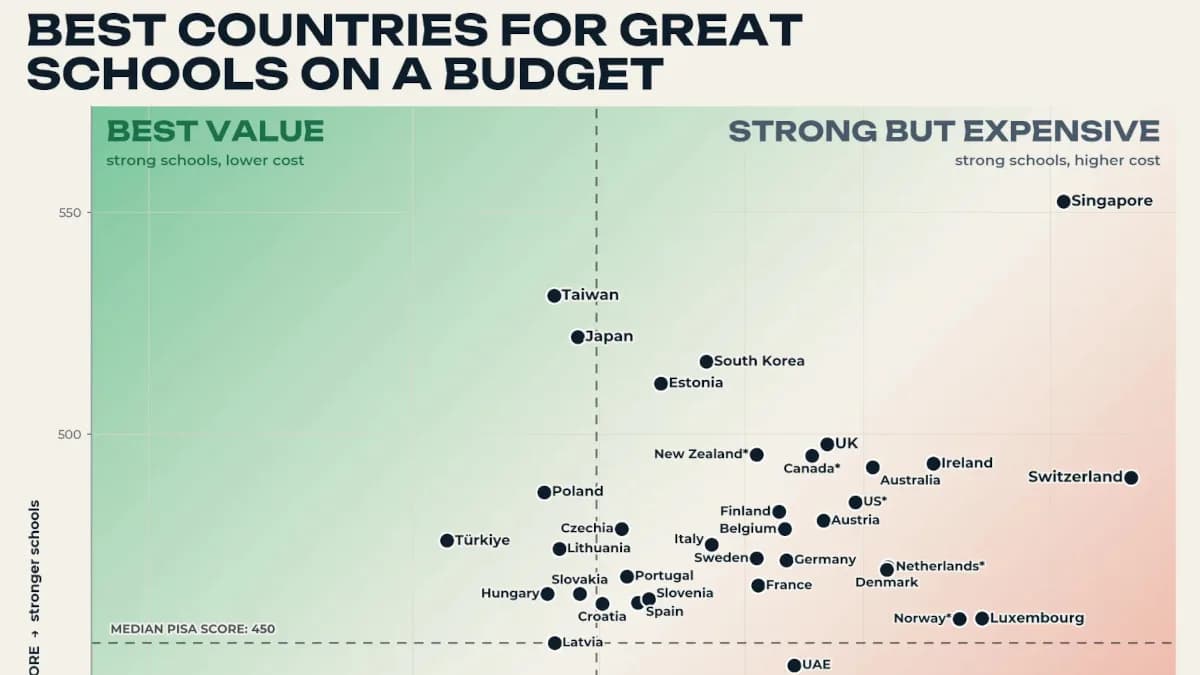
Taiwan and Japan offer some of the best value for education, combining top-three PISA scores with estimated monthly family budgets below $4,000.
Singapore leads in academic performance with a score of 553, but its estimated monthly family budget exceeds $8,100.
Poland, Lithuania, and Türkiye offer above-median academic performance at relatively affordable living costs.
Where can families find strong education systems without facing some of the world’s highest living costs?
This visualization, created by Valerii Emelianov, compares academic performance across 67 countries and economies using the OECD’s PISA 2025 results and estimated monthly living expenses from Numbeo.
The budget assumes a family of four renting a three-bedroom apartment outside the city center, excluding school tuition. Countries toward the upper-left of the chart combine stronger academic performance with lower estimated living costs.
Which Countries Offer the Best Education for the Money?
The following table ranks countries by their average mathematics, reading, and science scores, alongside estimated monthly family budgets. Data comes from the OECD’s PISA 2025 Results (Volume I), Table I.B1.2, and Numbeo.
CountryPISA 2025 Average ScoreMonthly Family Budget (USD)
Singapore552.558,162
Taiwan531.233,727
Japan521.893,866
South Korea516.324,711
Estonia511.424,393
United Kingdom497.725,673
New Zealand495.355,088
Canada495.075,543
Ireland493.316,681
Australia492.56,082
Switzerland490.159,051
Poland486.913,671
United States484.655,925
Finland482.455,267
Austria480.445,641
Czechia478.594,136
Belgium478.575,314
Türkiye475.973,163
Italy475.014,750
Lithuania474.093,758
Sweden471.935,090
Germany471.545,330
Netherlands470.026,229
Denmark469.396,219
Portugal467.94,171
France465.85,101
Slovakia463.983,879
Hungary463.93,690
Slovenia462.774,312
Spain461.984,243
Croatia461.664,015
Luxembourg458.387,199
Norway458.266,953
Latvia452.853,731
United Arab Emirates447.825,394
Iceland437.88,688
Israel437.076,904
Malta435.414,960
Vietnam430.712,132
Greece426.933,980
Chile426.892,967
Albania425.033,258
Uruguay424.214,163
Qatar422.865,233
Montenegro421.543,519
Serbia420.113,141
Romania418.932,953
Moldova411.932,921
Thailand410.282,853
Georgia407.552,900
Kazakhstan406.022,863
Bulgaria404.173,163
Malaysia403.132,417
Mexico403.033,650
Azerbaijan401.512,418
Cyprus400.85,102
Colombia397.843,579
Brazil397.772,535
Saudi Arabia396.873,511
Peru392.732,445
Argentina382.823,223
Indonesia372.591,913
North Macedonia371.912,452
Philippines370.292,151
Armenia364.243,444
Kyrgyzstan356.912,282
Morocco344.622,171
Taiwan and Japan stand out for combining strong academic results with relatively affordable living costs. Both outperform most countries in the ranking while costing less than half as much as Singapore, the highest-scoring education system.
East Asia Leads in Academic Performance
East Asian education systems dominate the upper end of the rankings, with Singapore, Taiwan, Japan, and South Korea occupying the top four positions.
However, living costs vary considerably among these countries. South Korea’s estimated monthly family budget of $4,711 is higher than Taiwan’s ($3,727) and Japan’s ($3,866), highlighting the differences in affordability even among top-performing education systems.
Japan’s strong results are especially evident in international science performance. The National Center on Education and the Economy also recognizes Japan and Singapore for their consistently strong education systems.
Europe Offers Several Affordable Alternatives
In Europe, Poland scores 487 points with an estimated monthly family budget of $3,671, while Lithuania scores 474 at $3,758. Türkiye is another relatively affordable option, scoring 476 at $3,163.
Meanwhile, the UK, Ireland, and Estonia perform strongly but have higher living costs. Ireland’s overall school score also reflect its established strength in reading performance.
North America is comparatively expensive. Canada scores 495 with a monthly budget of $5,543, while the U.S. scores 485 at $5,925.
What Do PISA Scores Actually Measure?
PISA assesses how well 15-year-old students apply mathematics, reading, and science knowledge to real-world problems. It provides a useful international benchmark but does not measure every aspect of school quality.
Other assessments, including the World Top 20 education rankings, consider factors such as graduation rates, enrollment, and educational access.
For families considering a move abroad, language of instruction, school availability, educational equity, and local enrollment requirements also matter. The estimated budgets exclude school tuition, which could substantially affect affordability for families requiring private or international schools.
Learn More on the Voronoi App
For another perspective on international education, explore Canada Is University Grads’ Dream Destination on Voronoi, examining Canada’s appeal to university graduates.
Related articles