How Hard Is It to Get Into Each Ivy League School?
Explore Ivy League acceptance rates, SAT scores, and average annual costs. See which schools are hardest to get into and how they compare.
This story was prepared automatically by software.
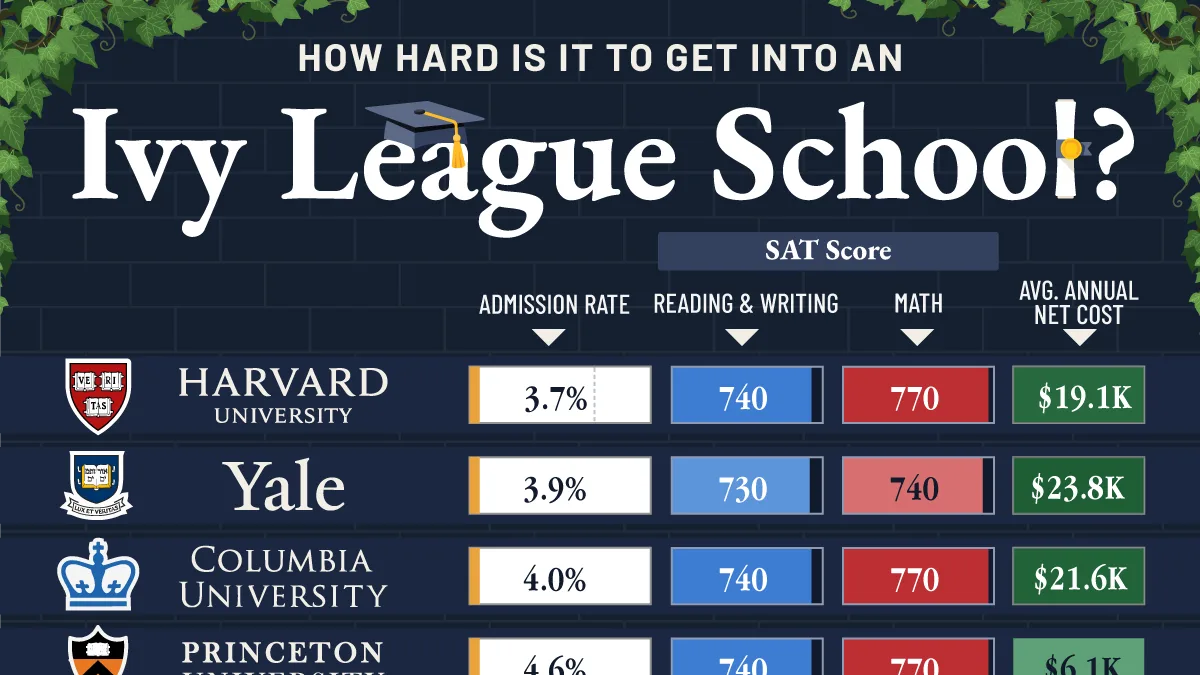
Just How Competitive Are Ivy League Admissions?
Key Takeaways
Every Ivy League school in this dataset admits fewer than one in 10 applicants.
Harvard has the lowest reported admission rate at 3.7%, followed by Yale at 3.9% and Columbia at 4.0%.
By comparison, about 59% of applications to U.S. four-year colleges without open-admission policies were accepted in fall 2024.
Getting into an Ivy League school is one of the toughest challenges in American higher education, with thousands of qualified applicants competing for limited spots.
This graphic ranks all eight Ivy League schools by admission rate, alongside SAT scores and average annual net costs. The data comes from the National Center for Education Statistics and the U.S. Department of Education’s College Scorecard.
SAT figures represent the 25th percentile among enrolled first-year students who submitted scores, not averages or minimum admission requirements. Average annual net cost includes tuition, living expenses, books, and fees after grants and scholarships for federal financial aid recipients.
Harvard Has the Lowest Reported Admission Rate
At the most selective Ivy League schools, fewer than four out of every 100 applicants are admitted. Even Cornell, which has the highest admission rate of the eight schools, accepts just 8.8% of applicants.
Ivy League SchoolAdmission
RateMath
(SAT Score)Reading & Writing
(SAT Score)Avg. Annual
Net Cost
Harvard3.7%770740$19.1K
Yale3.9%740730$23.8K
Columbia4.0%770740$21.6K
Princeton4.6%770740$6.1K
Brown5.4%770740$25.2K
University of Pennsylvania5.4%770740$28.7K
Dartmouth5.4%760740$29.5K
Cornell8.8%770730$28.7K
While Ivy League admission rates are exceptionally low, the broader U.S. college admissions landscape is far less selective. According to federal education data, about 59% of applications to four-year institutions without open-admission policies were accepted in fall 2024.
Why Are Ivy League Schools So Prestigious?
The Ivy League was formalized as an athletic conference in 1954, rather than as a ranking of America’s best universities. Its academic reputation has developed over centuries, supported by influential research, prominent faculty, and extensive alumni networks.
Harvard, founded in 1636, is the oldest university in the group and has been associated with more than 160 Nobel laureates.
Endowments also help sustain these advantages by funding professorships, libraries, research, and financial aid. That aid puts sticker prices in perspective: Princeton’s reported average annual net cost is about $6,100, compared with $29,500 at Dartmouth. However, these averages are not price quotes for individual students.
How Do the Ivies Rank Against Other Universities?
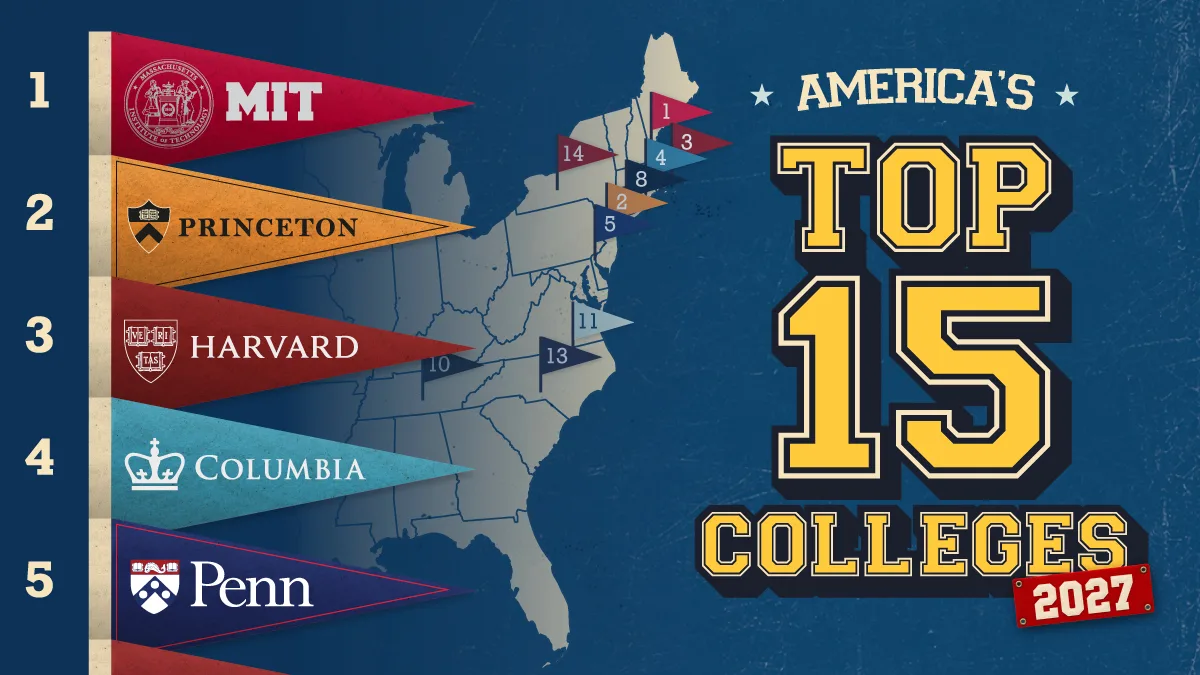
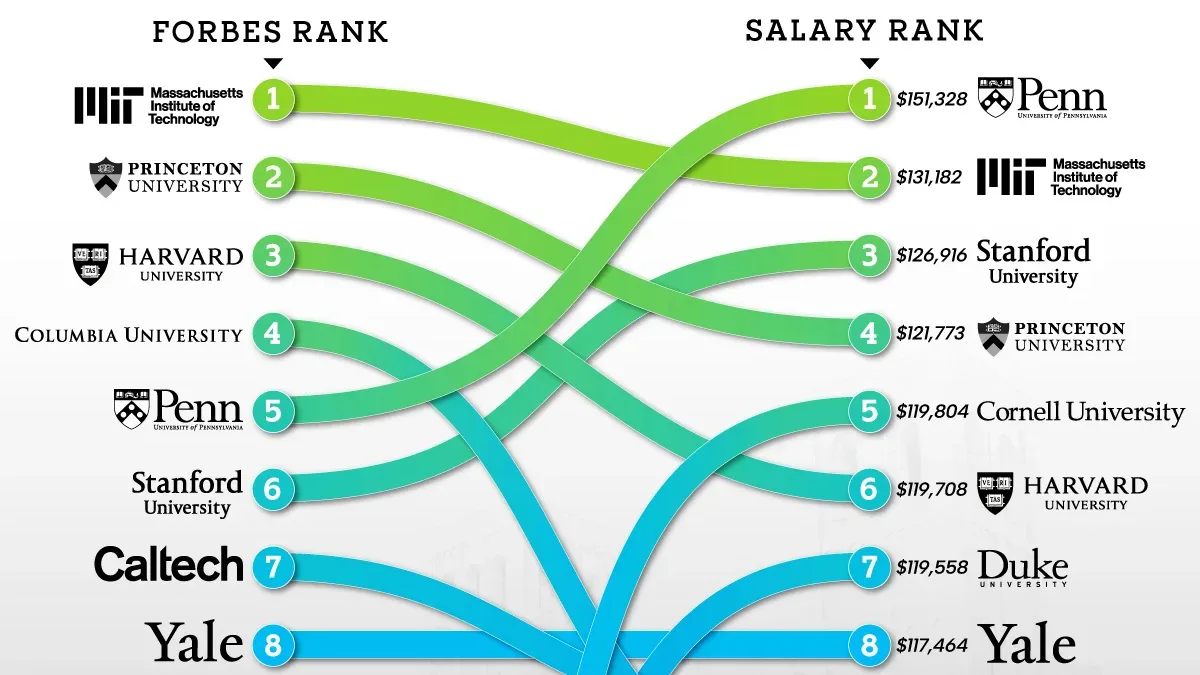
Six of the eight Ivy League schools rank among America’s top 15 universities, according to Forbes’ rankings.
Princeton and Harvard rank second and third, respectively, followed by Columbia in fourth and the University of Pennsylvania in fifth.
However, admission difficulty and academic rankings measure different things. Selectivity reflects applicant demand and available spots, while university rankings consider a broader range of institutional characteristics and student outcomes.
Ivy League Tuition Is Rising, but So Is Financial Aid
Attending an Ivy League school can come with a hefty price tag. At Harvard, annual tuition, housing, food, and mandatory fees rose from about $63,000 in the 2016–17 academic year to nearly $87,000 in 2025–26, an increase of roughly 38%.
However, these schools are also expanding financial aid. Starting in 2025–26, Harvard made tuition free for students from families earning $200,000 or less annually, assuming typical assets.
Yale introduced a similar policy for incoming students in 2026–27.
Meanwhile, Princeton says about one-quarter of its undergraduates pay nothing to attend, thanks to financial aid.
Learn More on the Voronoi App
If you enjoyed this visualization, check out Ranked: America’s 20 Highest-Paying College Degrees on the Voronoi app.
Related articles