
America’s Top Colleges, Re-Ranked by Graduate Salaries
See how America’s top colleges rank by alumni salary after 10 years, from Penn and MIT to Stanford and Princeton.
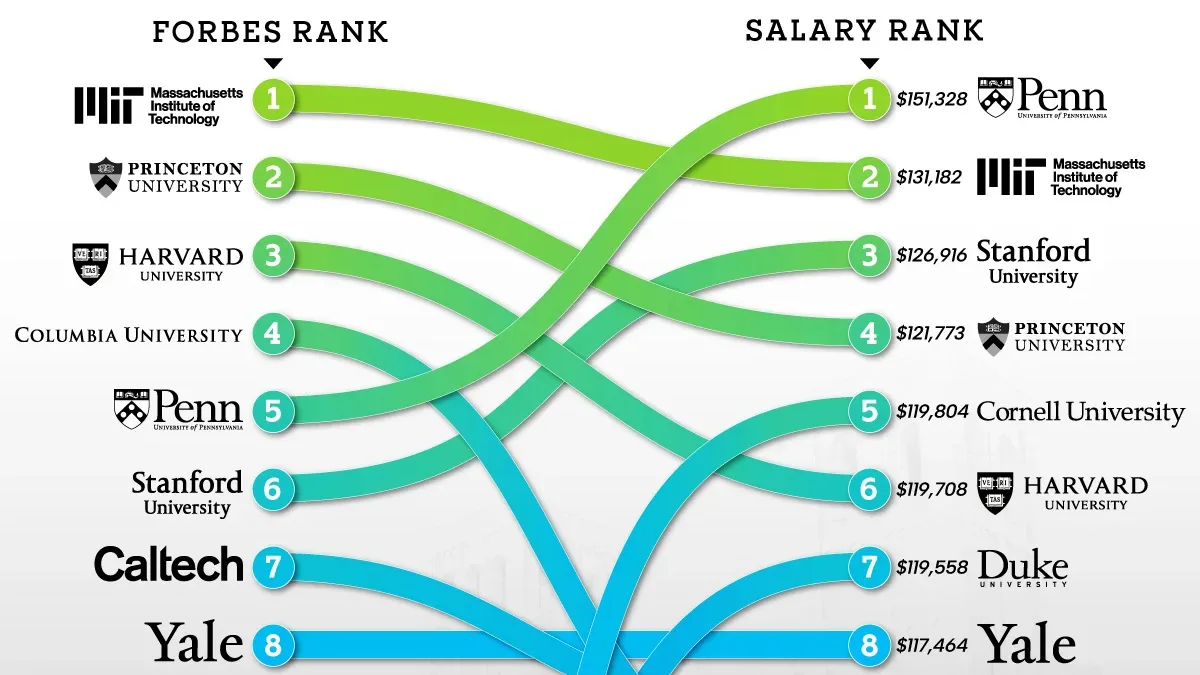
Which Top Colleges Have the Highest-Paid Graduates?
Key Takeaways
University of Pennsylvania alumni have the highest median salary 10 years after graduation among the 15 schools shown, at $151,328.
Cornell rises from 14th in Forbes’ overall ranking to fifth when the same schools are ranked by graduate earnings.
Alumni salary accounts for 20% of Forbes’ overall college ranking, alongside measures such as debt, graduation rates, return on investment, and academic success.
America’s top-ranked colleges don’t necessarily produce the highest-paid graduates. When these schools are ranked on earnings alone, the familiar hierarchy changes considerably.
This graphic takes the top 15 schools in Forbes’ 2027 America’s Top Colleges ranking and re-ranks them by median alumni salary 10 years after graduation. Forbes calculates its salary figures using a two-year average that combines data from People Data Labs with figures from the previous year’s ranking.
How the Rankings Change When Salary Comes First
The table below shows Forbes’ top 15 colleges for 2027, alongside median salaries for alumni with 10 years of work experience.
SchoolForbes overall college rank (2027)Median alumni salary
(USD; 10 years’ experience)
Massachusetts Institute of Technology1$131,182
Princeton University2$121,773
Harvard University3$119,708
Columbia University4$117,010
University of Pennsylvania5$151,328
Stanford University6$126,916
California Institute of Technology7$117,278
Yale University8$117,464
University of California, Berkeley9$111,530
Vanderbilt University10$115,467
Johns Hopkins University11$111,678
University of California, Los Angeles12$110,519
Duke University13$119,558
Cornell University14$119,804
Northwestern University15$113,972
Penn Alumni Lead by a Wide Margin
The University of Pennsylvania ranks fifth overall on Forbes’ list, but jumps to first when these 15 schools are ranked by graduate earnings.
Penn’s median alumni salary of $151,328 is more than $20,000 higher than MIT’s $131,182, the second-highest figure among the schools shown. Stanford follows at $126,916, while Princeton ranks fourth at $121,773.
Penn’s lead may partly reflect its strong pipeline into lucrative finance careers. The university is home to the Wharton School, and separate research from the Burning Glass Institute found that Penn finance graduates earned an average annual wage premium of about $61,000 over the first decade of their careers compared with the median finance graduate.
That placed Penn fourth among private U.S. colleges for high-paying finance careers. While this doesn’t fully explain Penn’s university-wide salary figure, it provides useful context for its strong long-term earnings.
Cornell Makes One of the Biggest Jumps
Cornell climbs from 14th in Forbes’ overall ranking to fifth among these schools by 10-year alumni salary, at $119,804.
Several of the university’s programs have strong pipelines into high-paying fields. Among Cornell’s Class of 2025 computer science graduates, 57% of those employed entered the technology sector and 23% entered financial services. Their mean starting salary was $128,000.
Cornell’s Dyson School of Applied Economics and Management shows a similar pattern. Financial services accounted for 71% of employed graduates in 2025, while the class reported a median base salary of $110,000.
These recent outcomes don’t directly explain the earnings of alumni with 10 years of experience, but they highlight Cornell’s strong connections to technology and finance.
Why Salary Changes the College Rankings
Other prestigious universities move in the opposite direction. Columbia falls from fourth overall to 10th by salary, while UC Berkeley moves from ninth to 14th among the 15 schools shown.
That doesn’t mean their graduates have weak earnings. Berkeley’s College of Engineering, for example, reported a $120,000 median starting salary for 2024 graduates who entered the workforce.
Instead, these shifts reflect the broader criteria used in Forbes’ overall ranking. Alumni salary accounts for 20% of the total score, based on earnings 3, 6, 10, and 20 years after graduation.
The remaining 80% considers student debt, graduation rates, alumni leadership and achievement, return on investment, retention rates, and academic success. Forbes says its methodology focuses on educational and career outcomes rather than a school’s reputation.
There is also an important distinction between alumni earnings and the financial value of a degree. Salary figures alone don’t account for tuition costs, student debt, or differences in the industries graduates enter.
Ultimately, the two rankings answer different questions: which colleges perform best across a broad range of outcomes, and which have the highest-earning alumni a decade into their careers.
Learn More on the Voronoi App
If you enjoyed this visualization, check out Ranked: The Cost of a College Degree Around the World on the Voronoi app.
Related articles
Where America’s 1.2 Million International Students Come From
Where do America’s 1.2 million international students come from? India and China lead, as enrollment trends begin to shift.

How Asia Took Over the Global Math Rankings (2003-2025)
The best countries at math have shifted since 2003, with Asian economies now occupying all seven top spots in PISA.
Mapped: Average Student Debt by State in 2026
Washington, D.C. may have high salaries, but the average borrower has more student debt there than anywhere else.