Ranked: The World’s Oceans by Surface Area
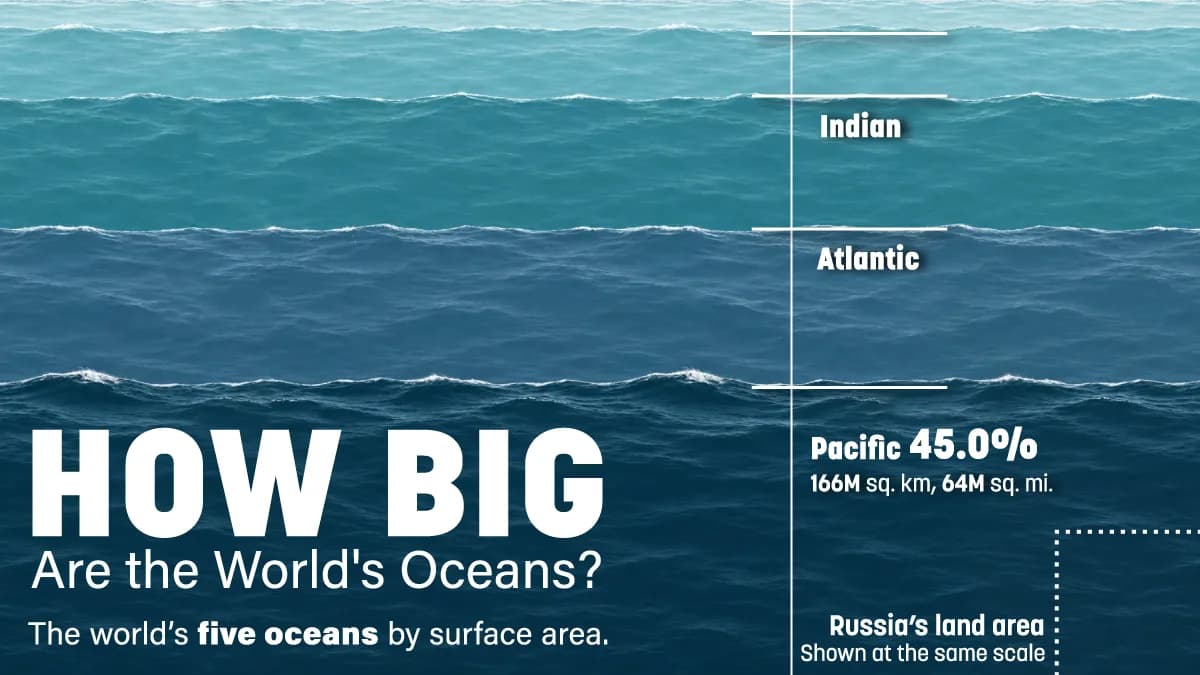
The Pacific Ocean is so vast that it's larger than the Atlantic and Indian Oceans combined.
How Do the World’s Five Oceans Compare in Size?
Key Takeaways
The Pacific Ocean is the world’s largest, accounting for 45% of the global ocean surface.
At 64 million square miles, the Pacific is larger than the Atlantic and Indian Oceans combined.
The Arctic Ocean is the smallest of the five, covering just 4.7 million square miles, less than one-thirteenth the size of the Pacific.
The world’s oceans cover approximately 71% of Earth’s surface and contain about 97% of its water. Together, they form a single interconnected body of salt water, divided into five major oceans.
This visualization ranks all five oceans by surface area, using data from the National Oceanic and Atmospheric Administration (NOAA). The figures include the seas associated with each ocean, but exclude lakes.
How Much Larger Is the Pacific Ocean Than the Others?
Stretching from the eastern coasts of Asia and Australia to the western coasts of North and South America, the Pacific Ocean covers approximately 64 million square miles (166 million square kilometers).
The Pacific also ranks as the largest ocean by water volume, and its enormous scale makes it a major influence on global ocean circulation, weather patterns, and marine ecosystems.
The table below ranks all five oceans by surface area and their share of the global ocean:
OceanSurface Area
Million Miles²Million Kilometers²Share of Global Ocean Area (%)
Pacific64.0166.045.0
Atlantic31.682.022.2
Indian28.473.620.0
Southern13.535.09.5
Arctic4.712.23.3
Pacific Larger Than the Atlantic and Indian Oceans Combined
The Atlantic Ocean ranks second at 31.6 million square miles, followed by the Indian Ocean at 28.4 million square miles.
Together, these two oceans cover 60 million square miles, still less than the Pacific’s 64 million square miles.
The three largest oceans account for 87.2% of the world’s total ocean surface area, leaving just 12.8% for the Southern and Arctic Oceans combined.
How Small Are the Arctic and Southern Oceans?
At the other end of the ranking, the Arctic Ocean covers approximately 4.7 million square miles (12.2 million square kilometers), representing just 3.3% of the global ocean surface.
To put that into perspective, the Arctic Ocean is smaller than Russia, the world’s largest country by land area, which covers more than 6.6 million square miles.
The Southern Ocean, which surrounds Antarctica, is nearly three times larger than the Arctic, covering approximately 13.5 million square miles.
Despite their smaller size, both polar oceans play important roles in Earth’s climate system through their interactions with polar ice and global ocean circulation.
Learn More on the Voronoi App
To see how Earth’s ocean water volume compares with bodies of water on other planets and moons in our solar system, check out The Largest Bodies of Water in the Solar System: Visualized on Voronoi.
Source: https://www.visualcapitalist.com/the-worlds-oceans-by-surface-area/
Get the latest news delivered to your inbox.
Related articles