Quantum chromodynamics could explain dark energy origins, scientists say
Despite dark energy making up around 70% of the total energy in the Universe, we...
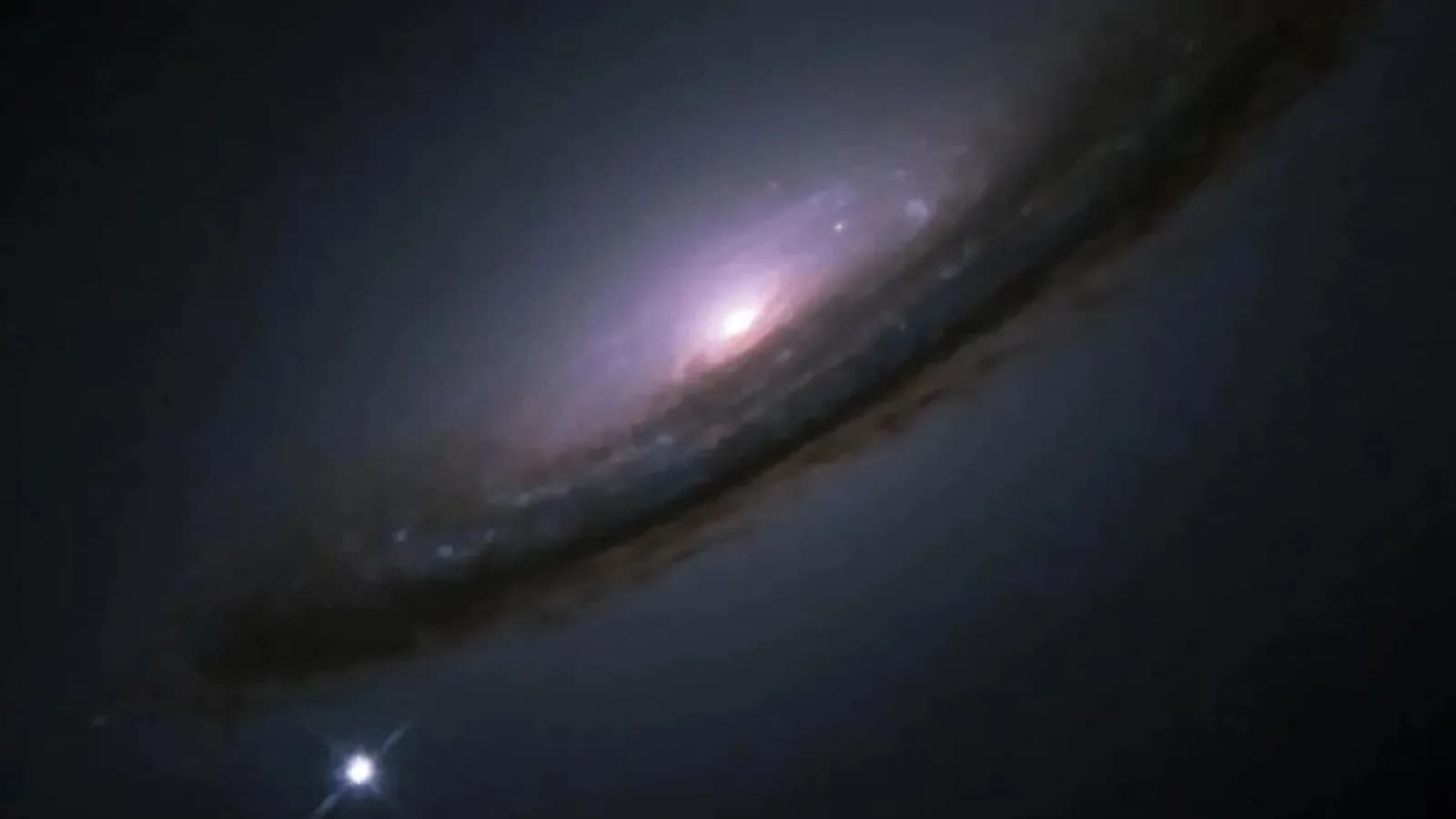
Despite dark energy making up around 70% of the total energy in the Universe, we still do not know what it is or where it originated from. Many theories have been proposed which include new fundamental particles/fields.
Scientists at the University of British Columbia and University of Sheffield suggest that dark energy may arise from the quantum vacuum in Quantum Chromodynamics (QCD).
QCD is a well established theory which describes the strong nuclear forces binding quarks together within protons and neutrons.
The quantum vacuum could be behind dark energy
The topology of the QCD vacuum was considered. Although it may seem as though there is nothing in space, quantum physics tells us there are fields and energy present. Within this model, changes in the expansion of the universe cause changes in the energy of the quantum vacuum, leading to dark energy. No new fundamental fields or additional dynamical degrees of freedom are required.
“Our theoretical framework suggests no new particles may be required at all,” explains Professor Ariel Zhitnitsky, with Physics and Astronomy at UBC. “We find that the energy scale associated with the QCD vacuum and gravity naturally aligns with the scale of dark energy we currently observe in the universe. No arbitrary fields or parameters are required in our model.”
“The most striking result is that the observed dark-energy scale emerges naturally from known physical constants, without the need for any additional fitting parameters,” says UBC Professor Ludovic Van Waerbeke.
Testing the theory against cosmic observations
The proposed model was compared to observations from the Planck satellite, Atacama Cosmology Telescope, and South Pole Telescope (SPT-3G). Observations of baryon acoustic oscillations were taken from the Dark Energy Spectroscopic Instrument (DESI) Data Release 2. Type Ia supernovae observations were taken from the Pantheon+ and DES-Dovekie surveys.
The QCD-based model was compared to the standard Lambda-CDM (ΛCDM) model of cosmology, and the w0waCDM model. It demonstrated good agreement with all observations and matches the late-time evolution of dark energy preferred by DESI.
This model predicts an effective phantom crossing occurring at redshifts around (z ~ 0.67). Instabilities associated with phantom scalar fields are circumvented in this model. From the goodness of fit statistics (Akaike information criterion, Deviance Information Criterion), and Bayesian evidence calculated from Markov Chain Monte Carlo chains, comparison of this model to ΛCDM shows preference for the QCD induced model given early and late universe data. Lead author of this research, Dong Ha Lee, a PhD researcher from the University of Sheffield, comments that further research is required to understand how the QCD vacuum reacts to the expansion of the universe.
Improvements will be made to the calculations performed, and this model will be compared to future observations, including data from next generation space telescopes. Although this research provides a potential explanation for dark energy using established physics, further theoretical and observational work is required to confirm that dark energy in the universe can be explained by dark energy arising from the QCD vacuum.
This research, entitled ‘Evolving Dark Energy Is Vacuum Energy After All’, was published in The Astrophysical Journal on the 20th November 2026. The authors of this paper were Dong Ha Lee, Carsten van de Bruck, Eleonora Di Valentino, Ludovic Van Waerbeke, and Ariel Zhitnitsky.
Source: https://interestingengineering.com/science/quantum-origin-dark-energy-physics
Get the latest news delivered to your inbox.
Related articles