Dark energy may come from the same force that holds atomic nuclei together
For nearly three decades, physicists have struggled to explain dark energy, the mysterious component driving...
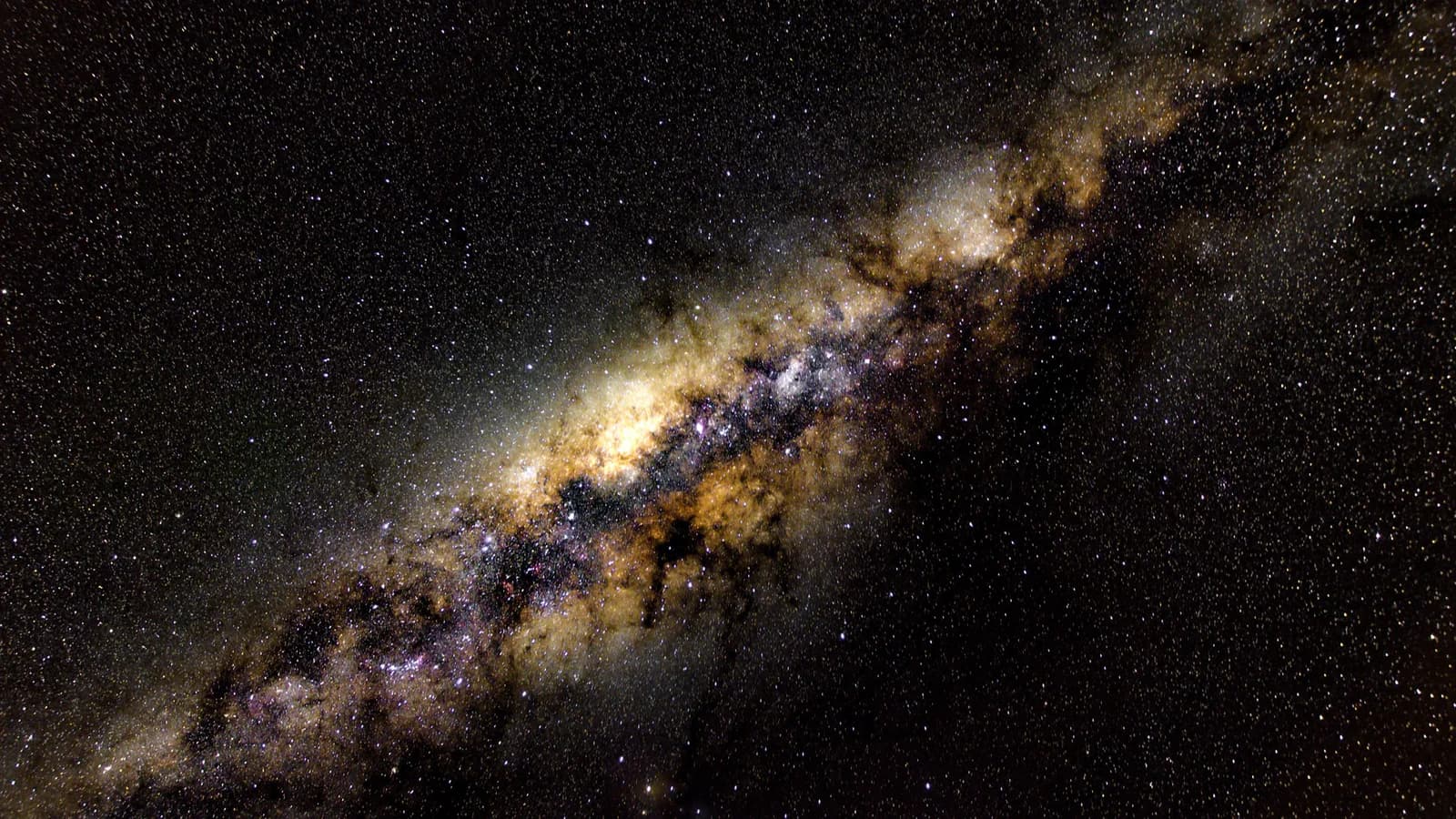
For nearly three decades, physicists have struggled to explain dark energy, the mysterious component driving the universe’s accelerating expansion. It accounts for roughly 70 percent of the universe’s total energy density, yet its physical origin remains unknown.
Most explanations introduce hypothetical particles or fields that have never been detected. However, now researchers at the University of British Columbia (UBC) and the University of Sheffield have proposed an unexpected alternative.
Their latest study suggests that dark energy could originate from the quantum physics of the force that holds atomic nuclei together. “Our theoretical framework suggests no new particles may be required at all,” Ariel Zhitnitsky, one of the study authors and a physics and astronomy professor at UBC, said.
A familiar force could explain dark energy
The proposal centers on quantum chromodynamics (QCD), the established theory describing the strong nuclear force. This force binds tiny particles called quarks together to form protons and neutrons, the building blocks of atomic nuclei.
QCD also describes the quantum vacuum, which is not truly empty space. It contains quantum fields and energy, along with complex properties that can influence how particles interact. One of these properties is called topology, which describes the different possible configurations of the quantum vacuum.
The researchers propose that the vacuum can exist in different topological configurations, with quantum tunnelling allowing it to move between them. These processes contribute to the vacuum’s energy. Crucially, that contribution may change as the universe expands.
In ordinary flat spacetime, the QCD vacuum has a particular energy. However, the researchers propose that its topological structure responds differently in an expanding universe. This creates a small difference in vacuum energy that could drive cosmic acceleration.
“The characteristic energy scale predicted from the QCD vacuum and gravity comes out close to the observed dark-energy scale today without having to introduce an ad hoc new field or a new parameter,” Zhitnitsky said.
This suggests that dark energy’s observed strength could emerge from established physical constants rather than requiring an entirely new fundamental ingredient.
However, there is an important distinction between the underlying physics and its cosmological implementation. Although the proposed mechanism does not require new fundamental particles or fields, the researchers’ model uses two additional parameters to describe when its dark-energy contribution becomes significant and how gradually it develops.
Does the idea match what astronomers see?
A promising theory must also explain what telescopes observe. To test their proposal, the researchers compared its predictions with measurements of distant Type Ia supernovae, the cosmic microwave background (CMB), and baryon acoustic oscillations (BAO), patterns in the distribution of galaxies that help scientists track the universe’s expansion.
The analysis included observations from the Planck, Atacama Cosmology Telescope and South Pole Telescope experiments, alongside measurements from the Dark Energy Spectroscopic Instrument (DESI).
For supernova data, the researchers tested two alternative datasets: Pantheon+ and the recalibrated Dark Energy Survey sample known as DES-Dovekie. The researchers compared its framework with the standard Lambda-CDM model, which treats dark energy as a constant, and another model that allows dark energy to change over time.
The QCD-based model performed comparably to Lambda-CDM when early- or late-universe observations were considered separately. However, combining measurements from both periods made it mildly to moderately preferable in the researchers’ Bayesian comparison.
The results suggest that the framework could reproduce the evolving dark-energy behavior indicated by recent DESI observations while offering a possible explanation for dark energy’s physical origin rather than simply describing its effects.
“The idea that the quantum vacuum as described by QCD could have the right properties to account for the accelerated expansion of the universe is very intriguing,” Dong Ha Lee, first study author and a PhD student at the University of Sheffield, said.
What this means for physics
If confirmed, the proposal could establish an unexpected connection between the physics of atomic nuclei and the cosmological model describing the universe. It could also offer a way to explain dark energy using established particle physics rather than introducing entirely new fundamental ingredients.
However, matching observations does not prove that QCD is responsible for dark energy. The mechanism still needs stronger theoretical support, particularly a better understanding of how the quantum vacuum behaves in expanding spacetime.
The researchers plan to refine their calculations and test the framework against future astronomical observations, which could help determine whether this familiar nuclear force really has a cosmic role.
The study is published in The Astrophysical Journal.
Source: https://interestingengineering.com/science/dark-eneegy-source-atomic-nuclei
Get the latest news delivered to your inbox.
Related articles