Ranked: America’s Best Universities Across 3 Rankings
See the top U.S. universities 2026 across Forbes, QS, and Shanghai Ranking, revealing where America’s leading institutions stand.
Which U.S. Universities Rank Among the Best?
Key Takeaways
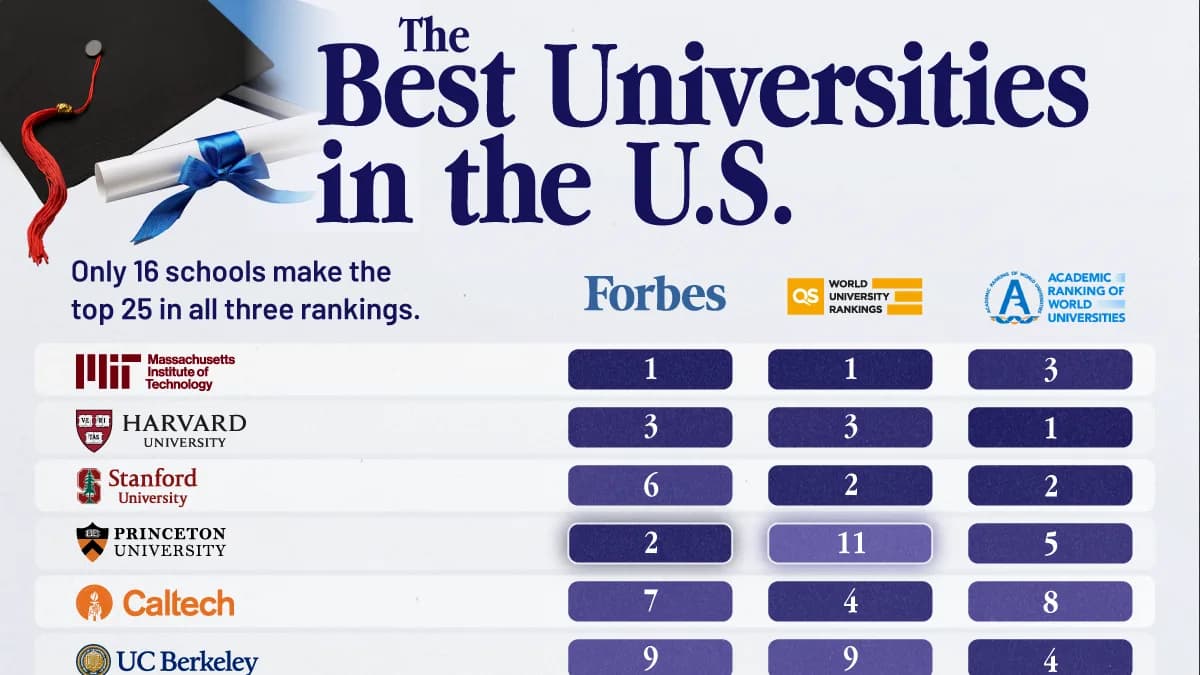
MIT ranks first among U.S. institutions in both Forbes and the QS World University Rankings, while Harvard takes the top spot on the Academic Ranking of World Universities list.
Sixteen U.S. universities appear in the top 25 across all three rankings, including UC Berkeley, UCLA, and UC San Diego.
Princeton shows how much rankings can differ, placing second in Forbes but 11th in QS.
Which U.S. universities come out on top? Three major rankings offer different perspectives on the country’s leading institutions, from undergraduate outcomes to academic reputation and research performance.
This infographic compares American institutions appearing in the top 25 U.S. positions of Forbes America’s Top Colleges (2027), QS World University Rankings (2027), and ShanghaiRanking’s Academic Ranking of World Universities (2026).
For QS and ARWU, international universities are excluded so the numbers represent positions among U.S. institutions rather than global ranks.
MIT, Harvard, and Stanford Lead the Pack
MIT is the most consistent leader, taking first place in both Forbes and QS and third in ARWU. Harvard claims the top position in ARWU while ranking third in the other two.
Stanford ranks second in QS and ARWU but sixth in Forbes. All three universities rank among the top six U.S. institutions across every list, despite the different criteria involved.
UniversityForbes 2027 (#)QS 2027ARWU 2026
MIT113
Harvard331
Stanford622
Princeton2115
Caltech748
UC Berkeley994
Columbia4126
University of Pennsylvania5512
Yale879
University of Chicago17107
Cornell14610
Johns Hopkins11816
UCLA121411
Northwestern151319
University of Michigan211521
UC San Diego222214
Duke1319—
NYU—1717
Brown1818—
University of Washington—2413
Carnegie Mellon2516—
University of Texas at Austin—2025
University of Illinois—2124
Vanderbilt10——
UC San Francisco——15
Rice16——
Washington University in St. Louis——18
Williams College19——
Dartmouth20——
Rockefeller University——20
University of Wisconsin–Madison——22
Notre Dame23——
University of North Carolina——23
Penn State—23—
Bowdoin College24——
Boston University—25—
MIT tops Forbes’ ranking for the second consecutive year, supported by strong alumni earnings, low student debt, and a 96% six-year graduation rate. The university also offers free tuition to students from families earning under $200,000, subject to financial eligibility.
Why the University Rankings Differ
Different priorities produce striking contrasts. Vanderbilt, for example, ranks 10th in Forbes but falls outside the U.S. top 25 in both QS and ARWU.
Forbes emphasizes undergraduate outcomes, including earnings, student debt, and graduation rates, whereas QS considers research, reputation, and international reach. ARWU places greater weight on research indicators such as highly cited researchers, major scientific prizes, and published work.
As a result, universities that excel in undergraduate outcomes may not rank as highly on research-focused measures, making the three rankings complementary rather than interchangeable.
Public Universities Stand Out
Public universities are also well represented. UC Berkeley ranks ninth in Forbes and QS and fourth in ARWU, making it one of just six institutions in the top 10 across all three lists.
UCLA places 12th, 14th, and 11th, respectively, while UC San Diego ranks 22nd in Forbes and QS but 14th in ARWU.
The University of Michigan also appears in the top 25 of all three rankings, highlighting the strength of public research universities alongside elite private institutions.
The Northeast Has the Most Top Universities
The Northeast has the highest concentration of top-ranked universities in the U.S., accounting for 16 of the 36 institutions in the dataset (44%).
The Midwest and West follow with seven universities each, while the South has six.
Massachusetts and New York alone account for eight institutions, including MIT, Harvard, Columbia, and Cornell.
California dominates the West, with six of the region’s seven institutions, including Stanford, UC Berkeley, and UCLA.
Learn More on the Voronoi App
If you enjoyed today’s post, check out Mapped: Which Countries Have the Most Top 1,000 Universities? on Voronoi.
Get the latest news delivered to your inbox.
Related articles