Ranked: The Most Educated Countries in the World
Canada has the highest share of college-educated adults at 64%, but China and India have the most. See how 47 countries compare.
This story was prepared automatically by software.
Which Countries Have the Most Educated Adults?
Key Takeaways
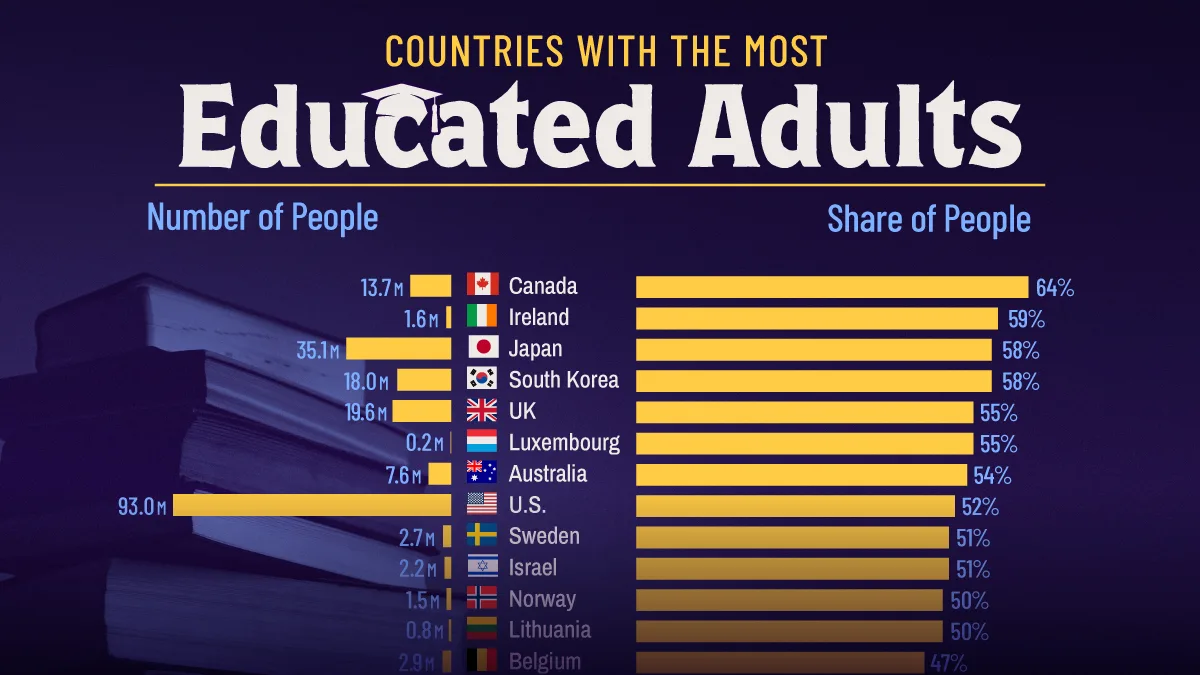
Canada has the highest share of adults with college or university qualifications at 64%, followed by Ireland (59%), Japan (58%), and South Korea (58%).
China (152.4M), India (119.2M), and the U.S. (93.0M) have the largest numbers of college-educated adults.
Japan has more college-educated adults (35.1M) than Germany and France combined (30.4M).
A college education is now the norm for working-age adults in a growing number of wealthy countries, but the countries with the highest shares of graduates are not necessarily those with the largest numbers.
This graphic ranks 47 countries by the share of adults aged 25–64 with college or university qualifications, from two-year college diplomas to doctoral degrees. It also shows how many adults those shares represent.
The data comes from the OECD’s Education at a Glance 2026, covering 2025 or the latest available year (as early as 2023), combined with population estimates from the UN. China, which is not covered by the OECD data, uses 2020 census figures from the National Bureau of Statistics of China.
Canada Has the Highest Share of College-Educated Adults
Canada’s lead is partly explained by its extensive college sector, which offers qualifications beyond high school but below a bachelor’s degree.
Among Canadian adults, 25% have a two-year college diploma as their highest qualification, while 39% hold a bachelor’s degree or higher. Statistics Canada credits the country’s college sector and highly educated immigrant population for its leading position.
The table below shows the share and number of adults with college or university qualifications in each of the 47 countries:
CountryAdults With College or University Qualifications
Share (%)Number (Millions)
Canada6413.7
Ireland591.6
Japan5835.1
South Korea5818.0
UK5519.6
Luxembourg550.2
Australia547.6
U.S.5293.0
Sweden512.7
Israel512.2
Norway501.5
Lithuania500.8
Belgium472.9
Netherlands464.4
Switzerland462.3
Denmark461.4
France4514.6
New Zealand441.2
Iceland440.1
Finland431.2
Spain4211.2
Estonia420.3
Latvia410.4
Poland408.4
Austria381.9
Chile374.1
Bulgaria361.3
Germany3515.8
Greece351.8
Slovenia350.4
Portugal331.8
Hungary321.6
Croatia310.6
Slovakia300.9
Colombia298.6
Czechia291.6
Türkiye2813.3
Costa Rica280.8
Argentina235.4
Brazil2225.9
Mexico2214.8
Italy227.0
Romania192.0
China18152.4
India16119.2
Indonesia1319.0
South Africa82.8
OECD Average43--
The U.S. ranks eighth at 52%, well above the OECD average of 43%. At the bachelor’s degree level or higher, the U.S. (41%) is slightly ahead of Canada (39%), meaning Canada’s overall advantage is driven by its much larger share of adults with shorter college qualifications.
China and India Have the Most College-Educated Adults
Population size reshuffles the ranking. China has the most adults with college or university qualifications at 152.4 million, based on its 2020 census, followed by India (119.2 million) and the U.S. (93.0 million).
Yet only 18% of working-age adults in China and 16% in India hold these qualifications, compared with 52% in the U.S.
Together, these three countries account for 56% of the 647.1 million college-educated adults across the 47 countries. Canada, despite leading by share, ranks 12th by total number at 13.7 million.
Richer Countries Tend to Have More College-Educated Adults
College attainment generally rises with national income. All nine countries in the ranking with GDP per capita below $35,000 have college attainment rates below 30%, based on World Bank data adjusted for purchasing power.
But wealth doesn’t tell the whole story.
Italy and the UK have nearly identical incomes per person, yet 55% of UK adults have college qualifications compared with just 22% in Italy. A third of Italian adults have not completed high school.
Germany (35%) and Austria (38%) also rank well below Japan (58%), despite having higher incomes per person. Both countries have strong apprenticeship systems that train skilled workers without requiring college degrees.
These examples show why college attainment alone doesn’t capture the full picture of a country’s education and workforce skills.
Learn More on the Voronoi App
If you enjoyed today’s post, check out The Best Countries at Reading on Voronoi.
Related articles