
US Air Force boosted B-52 bomber battle readiness by 40% without buying new jets
The USAF’s North Star Readiness Campaign has boosted the number of flyable B-52 “Stratofortresses” by...
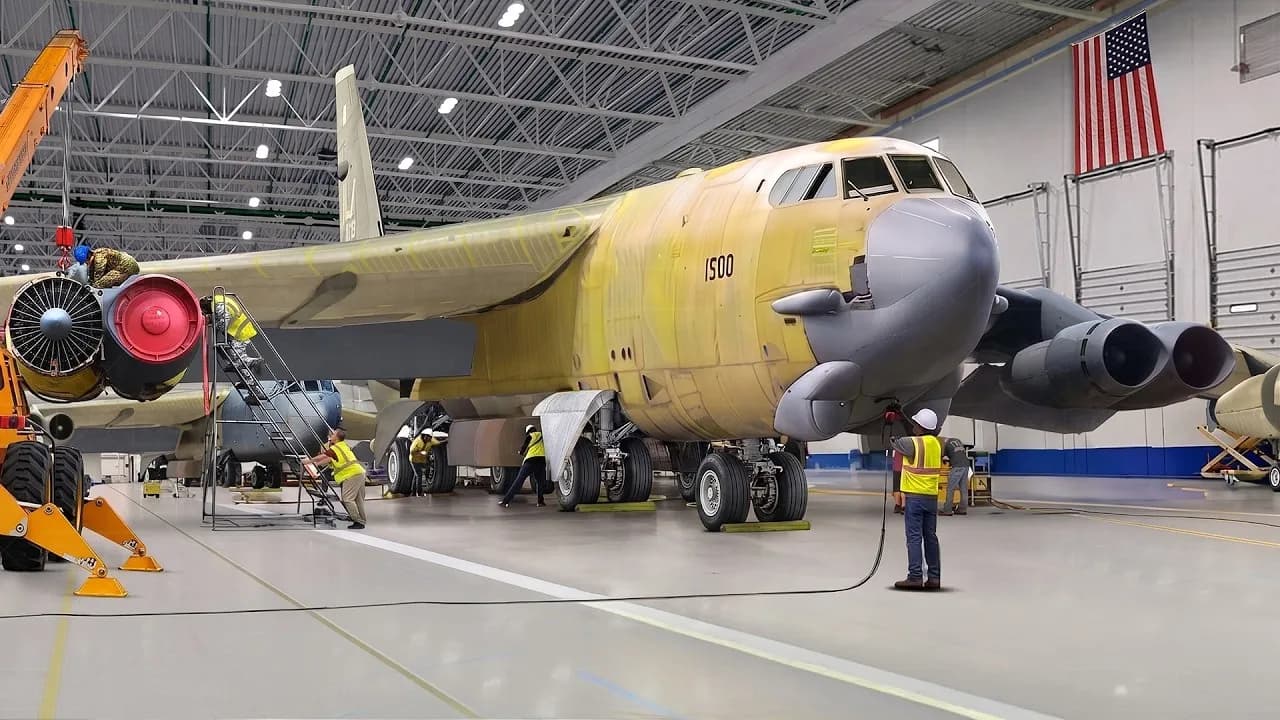
The USAF’s North Star Readiness Campaign has boosted the number of flyable B-52 “Stratofortresses” by 40 percent. That doesn’t mean they’ve acquired more aircraft; it means the number unavailable due to maintenance and logistics bottlenecks has been dramatically slashed.
Like any machine, aircraft like the B-52 require ongoing maintenance and repair and require other supplies to remain operational. For a venerable and ancient aircraft such as the B-52, a plentiful and timely supply of spare parts and consumables is essential to ensuring it can remain operational.
In fact, most aircraft can be perfectly serviceable, but may remain grounded due to waiting for spare parts, an engineering decision, depot work, or some other bit of support. At present, the USAF operates somewhere in the order of 76 B-52s.
About three-quarters of those are in active service, with the remainder held in reserve for a variety of reasons. Another 12 or so airframes are also held in “deep storage” at the Davis-Monthan AFB Boneyard to act as donors for spare parts or potential backup reinforcements.
Keeping more B-52s airborne
That’s where the North Star Readiness Campaign comes in. It is essentially an Air Force-wide effort to attack those bottlenecks rather than treating readiness as merely a problem for mechanics on the flight line.
It brings maintenance, logistics, supply, engineering and depot organisations together to get aircraft returned to service faster. With it, something that previously might have taken a week or more to reach an aircraft can apparently now arrive in days.
That’s a big deal when you’ve got a relatively small bomber fleet: shaving several days off every repair can mean several additional aircraft being available at any given time. This program is also making headway for other key aircraft like the B-1 “Lancer.”
According to reports, the number of so-called Mission Impaired Capability Awaiting Parts (MICAPS), essentially serious parts shortages keeping aircraft from being fully operational, fell from more than 450 to about 160.
The strategic reason for doing this now is the transition to the B-21 “Raider.” The USAF still needs the old B-52s and B-1s to provide long-range strike capability while some aircraft are simultaneously undergoing maintenance and modernization and while the B-21 gradually enters service.
Logistics is key
Getting more aircraft out of maintenance therefore gives commanders a larger usable force without actually buying any additional B-52s. To give you an idea of how significant this could be, let’s say 30 B-52s were available for active duty before North Star.
Using it, this could be increased to 42, an increase of 40 percent. Of course, this is just an illustration, as the actual numbers are reported. It could be higher or lower in reality.
Whatever the case may be, it is interesting to see that something as mundane as improved logistics can significantly lead to tangible increases in combat readiness in the form of more available aircraft.
This is all the more important for smaller fleets or aircraft, particularly large and expensive things like B-52, B-1, or B-21 bombers.
Related articles

China fears US deployment of space weapons raises risks of fresh arms race: Report
The United States has publicly acknowledged that it has weapons deployed in orbit, marking a...

Trump wants ‘AI Force’ to keep US AI race moving, push ahead with modern tech despite concerns
President Donald Trump says he plans to create an “AI Force” and appoint a new...

Scientists transport 92 antiprotons by road for first time, store them in vessel for over a month
Scientists succeeded in transporting antiprotons by road for the first time in a purpose-built trap...

A mathematical rule against disagreement survives beyond quantum mechanics
Two people can examine the same evidence and reach different conclusions. However, if they share...

Volkswagen electric bus sets Guinness World Record, drives 62,000 miles across 92 countries
A Volkswagen ID. Buzz has completed a 99,767-kilometer (roughly 62,000 miles) journey through 92 countries...
Low-cost US interceptor destroys drones without jamming their signals
A US defense startup has tested a low-cost interceptor missile designed to physically destroy small...