
Volkswagen electric bus sets Guinness World Record, drives 62,000 miles across 92 countries
A Volkswagen ID. Buzz has completed a 99,767-kilometer (roughly 62,000 miles) journey through 92 countries...
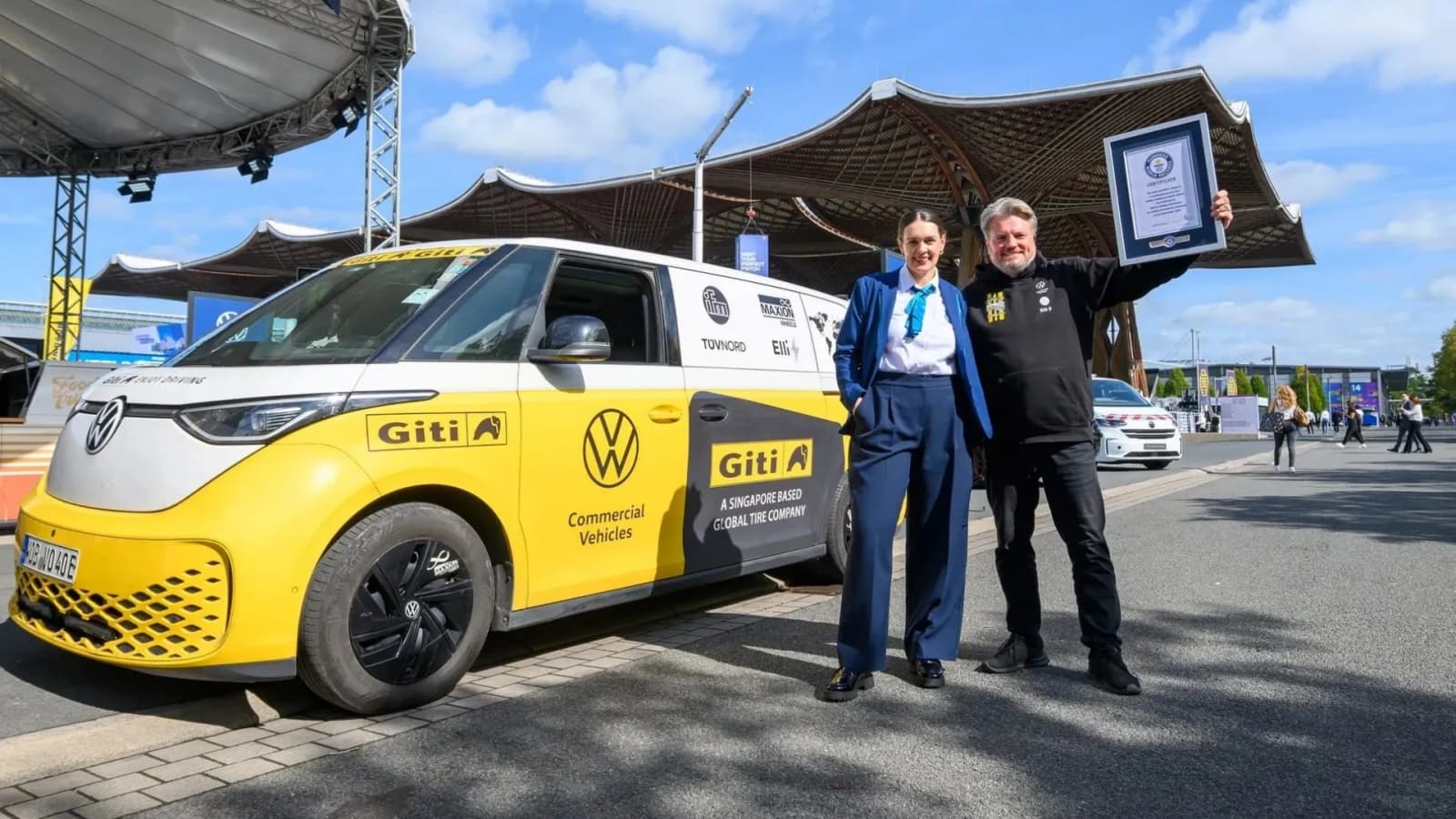
A Volkswagen ID. Buzz has completed a 99,767-kilometer (roughly 62,000 miles) journey through 92 countries and six continents, earning a Guinness World Record after spending 445 days on the road. German long-distance driver Rainer Zietlow drove the series-production electric van from Hanover, Germany, around the world and back.
Guinness World Records recognized the journey in the category of “Most countries visited in a continuous journey by a battery-powered electric vehicle,” and presented the certificate at IAA Transportation 2026 in Hanover.
Nearly 62,000 miles across the world
Zietlow began the journey on July 1, 2025, from Volkswagen Commercial Vehicles’ customer center in Hanover, where the ID. Buzz is produced. Over the following 445 days, the van crossed six continents, traveling through major cities, deserts, mountain regions, and areas with very different levels of EV infrastructure.
The trip covered 99,767 km, or roughly 62,000 miles, and involved more than 300 charging cycles. Because the journey crossed oceans, the vehicle also made 16 container-ship crossings. It retained its standard-production Giti tires throughout the record attempt.
According to Volkswagen and Zietlow, the vehicle completed the journey without a technical breakdown. That claim is particularly notable given the range of conditions encountered, although the experience represents a single vehicle rather than a controlled durability test of the ID. Buzz fleet.
The journey also highlighted a practical limitation for long-distance electric travel: charging infrastructure remains highly uneven around the world.
Charging an EV around the world
Zietlow said some regions presented few conventional charging options. In parts of Africa, including Zambia and Tanzania, the team charged at national substations under supervision. Other countries offered considerably more developed charging networks.
South Africa, Morocco and Rwanda were among the countries Zietlow identified as having stronger charging infrastructure, while he also noted rapid growth in Saudi Arabia. Brazil and Chile were highlighted for the expansion of electric mobility in South America, while China stood out for the scale of EV adoption.
The experience highlights an important distinction between an EV’s technical ability to travel long distances and the infrastructure needed to make that travel practical. The ID. Buzz could cover the distance, but planning where and how to recharge remained an essential part of the expedition.
Battery retains 95.75% state of health
Perhaps the most interesting technical result came after the journey. Following the ID. Buzz’s return to Germany, TÜV Nord assessed its high-voltage battery and recorded a 95.75% state of health after almost 100,000 km (roughly 62,000 miles) and more than 300 charging cycles. TÜV Nord had also inspected the vehicle before the journey, helping verify that the same production vehicle completed the trip.
The figure should not be interpreted as a guarantee that every ID. Buzz battery will retain 95.75% capacity after the same mileage. Battery degradation depends on factors including temperature, charging behavior, power levels, and usage patterns, and this was a single vehicle.
Still, the result provides an unusual real-world data point for an electric vehicle subjected to a year-plus of international driving. For Zietlow, the journey was the biggest project of his 20-year career. It also offered a test of something less dramatic but increasingly important for EV adoption: whether a production electric vehicle can remain usable across vastly different environments when the infrastructure is far from uniform.
The answer from this particular ID. Buzz is encouraging, but the world tour also showed that charging availability, rather than simply vehicle range, remains one of the biggest variables in global electric travel.
Related articles
China fears US deployment of space weapons raises risks of fresh arms race: Report
The United States has publicly acknowledged that it has weapons deployed in orbit, marking a...

Trump wants ‘AI Force’ to keep US AI race moving, push ahead with modern tech despite concerns
President Donald Trump says he plans to create an “AI Force” and appoint a new...
Scientists transport 92 antiprotons by road for first time, store them in vessel for over a month
Scientists succeeded in transporting antiprotons by road for the first time in a purpose-built trap...

A mathematical rule against disagreement survives beyond quantum mechanics
Two people can examine the same evidence and reach different conclusions. However, if they share...
Low-cost US interceptor destroys drones without jamming their signals
A US defense startup has tested a low-cost interceptor missile designed to physically destroy small...

US project combines quantum AI and robotics for competitive rare earth supply chain
USA Rare Earth has partnered with French quantum computing company Pasqal and industrial AI specialist...