
Low-cost US interceptor destroys drones without jamming their signals
A US defense startup has tested a low-cost interceptor missile designed to physically destroy small...
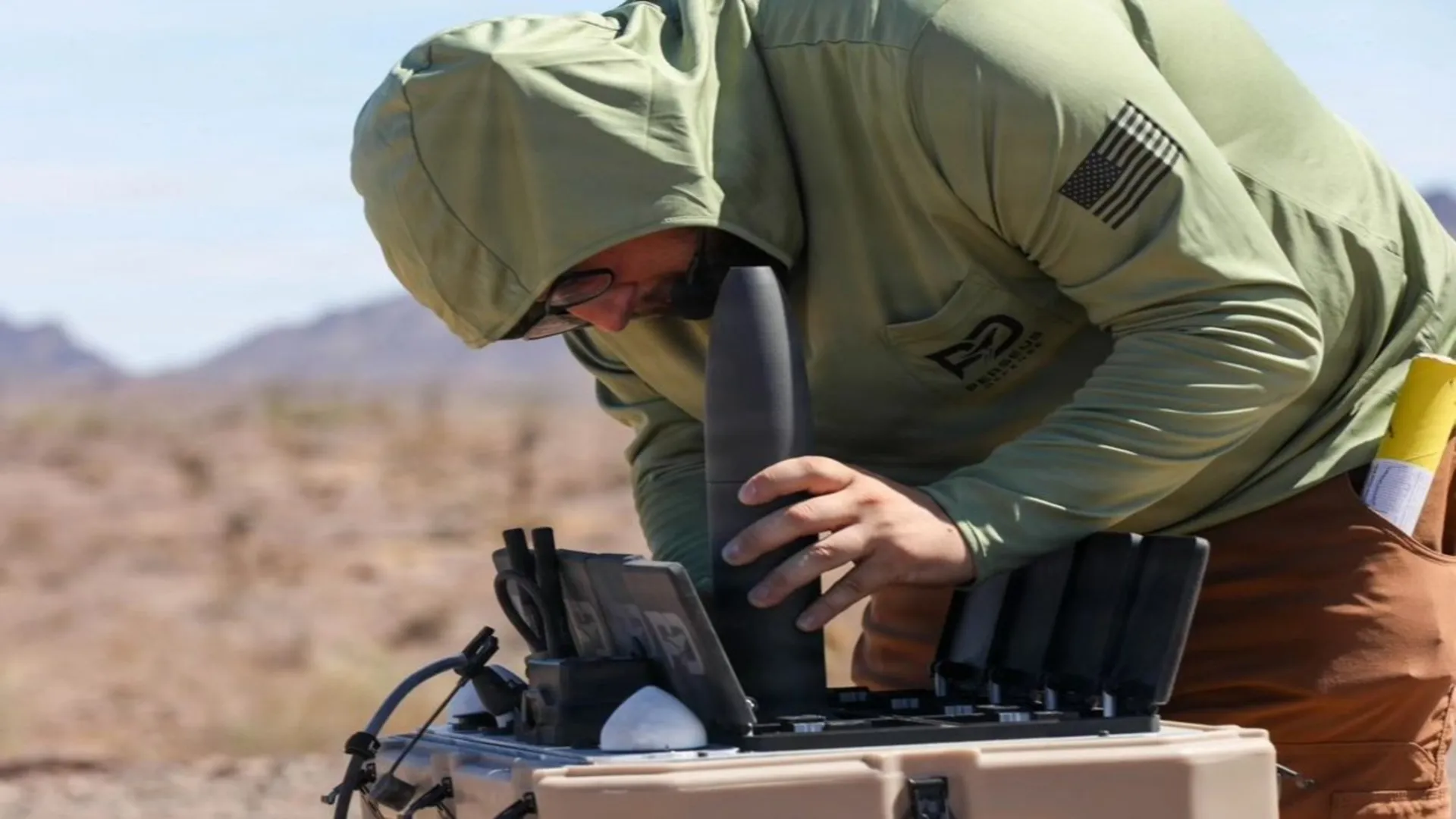
A US defense startup has tested a low-cost interceptor missile designed to physically destroy small drones, offering the military a potentially affordable way to protect installations from aerial incursions.
Perseus Defense fired its Mk-III interceptor from an eight-shot launcher at Cibola Range Site 17 at Arizona’s Yuma Proving Ground this month.
The demonstration formed part of Falcon Peak 26.2, a counter-small unmanned aircraft systems experiment involving US Northern Command, NORAD and the Pentagon’s Joint Interagency Task Force 401.
Each interceptor reportedly costs approximately $2,500 to build, according to the company. That could help address the cost imbalance created when militaries use missiles priced above $100,000 to destroy drones worth only a few hundred dollars.
Physically striking drones
The Mk-III uses a kinetic hit-to-kill approach, meaning it destroys a drone through physical impact rather than electronically disrupting its communications.
Electronic warfare systems commonly work by jamming or spoofing the radio links used to control unmanned aircraft.
However, their effectiveness can be limited against drones navigating along preprogrammed routes or communicating through fiber-optic cables. A kinetic interceptor provides another layer of defense against such threats.
Perseus is also pitching its system as a low-collateral option suitable for protecting military installations on US soil, where commanders must consider the risks posed by falling debris and conventional air-defense missiles.
During the Yuma event, the interceptor was loaded into an eight-shot launcher and demonstrated to distinguished visitors. Perseus said the system featured “Lattice-level integration,” referring to its compatibility with Anduril Industries’ Lattice command-and-control software.
The demonstration followed an earlier appearance at Operation Jailbreak, an experimentation exercise held at Fort Carson.
Closing gaps in US base defense
Demand for improved domestic counter-drone systemsintensified after unidentified drones repeatedly flew over Joint Base Langley-Eustis in Virginia in December 2023.
The incursions reportedly forced the base to temporarily relocate its F-22 fighters and highlighted both legal and operational limitations surrounding responses to drones flying over US territory.
Similar sightings were recorded at other military installations through 2024 and 2025.
JIATF-401 was subsequently established in 2025 to accelerate the development and deployment of counter-drone capabilities for US forces and domestic installations.
Falcon Peak 26.2 is intended to evaluate emerging systems, improve cooperation between military and civilian partners, and provide developers with rapid feedback.
The campaign also places particular emphasis on technologies capable of defeating drones while minimizing collateral damage.
This year marked the first time the experiment was conducted at Yuma Proving Ground after previously being hosted at Eglin Air Force Base in Florida.
Compact system with deeper magazine
Other reporting from the exercise identified a Perseus interceptor called Harpe. The missile measures approximately 24 inches (61 centimeters) and has a stated engagement range of 1.2 miles (2 kilometers).
Its launcher weighsless than 79 pounds (36 kilograms), potentially allowing personnel to move and deploy it without heavy vehicles or permanent infrastructure.
US Northern Command evaluated the system alongside other short-range counter-drone technologies, with mobility, cost per interception, and magazine depth among the main considerations for base defense.
Perseus Defense was founded in 2025 by Penn State aerospace engineering graduates Jason Cornelius and Steve Messinger. The Y Combinator-backed company has raised $6.5 million in seed funding.
Related articles

China fears US deployment of space weapons raises risks of fresh arms race: Report
The United States has publicly acknowledged that it has weapons deployed in orbit, marking a...

Trump wants ‘AI Force’ to keep US AI race moving, push ahead with modern tech despite concerns
President Donald Trump says he plans to create an “AI Force” and appoint a new...

Scientists transport 92 antiprotons by road for first time, store them in vessel for over a month
Scientists succeeded in transporting antiprotons by road for the first time in a purpose-built trap...

A mathematical rule against disagreement survives beyond quantum mechanics
Two people can examine the same evidence and reach different conclusions. However, if they share...

Volkswagen electric bus sets Guinness World Record, drives 62,000 miles across 92 countries
A Volkswagen ID. Buzz has completed a 99,767-kilometer (roughly 62,000 miles) journey through 92 countries...

US project combines quantum AI and robotics for competitive rare earth supply chain
USA Rare Earth has partnered with French quantum computing company Pasqal and industrial AI specialist...