A piece of Mars older than 4 billion years reveals its ancient watery history
Much of Mars’ surface preserves a geological history stretching back billions of years, yet most...
Much of Mars’ surface preserves a geological history stretching back billions of years, yet most Martian meteorites found on Earth come from considerably younger periods. This leaves scientists with few physical samples from the planet’s earliest history.
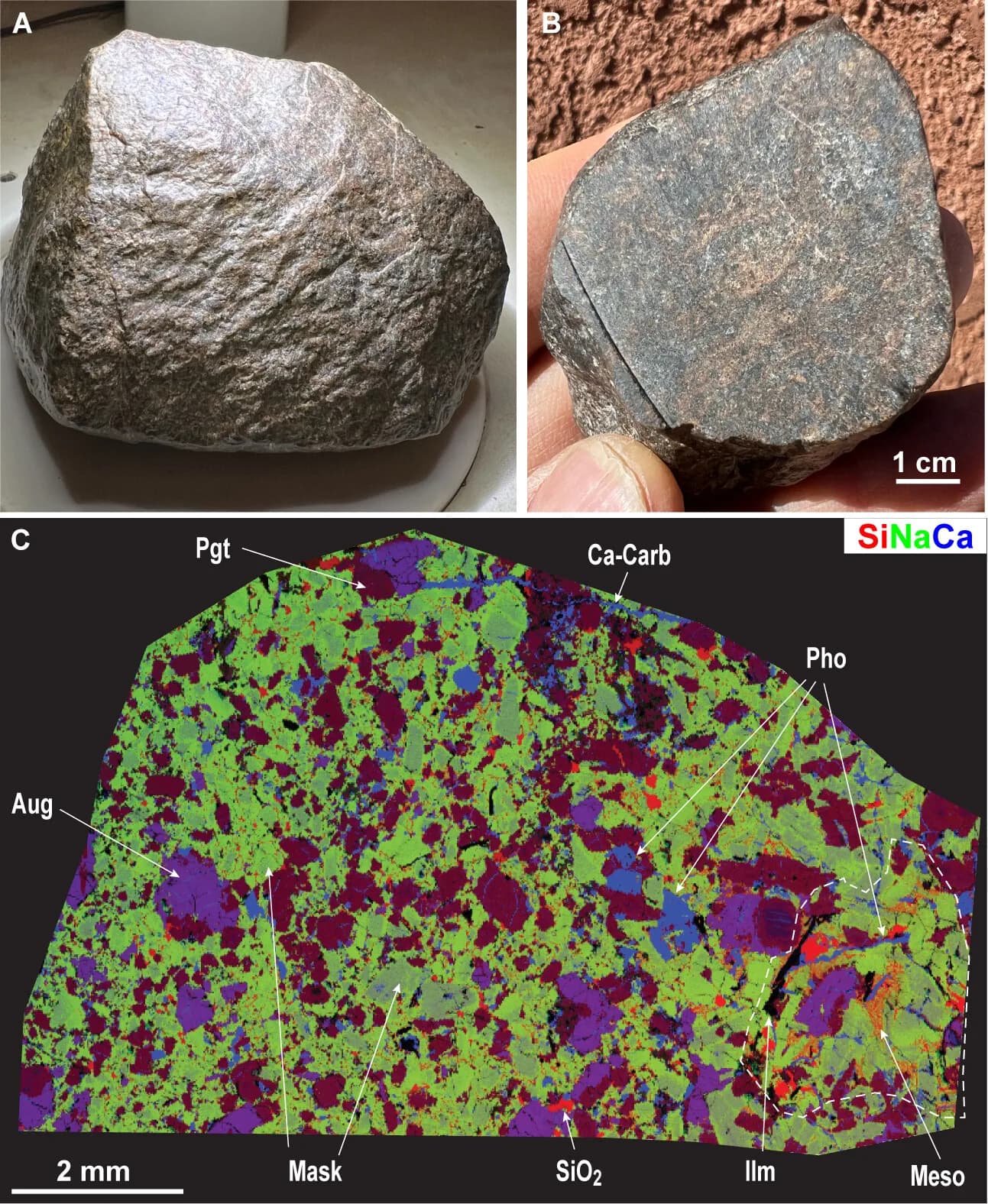
Now, a rose-colored rock recovered from the Sahara Desert could help fill that gap. Named Teghaza 001, the 800-gram meteorite preserves a piece of Martian crust that formed at least 4.1 billion years ago, carrying clues to how the planet’s interior, surface, and water systems evolved.
This discovery, described in detail in a recent study, is particularly important because the meteorite does not simply offer another glimpse of ancient Mars. Its unusual mineral composition points to a previously unsampled type of crust, while signs of water-related alteration suggest that liquid interacted with Martian rocks during the planet’s earliest geological history.
“This is really our first piece of Martian crust from a part of Mars we’ve never had a sample of before. It records interactions of water and rock and maybe even an imprint of the Martian atmosphere as it was losing water,” Lee Saper, one of the study authors and a scientist at NASA, said.
A different kind of Martian rock
Teghaza 001 was discovered in Mali’s Sahara Desert in 2022 and initially identified as Martian through its oxygen isotopes. These isotopes act as geochemical fingerprints, allowing researchers to distinguish material originating from Mars from rocks belonging to Earth or other planetary bodies.
However, its real significance emerged when scientists examined its internal structure and mineral composition. The rock contains a distinctive mixture of igneous minerals, formed when molten material cooled and solidified. Its texture suggests that the magma cooled relatively slowly beneath the surface rather than erupting as lava.
This combination makes it different from other ancient Martian meteorites. ALH84001, for instance, is approximately the same age but consists almost entirely of one mineral. Another famous sample, Black Beauty, formed around 2.1 billion years ago and contains small fragments of volcanic rock.
Teghaza 001 instead preserves a more varied record of ancient crust formation. Its composition suggests that the material originated from a geochemically distinct, relatively primitive region of Mars’ mantle.
“It was only after we started looking closely that we realized this meteorite is really unique,” Yang Liu, lead study author and a planetary scientist at NASA’s Jet Propulsion Laboratory (JPL), said.
Researchers compared its mineralogy and chemistry with observations from NASA’s Mars Reconnaissance Orbiter, identifying 13 possible locations in the planet’s southern highlands that could match its characteristics. Its precise birthplace, however, remains unknown.
The clues water left behind
Beyond its age, one of the most intriguing features of Teghaza 001 is evidence that water changed some of its minerals after the original rock formed.
Source: Yang Liu et al./Science (2026)
Scientists found that the meteorite contains minerals affected by aqueous alteration, meaning they interacted with liquid water or water-rich fluids. Its minerals also show evidence of interaction with fluids enriched in oxygen-18, a heavier form of oxygen.
Together, these features suggest that water circulated through ancient Martian crust and potentially preserved traces of changes in the planet’s early water and atmospheric systems.
“This is really our first piece of Martian crust from a part of Mars we’ve never had a sample of before. It records interactions of water and rock and maybe even an imprint of the Martian atmosphere as it was losing water,” Saper added.
A separate study published this year examined hydrogen isotopes in the meteorite’s apatite crystals, finding that the ancient Martian water had a deuterium-to-hydrogen ratio approximately twice that of Earth’s seawater.
This provides evidence of how Mars’ water reservoirs changed over time, supporting the idea that the planet lost substantial amounts of water to space. Related evidence of ancient wet-dry cycles on Mars has also been identified in geological features examined by NASA’s Curiosity rover.
Dating a rock without destroying it
Establishing the meteorite’s history presented another challenge: scientists needed to determine its age without consuming a significant portion of an exceptionally rare sample.
The researchers identified zircon crystals, minerals that can preserve information about the conditions and timing of a rock’s formation. They also used a specialized in-situ rubidium-strontium dating technique developed by at team of Caltech researchers. Instead of dissolving an entire sample for analysis, this method measures individual mineral grains directly. The researchers needed a fragment smaller than a fingernail.
The resulting measurements, considered alongside other mineral dating evidence, established that the meteorite is at least 4.1 billion years old. Its minerals also preserve evidence of subsequent geological alteration, although the dating results do not establish the precise timing of every water-related change.
“Right now, we are one of very few labs in the world able to perform this kind of age-dating, and the first to date such an ancient Martian meteorite. Our hope is to pave the way for dating even more Martian meteorites, or samples returned from other planets, their moons, and asteroids,” François Tissot, one of the study authors and a geochemistry professor at Caltech, said.
Teghaza 001 cannot reconstruct Mars’ entire early environment or reveal exactly where it originated, but it gives researchers a physical record of a part of the planet’s history that has remained largely inaccessible.
Further mineral analysis and comparisons with orbital observations could help narrow down its birthplace and establish how ancient water transformed the Martian crust.
Moreover, the dating technique could also help scientists investigate other rare planetary samples without destroying them in the process.
The study is published in the journal Science.
Source: https://interestingengineering.com/space/piece-of-mars-watery-history
Get the latest news delivered to your inbox.
Related articles