
US to conduct anti-submarine operations perfectly with tiltrotor that deploys undersea sensors
A joint U.S. Navy–Marine Corps test has demonstrated a new potential role for the MV-22B...
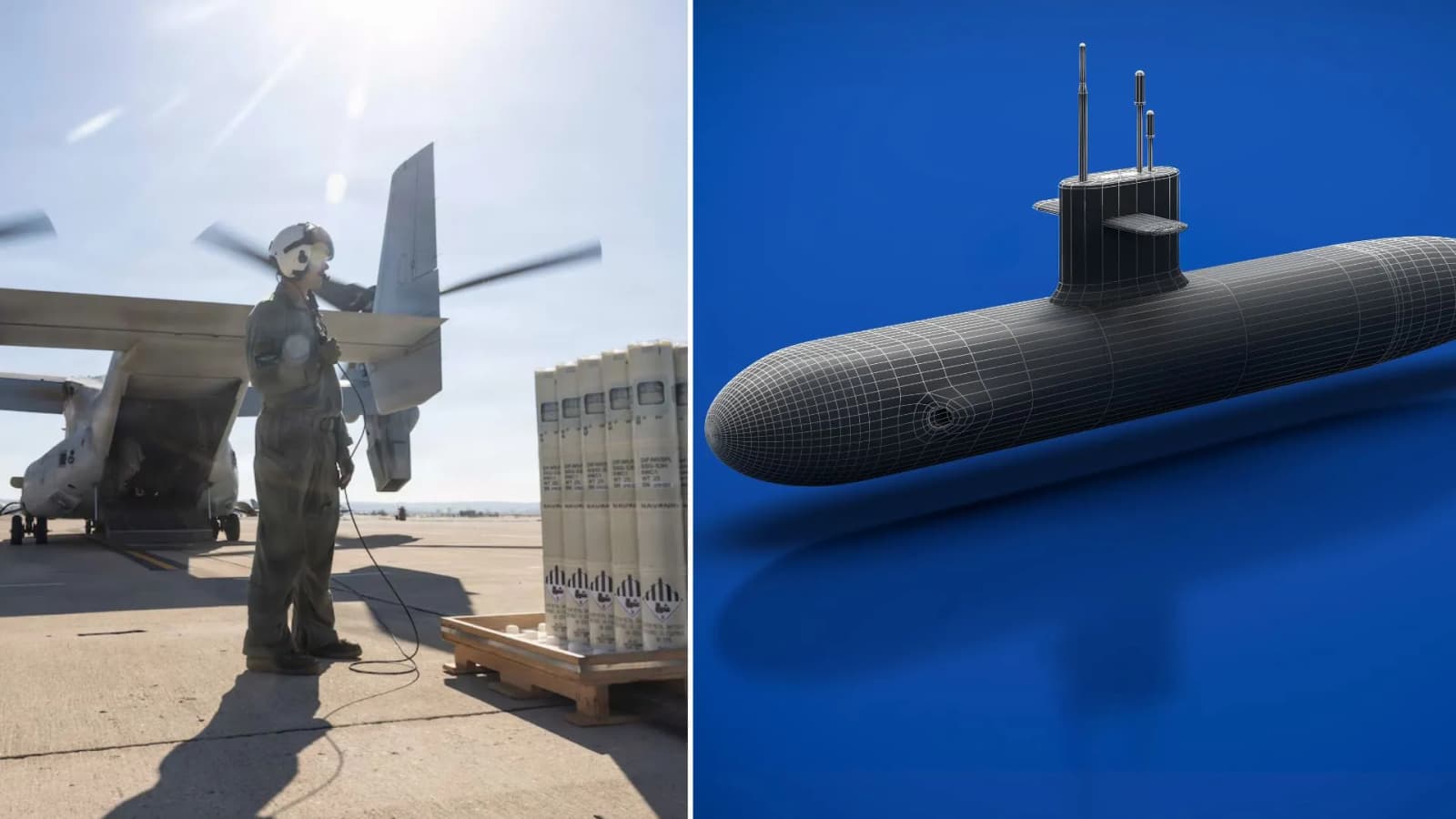
A joint U.S. Navy–Marine Corps test has demonstrated a new potential role for the MV-22B Osprey in supporting the U.S. fleet’s anti-submarine warfare capabilities.
The development marks an important step toward greater flexibility in maritime operations.
Conducted off the coast of San Clemente Island, the milestone test involved the first lot acceptance test of sonobuoys launched from an MV-22B Osprey tiltrotor aircraft. The evaluation was conducted jointly by the Air Anti-Submarine Warfare Systems Program Office, the Osprey Joint Program Office and Marine Operational Test and Evaluation Squadron 1.
Sonobuoys are essential component of modern anti-submarine warfare
The demonstration established that the Osprey could serve as an alternative aircraft for the Navy’s sonobuoy quality assurance program. Beyond providing another testing platform, the effort could help strengthen operational readiness and reduce dependence on a limited number of specialized aircraft for critical sonobuoy testing.
Sonobuoys are an essential component of modern anti-submarine warfare. These expendable sensors are deployed into the ocean to detect and monitor underwater acoustic activity, providing information that can help aircraft and naval forces locate and track submarines.
Before sonobuoys enter the Navy’s operational inventory, randomly selected production samples undergo over-water testing. The quality assurance process evaluates their reliability and acoustic performance to ensure that equipment delivered to operational squadrons meets required standards.
System can detect and track undersea threats
“Our primary focus in the quality assurance program is making sure the sonobuoys delivered to the fleet perform exactly as expected,” said Navy Capt. Greg Hinkle, program manager of the Air Anti-Submarine Warfare Systems Program Office.
“By utilizing the [Osprey] for this type of mission, we are reinforcing our supply chain and ensuring front line aircrews have the mission-ready stores they need to detect and track undersea threats.
Historically, the Navy has relied on P-3C Orion aircraft assigned to Air Test and Evaluation Squadron 30 to conduct these quality assurance drops using automated launch systems. The introduction of the Osprey as an alternative platform provides an additional option when the primary aircraft are unavailable.
This flexibility could help prevent testing backlogs and reduce disruptions to sonobuoy delivery schedules, ultimately supporting the availability of mission-ready stores for operational units.
The test also highlighted a significant difference between operating the Osprey and the P-3C Orion for sonobuoy deployment.
The Orion uses automated launch containers operated from the cockpit. The Osprey, by contrast, requires its crew to manually release the sonobuoys through the aircraft’s open rear cargo ramp.
“From an aircrew standpoint, this event provided an invaluable opportunity for our pilots and crew chiefs to build proficiency working through the mechanics of manual sonobuoy drops in a controlled setting,” said Marine Corps Lt. Col. Brandon Pope, Osprey pilot and advanced projects lead assigned to the Marine Operational Test and Evaluation Squadron 1.
“Hand-launching from an open ramp requires split-second coordination; the crew must be deliberate with timing, airspeed control and internal communication. This test demonstrated how the [Osprey’s] range, speed and versatility can support broader maritime domain awareness and distributed fleet operations.”
During the test, crew chiefs removed container caps and inverted launch tubes before releasing the sonobuoys into the aircraft’s slipstream. This process requires considerably more coordination among the flight crew and cargo-bay personnel.
Manual deployment also produces greater intervals between individual buoy releases. To compensate, the evaluation aircrew reduced the aircraft’s speed, allowing them to maintain the required spacing and target pattern for acoustic testing.
The procedure therefore became more than simply a test of the sonobuoys themselves. It also provided the Marine Corps with practical experience in operating the Osprey in a mission profile different from its traditional transport and assault-support roles.
The test demonstrated the importance of precise coordination when launching sonobuoys from the Osprey’s rear ramp.
The pilot must maintain stable flight parameters while the copilot manages navigation, timing and communications. At the same time, crew chiefs in the cargo compartment must prepare, program and release the sonobuoys according to the required sequence.
Source: https://interestingengineering.com/military/us-anti-submarine-warfare-osprey-sonobuoy
Related articles

Muse sure looks a lot like OpenClaw
We seem to be entering into an AI agent renaissance.

Muse will apparently let you download its entire filesystem
A pair of developers say that with very little prompting, Meta's Muse will share its entire filesystem with you. Peter James and Jonny L.

Meta is going to let you build games with AI right on your phone
Meta has a new plan to get people to make games for its Horizon social platform.

Jensen Huang talks about AI and climate change like a supervillain
As Jensen Huang puts it, AI can help fight climate change - but only if it inflicts "an enormous amount of pain and suffering" first.

Google sends TPU chips into orbit to test hardware for future space data centers
In a move that could scale AI compute in space, Google is preparing to send...

These smart glasses have been recalled for overheating temples causing burns
A company called Inmo that makes several different variations of smart glasses has issued a recall for its Air3 because the left temple "can overheat during extended use, posing a risk of serious…