
Super rare radioactive element recovered at 99.93% purity from US nuclear waste
Researchers in the US have recovered 95 percent of ultra-rare einsteinium and achieved nearly 99.93...
Researchers in the US have recovered 95 percent of ultra-rare einsteinium and achieved nearly 99.93 percent purity in fermium extracted from nuclear waste generated during californium-252 production.
The research took place at the Department of Energy’s (DOE) Oak Ridge National Laboratory (ORNL) in Tennessee. At the site, the team is developing more efficient ways to recover scarce radioisotopes that would otherwise be discarded as waste.
The isotopes include berkelium, einsteinium, and fermium. They are generated as byproducts during the manufacture of californium-252 (Cf-252). The materials are produced in remarkably small quantities.
A single Cf-252 production campaign yields milligrams of berkelium-249 (Bk-249), micrograms of einsteinium-253/254 (Es-253/254), and just picograms of fermium-257 (Fm-257). However, these extremely small quantities are still in high demand.
“For the amount we’re producing, you shouldn’t be able to see anything with your naked eye,” Cristian Celis-Barros, PhD, an R&D radiochemist in ORNL’s Isotope Science and Enrichment Directorate, stated. “That’s how pure this is.”
Extracting rare isotopes
ORNL is the only producer of Cf-252 in the Western world. The neutron-emitting radioisotope is used for several applications, such as starting up nuclear reactors. Producing it also creates rare radioisotopes that would otherwise become waste.
For Bk-249, the scientists added an extra column separation step to capture the isotope while impurities pass through. The process then converted the yellowish solution into a purer crystalline green solid.
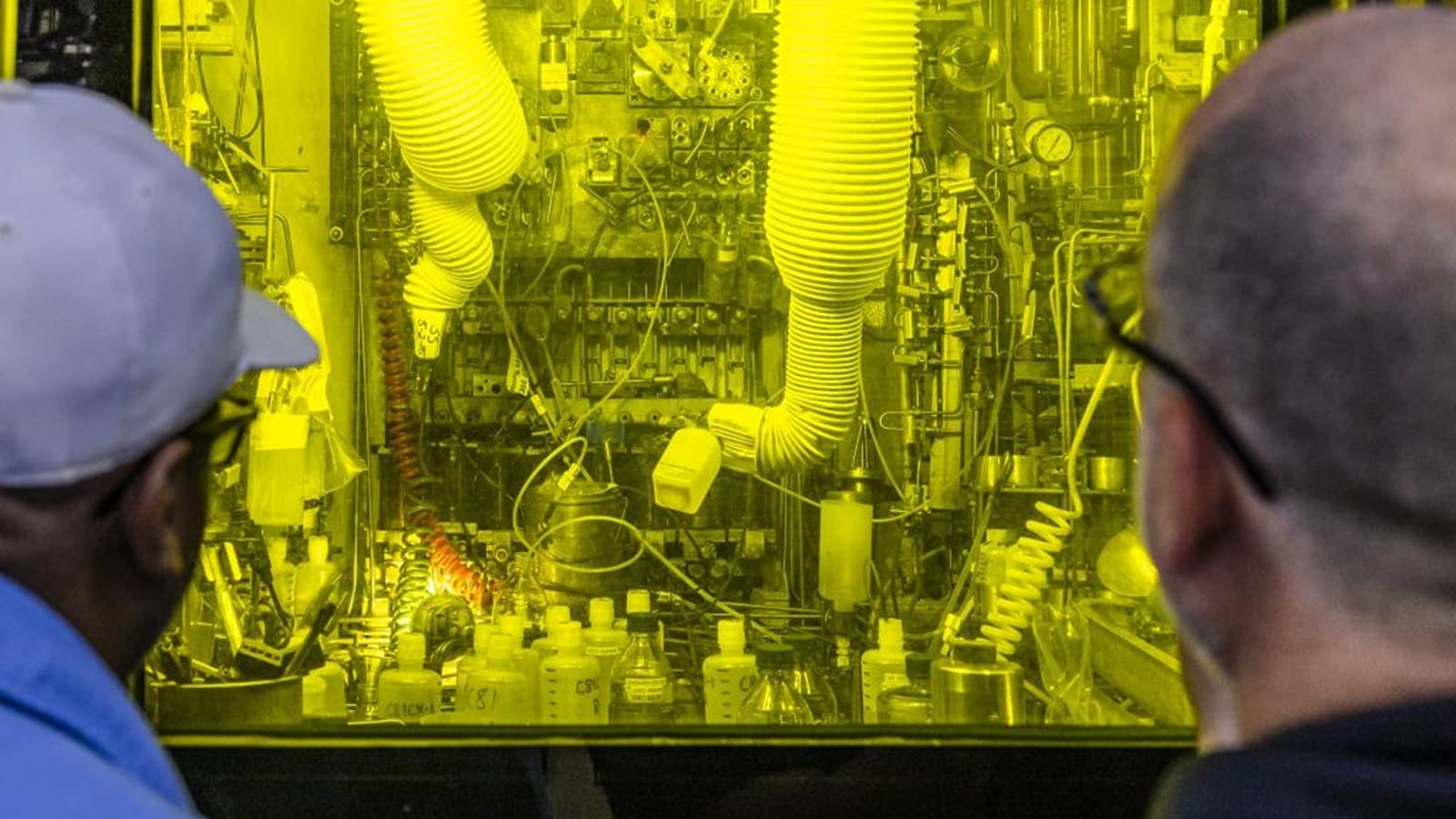
Technicians look into a hot cell in the Radiochemical Engineering Development Center where Cf-252 is produced. Credit: Carlos Jones / ORNL, US Dept. of Energy
Meanwhile Celis-Barros also optimized the separation of Es-253/254 from Cf-252. By the end of the latest production campaign, the process recovered 95 percent of the einsteinium during each column run, according to ORNL. “That was pretty satisfying to see at the end of the campaign,” he said.
The achievement could allow the team to operate more efficiently during the next Cf-252 production campaign in 2027. Separating the isotopes presents another challenge as the extremely small amounts must be recovered from solutions that can still contain micrograms of highly radioactive Cf-252.
Higher isotope purity
The team also focused on Fm-257 amid growing interest in the element. During the latest campaign, Celis-Barros switched the resin used in a separation column to improve the separation of Es-253/254 from Fm-257. “In previous campaigns, there was no interest for separating Es-253/254 and Fm-257 from each other,” the researcher said.
According to ORNL, the final material was nearly 99.93 percent pure. “What we’re doing is nothing that hasn’t been done,” Celis-Barros, stated. “We’re just trying to simplify and come up with processes that are more efficient and expose workers to less radiation.”
The team now hopes that the process will eventually allow Fm-257 to be supplied to researchers interested in studying the elusive element. Such work has already contributed to major discoveries. For example, ORNL-produced Bk-249 was used in the discovery of element 117, tennessine.
Moreover, radioisotopes produced at the lab contributed to the discoveries or confirmations of superheavy elements 114 (flerovium), 115 (moscovium), 116 (livermorium), and 118 (oganesson). Still, fermium remains poorly understood. The element was discovered in 1952, but renewed scientific interest has created fresh demand for its radioisotopes.
The ORNL researchers hoped that future studies of fermium could reveal uses in medicine or industry. “Physicists are interested,” Celis-Barros concluded in a press release. “They need atoms to do experiments.” They plan to improve recovery and make more of these rare isotopes available for research.
Related articles
US lab activates automated ‘nuclear-grade banana peeler’ to strip and chop reactor fuel
Engineers at Idaho National Laboratory have brought a custom dismantling rig online to peel the...
US tech drives European nuclear reactor to ditch weapons-grade uranium fuel
One of Europe’s most critical nuclear research reactors has moved closer to running on low-enriched...
World-first: Scientists use lutetium to build world’s most accurate atomic clock
Researchers at the Centre for Quantum Technologies (CQT) in Singapore have built the world’s most...
What’s changing the length of our days, scientists find reason deep beneath Earth
Earth’s rotation changes by tiny amounts all the time. A new study suggests that forces...

China launches first trio of satellites to start 60-spacecraft radio tracker network
China has put three satellites into orbit that can locate radio signals from space, marking...
Claude scans 200,000 enzymes to uncover new CRISPR-like system hidden in phages
Anthropic’s Claude has identified a previously uncharacterized enzyme system in bacteriophages after searching more than...