2,200-pound payload, 2.5-kW power: Reusable space capsule debuts with 10x capacity jump
A European space startup, Space Cargo Unlimited, has rolled out its latest reentry vehicle, REV1,...
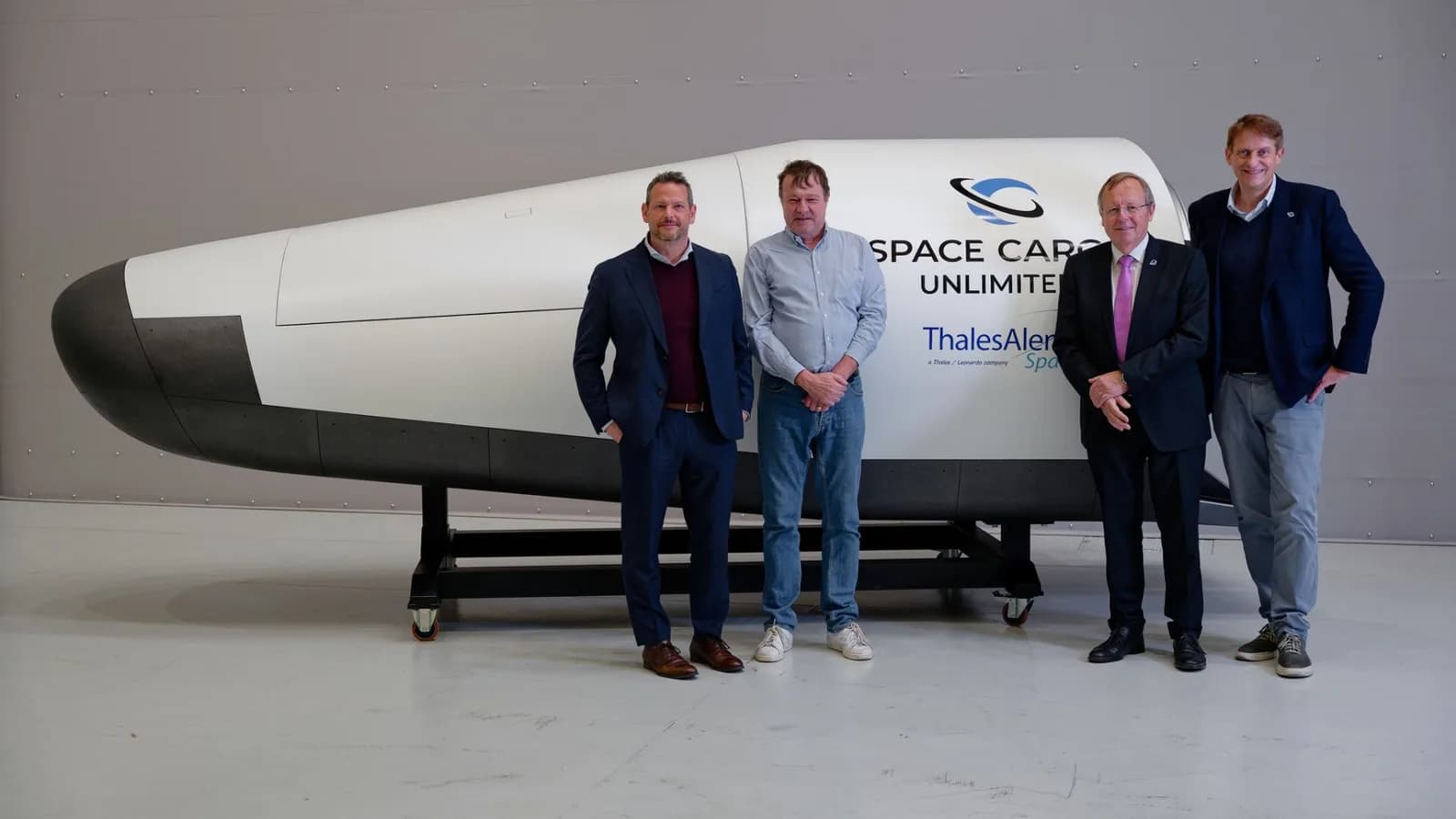
A European space startup, Space Cargo Unlimited, has rolled out its latest reentry vehicle, REV1, designed to carry payloads of nearly 2,200 pounds (1,000 kg).
The unveiling took place Tuesday, November 17, during the Space Tech Expo in Bremen, Germany, nearly four years after the vehicle was first announced, according to a company statement.
The debut comes amid a busy year for Space Cargo Unlimited, which has booked at least 10 missions on various reentry vehicles as it expands its presence in the growing in-space manufacturing and return market.
The space capsule, which is expected to make its first flight in 2030, is being developed in partnership with Thales Alenia Space, an established European aerospace manufacturer.
Ten-fold payload capacity
Designed around BentoBox, Space Cargo Unlimited’s autonomous, modular platform for space manufacturing and microgravity research, REV1 expands on the current 220-pound (100-kg) payload system by enabling 10-fold larger payloads to be carried to orbit and returned to Earth.
“With BentoBox, we are developing the space factory that can fly across a fleet of vehicles. REV1 is being designed from the inside out to take this BentoBox capability even further,” said Nicolas Gaume, CEO of Space Cargo Unlimited.
The vehicle features a two-module reusable architecture, with one module designed to return to Earth while the second remains in orbit. This approach allows the company to maximize operational flexibility while supporting longer-duration missions.
The company has also designed the space pod to accommodate time-sensitive cargo, such as biological samples, at the last minute while protecting it during launch and reentry through vibration- and load-mitigation features.
Spacecraft features for longer missions
Delivering an uninterrupted power supply of 2.5 kilowatts (kW), REV1 can remain in orbit for up to six months, depending on mission requirements, the Luxembourg-based company said.
To support scientific and commercial users, the company is also developing continuous monitoring and data logging capabilities, along with certified pathways for biological payloads to meet chain-of-custody requirements in regulated industries such as pharmaceuticals and biotechnology.
To provide greater visibility into manufacturing and research activities conducted in orbit, the vehicle is equipped with real-time sensors and edge-computing capabilities, allowing users to monitor experiments while they are underway.
Other low-orbit missions
While REV1 represents the company’s long-term vision, Space Cargo Unlimited has already been working with partners to gain flight experience before deploying its own spacecraft.
In November last year, the company partnered with German startup ATMOS Space Cargo to launch their first collaborative mission to orbit and return to Earth in 2026. However, according to the latest announcement, the mission has now been rescheduled for 2027, although an exact launch date has not yet been disclosed.
During that mission, ATMOS‘ Phoenix 2.1 reentry vehicle will carry Space Cargo Unlimited’s BentoBox platform, enabling customers to manufacture products and conduct research in microgravity before returning them safely to Earth.
Looking further ahead, the European company also plans a separate mission, scheduled no earlier than 2028, in which a 2,200-pound (one-tonne) BentoBox platform will fly aboard SpaceX’s Starfall reentry vehicle.
“The ambition is not simply to send more capacity into space, but to give companies a practical way to bring their equipment and processes into microgravity, gain new insight from those operations and return materials to Earth,” the company said.
Get the latest news delivered to your inbox.
Related articles