250lb drone helicopter S-100 UAS launches UAV mid-flight, relays video in first test
Austrian aerospace and defense technology company Schiebel has successfully demonstrated its 250-pound (114-kg) CAMCOPTER S-100...
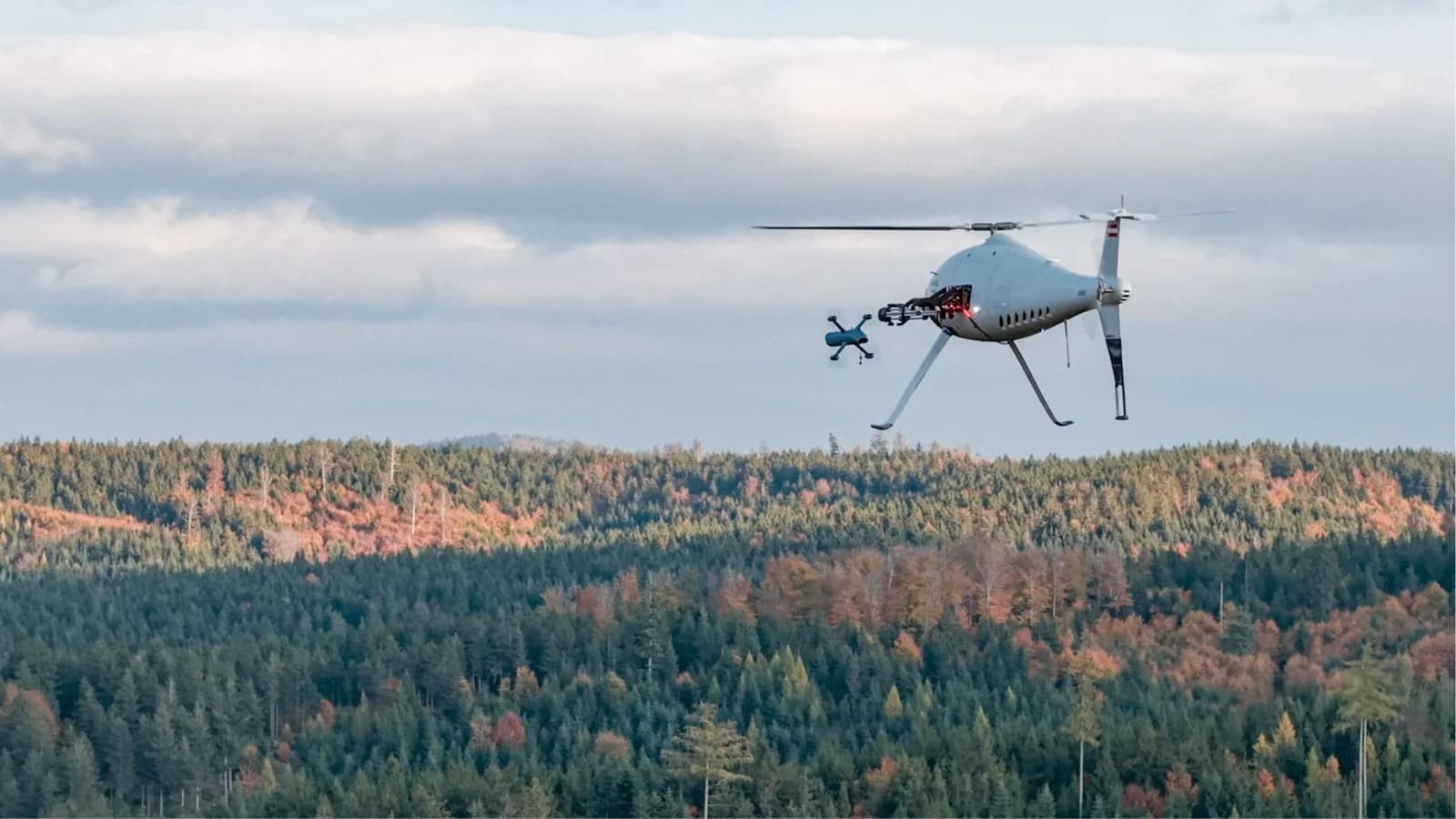
Austrian aerospace and defense technology company Schiebel has successfully demonstrated its 250-pound (114-kg) CAMCOPTER S-100 unmanned aerial system (UAS) carrying a smaller unmanned aircraft, releasing it in flight while maintaining a communications link.
The Vienna-based company announced the successful proof-of-concept demonstration on Wednesday, November 18, stating the trial validated the S-100’s ability to serve as both a drone carrier and an airborne communications relay.
This proof-of-concept demonstrates the incredible potential of combining the mature and proven CAMCOPTER® with smaller, specialized unmanned systems,” said Hans Georg Schiebel, Chairman of the Schiebel Group.
Larger UAS operates as drone mothership
The trial was conducted in Austria in partnership with OSIRIS Poland, another European defense technology company. During the demonstration, the S-100 remained in forward flight while carrying and deploying an inert version of the OSIRIS HSCD-1 High-Speed Camera Drone.
After release, the smaller drone maintained a communications link through the CAMCOPTER S-100, which continued to provide airborne communications and relay video data throughout the flight.
According to Schiebel, the demonstration successfully validated the concept of using the larger UAS as a drone mothership while simultaneously serving as an airborne command and video-relay platform.
The trial showcased three key capabilities: airborne transportation of a smaller drone, in-flight deployment, and continuous communications and video relay between the carrier aircraft and the deployed unmanned system.
The company said the concept could support a range of defense applications, including Counter-Unmanned Aircraft Systems (C-UAS). Although the demonstration used an inert payload, Schiebel noted that the architecture could eventually accommodate high-speed interceptor drones equipped with effectors.
“Acting as a force and capability multiplier, the CAMCOPTER® S-100, S-300, S-101 and S-301 systems can serve as carrier, launch platform and airborne communications relay for smaller unmanned systems and loitering munitions, extending their operational reach and flexibility,” the company said.
Designed for operations from land and sea
The CAMCOPTER S-100 was developed in the early 2000s for military, naval, security, and civilian missions. The rotary-wing aircraft can carry payloads of up to 110 pounds (50 kg), excluding fuel, and has a maximum takeoff weight of about 440 pounds (200 kg).
Unlike conventional fixed-wing unmanned aircraft, the S-100 uses a rotary-wing configuration, enabling vertical takeoff and landing without a runway. This capability allows it to operate from naval vessels, confined landing zones, and remote locations where conventional UAVs would be difficult to deploy.
Over the years, the platform has been used for maritime surveillance, intelligence gathering, border security, disaster response, and other specialized military missions.
The helicopter drone has a cruising speed of more than 60 mph (102 km/h) and can reach speeds of up to 115 mph (185 km/h), depending on payload, fuel load, mission configuration, and operating conditions.
Under standard operating conditions, the aircraft can remain airborne for more than six hours, with endurance extending to 10 hours or more in optimized configurations.
Although the S-100’s 110-pound payload capacity was originally designed for surveillance sensors and mission equipment, the latest demonstration shows that the platform can also support a compact drone-carrying role. By integrating a smaller unmanned aircraft, along with its mounting hardware, release mechanism, communications equipment, and control interfaces, Schiebel demonstrated that the S-100 can function as an airborne launch platform without compromising its ability to relay data and maintain communications throughout the mission.
Get the latest news delivered to your inbox.
Related articles