A triple-star system that shouldn’t exist: 28-light-year Welopōʻai exposes hidden white dwarf
Astronomers searching for planets around a nearby red dwarf have instead found a triple-star system...
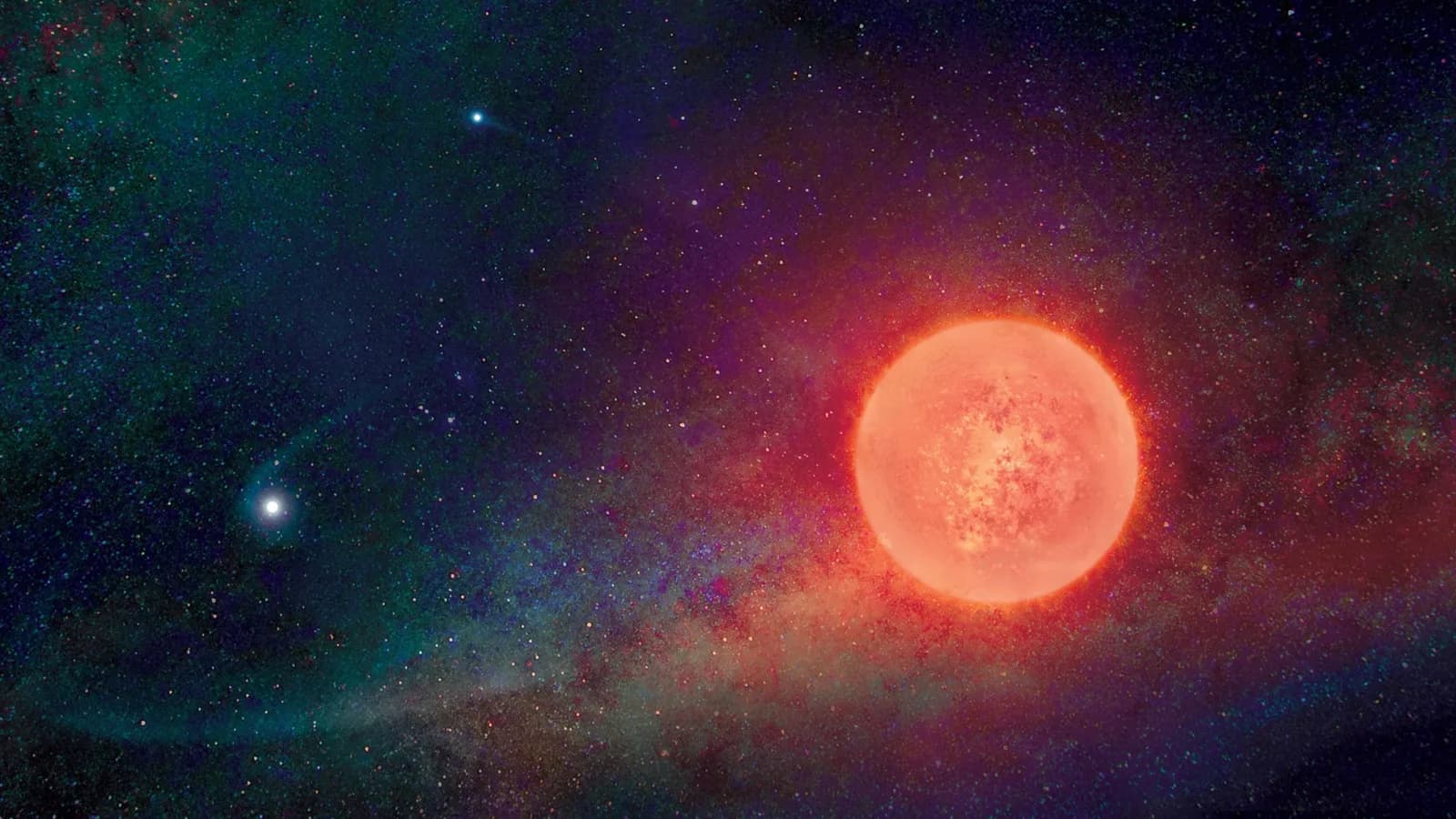
Astronomers searching for planets around a nearby red dwarf have instead found a triple-star system just 28 light-years (about 165 trillion miles) from Earth. Its discovery challenges ideas about how stars live, die, and interact as they evolve.
Named Welopōʻai, the system was found by an international team led by the Trottier Institute for Research on Exoplanets (IREx) at Université de Montréal. The study appears in Astronomy & Astrophysics.
It contains two white dwarfs, the extremely dense remnants of Sun-like stars that have exhausted their fuel, and a red dwarf, a star much dimmer than the Sun. “We were actually looking for planets,” said lead author Étienne Artigau of IREx.
A signal too big
The discovery began with the SPectropolarimètre InfraROUge (SPIRou) instrument at the Canada-France-Hawaii Telescope on Maunakea, Hawaiʻi, which detects exoplanets by measuring tiny changes in a star’s velocity.
One nearby red dwarf behaved differently, with velocity variations of nearly 10 miles per second (16 kilometers per second), more than a thousand times larger than expected. After several years of follow-up, the team established that an unseen companion had more than half the Sun’s mass.
That mass combined with very low brightness left one plausible explanation: the remnant of a dead star, said co-author Charles-Antoine Parent, an undergraduate student at Université Laval. A white dwarf was most likely, though a neutron star or black hole could not be ruled out.
Gemini finds the companion
The team turned to the Gemini North telescope on Maunakea. Its ʻAlopeke instrument’s high-resolution images directly detected a faint companion, a white dwarf.
A second, much more distant white dwarf was already known to belong to the system. A red dwarf and a white dwarf orbit close together, while the second white dwarf orbits the pair. No comparable system is known within 100 light-years of Earth.
Why it shouldn’t exist
The team measured the new white dwarf’s mass with an uncertainty below 1%, a valuable test of stellar evolution models and the physics of matter at extreme densities.
Before becoming a white dwarf, the companion was a star about 40% more massive than the Sun. As it became a giant, it swelled to several hundred times its size, and the red dwarf must have orbited close enough that an interaction was almost inevitable.
In many similar systems, the expanding star can engulf its companion or cause the two to merge. Against expectations, Welopōʻai’s red dwarf appears to have survived and remains in a surprisingly wide, stable orbit.
Université de Montréal professor Patrick Dufour, a white dwarf specialist, said the system “should not exist” and that there is no clean explanation for how it got there. That question drives the team’s next observations.
Next steps, Hawaiian name
The team’s next goals include better understanding the gravitational interactions among the three stars and whether they could explain the system’s unusual history.
Artigau said discoveries like this remind astronomers that the cosmic neighborhood still holds remarkable surprises, and that even a planet search can turn up something completely unexpected.
The name Welopōʻai came through A Hua He Inoa (“To Call Forth a Name”), a program of the ʻImiloa Astronomy Center of Hawaiʻi. It combines welo, an inherited or family trait, and pōʻai, an orbit or circular path, evoking a “path of family traits.”
Get the latest news delivered to your inbox.
Related articles