All the Metals the World Mines in a Year, Visualized
Explore global metal production in 2025, from 2.6 billion tonnes of iron ore to lithium, rare earths, and precious metals.
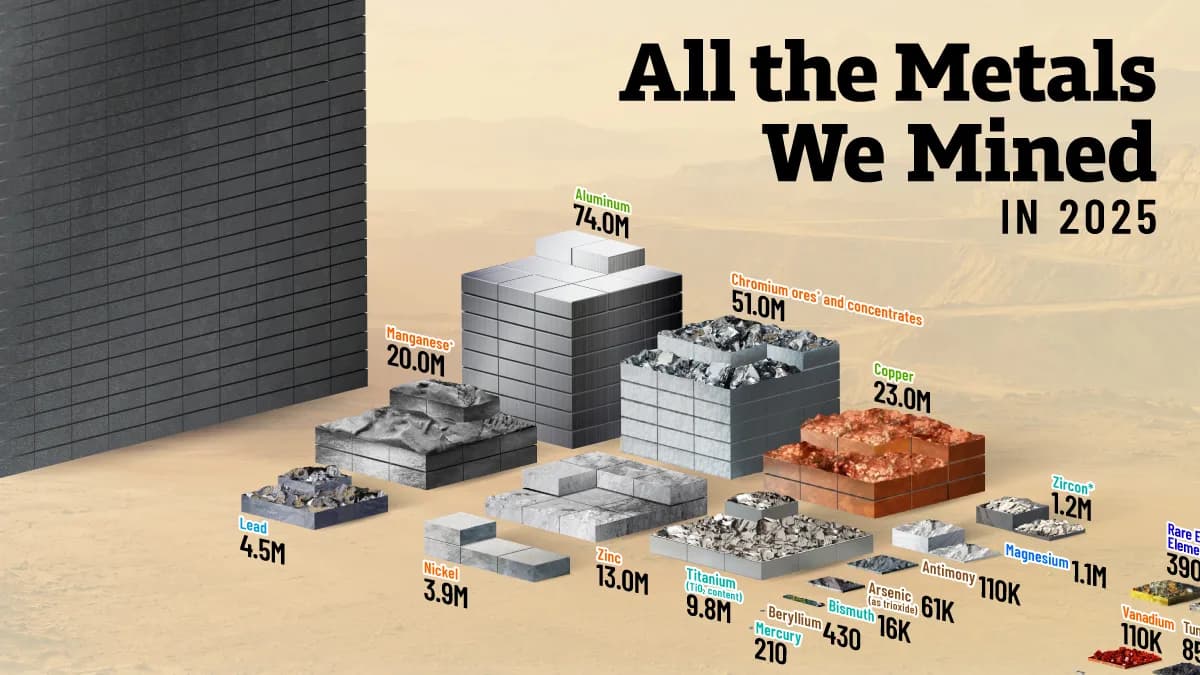
View the full-size infographic
How Much Metal Does the World Mine in a Year?
Key Takeaways
Iron ore accounts for approximately 93% of the combined weight of the commodities shown, reflecting the massive scale of steelmaking.
Global lithium production more than tripled between 2020 and 2025.
Rare earth production reached an estimated 390,000 tonnes of oxide equivalent in 2025, up approximately 39% from 2021.
From skyscrapers and bridges to electric vehicles and smartphones, modern economies depend on metals extracted from the ground. But the quantities produced each year vary enormously, from billions of tonnes of iron ore to just a few dozen tonnes of specialized metals.
This visualization compares estimated 2025 production across 35 metal-related commodities, revealing the vast quantities needed for global infrastructure alongside the much smaller volumes used in electronics, batteries, and other advanced technologies.
The data comes from the U.S. Geological Survey’s Mineral Commodity Summaries 2026, with figures converted to tonnes where necessary.
Together, the 35 commodities represent approximately 2.80 billion tonnes of reported production, although the figures reflect different stages of mining and processing.
Iron ore and chromite are measured by gross ore or concentrate weight, while copper, nickel, and lithium are reported by contained metal. Primary aluminum and magnesium reflect smelter output, so the figures are not directly equivalent measures of metal content.
Iron Ore Dominates Global Production by Weight
The clearest outlier is iron ore, with an estimated 2.6 billion tonnes produced in 2025. That’s more than 35 times the reported 74 million tonnes of primary aluminum output, the next-largest commodity in the visualization.
Much of this iron ore ultimately feeds steelmaking, which supplies beams, reinforcing bars, machinery, vehicles, railways, and the infrastructure of growing cities.
Industrial Metals Form the Backbone of Modern Infrastructure
Beyond iron ore, several familiar industrial materials account for the largest production volumes, including aluminum at 74 million tonnes, chromite ores and concentrates at 51 million tonnes, and copper at 23 million tonnes.
Industrial Metals2025 production (tonnes)
Aluminum74,000,000
Chromium ores and concentrates51,000,000
Copper23,000,000
Manganese20,000,000
Zinc13,000,000
Titanium9,800,000
Lead4,500,000
Nickel3,900,000
Zirconium mineral concentrates1,200,000
Magnesium1,100,000
Antimony110,000
Arsenic, as trioxide61,000
Bismuth16,000
Beryllium430
Mercury210
Total201,687,640 tonnes
Aluminum combines relatively low weight with corrosion resistance, making it useful for vehicles, packaging, buildings, and power transmission. Chromium is used to produce ferrochromium and stainless steel, where it helps form a protective surface layer that resists corrosion.
Manganese, at 20 million tonnes of contained metal, is another major steelmaking ingredient, while zinc, lead, and nickel support everything from galvanizing and batteries to specialized alloys.
Battery Metals and Rare Earths Are Growing Rapidly
Some of the most strategically important materials appear almost invisible next to iron ore, despite their growing importance to modern technology.
Lithium production reached an estimated 290,000 tonnes in 2025, compared with roughly 82,500 tonnes in 2020, amid rapid growth in demand for rechargeable batteries.
Tech and precious metals2025 production (tonnes)
Rare earths390,000
Cobalt310,000
Lithium290,000
Tin290,000
Molybdenum260,000
Niobium112,000
Vanadium110,000
Tungsten85,000
Silver26,000
Cadmium23,000
Selenium3,800
Gold3,300
Tantalum2,500
Indium1,100
Tellurium1,000
Gallium900
Palladium190
Platinum170
Rhenium81
Total1,909,041 tonnes
Rare earth production has also increased substantially, with magnet materials such as neodymium and praseodymium supporting electric motors, wind turbines, and other advanced technologies.
Cobalt, at 310,000 tonnes, plays an important role in certain battery chemistries, while metals such as gallium, indium, and tantalum serve specialized applications in semiconductors and other electronics.
Why Production Weight Doesn’t Tell the Whole Story
Gold illustrates the difference between production volume and economic importance.
The world mined about 3,300 tonnes of gold in 2025, compared with 26,000 tonnes of silver and 23 million tonnes of copper. Yet gold remains highly valuable because of its scarcity and use in jewelry, investment, and technology.
Platinum and palladium are produced on an even smaller scale, at roughly 170 and 190 tonnes, respectively. Both play important roles in applications such as catalytic converters and industrial processes, demonstrating why production volume alone doesn’t capture a material’s economic or strategic importance.
There are also limitations to the estimates. For some commodities, USGS figures exclude withheld U.S. production, including lithium and antimony. Reported selenium and tellurium output also does not cover every producing country.
Certain metals are produced as byproducts of other mining or refining operations, meaning their output cannot always be linked to a standalone mine.
Ultimately, the comparison highlights two distinct material needs of the global economy. Vast quantities of iron ore, aluminum, copper, and other industrial metals support physical infrastructure, while much smaller volumes of specialized metals enable many advanced technologies.
Learn More on the Voronoi App
If you enjoyed today’s post, check out this graphic showing which countries depend most heavily on China for rare earth metals.
Related articles