Mongolia’s parliament passes Minerals Law overhaul, doubling local royalty share and resetting copper royalties
On October 16, 2026, the State Great Khural adopted amendments to the Minerals Law that double the share of mineral royalties allocated to the Unified Local Development Fund and bring copper royalties in line with international practice. Nine of 11 accompanying bills passed; two environmental bills were sent back.
This story was prepared automatically by software.
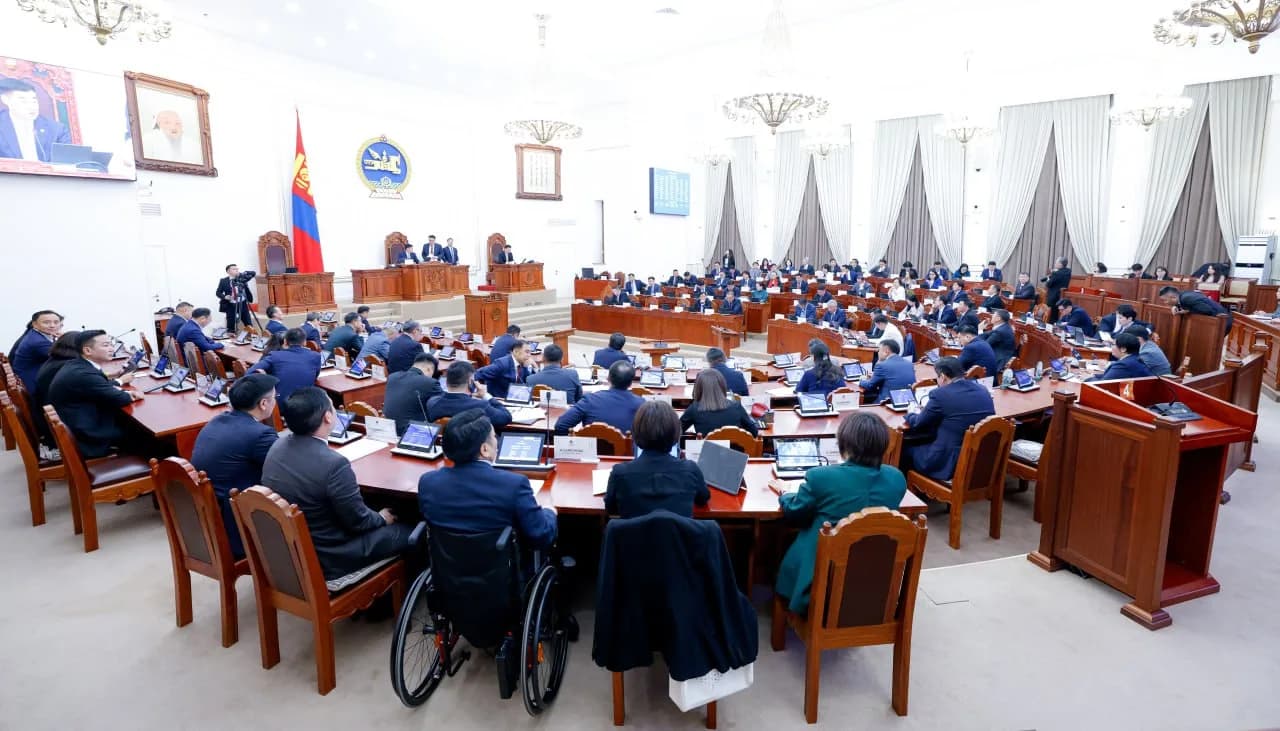
Mongolia’s State Great Khural on October 16, 2026, held the final reading of the bill amending the Minerals Law, together with the bills submitted alongside it, and adopted them. The two most notable changes double the share of mineral resource royalties (AMNAT) allocated to the Unified Local Development Fund and reset copper royalties in line with international practice.
Of the 11 accompanying bills submitted with the main bill to improve regulation of the sector, nine were supported and adopted, while two environmental protection bills were sent back.
The bill was initiated by the Government and submitted to parliament on May 26, 2026 (State Great Khural bill register).
Copper: room for higher output and royalty revenue
Copper royalty rates have been reset in line with international practice. As a result, the changes create the potential for:
- copper concentrate production to rise to as much as 3.3 million tonnes, an increase of up to 47%, and
- royalty assessments to rise to as much as MNT 2.25 trillion, an increase of up to 37%.
Twice the benefit for local communities
To increase the benefits local areas receive from mining, the law doubles the share of mineral royalties allocated to the Unified Local Development Fund. A policy of channelling more funding to affected areas will also be implemented.
Other key changes
Stepping up exploration to expand reserves. An improved legal framework for geological surveys, prospecting and exploration is expected to open the way for new deposits and occurrences to be discovered, increasing Mongolia’s mineral reserves and strengthening the foundation for the sector’s long-term development.
A legal basis for critical minerals policy. The amendments make it possible to pursue a policy aligned with national interests in identifying, using and processing reserves of strategically important critical and rare minerals, for which global demand is rising sharply.
Support for processing and added value. By backing a shift from extraction to processing, the law aims to ensure integrated use of mineral resources and increase the production and export of value-added products, creating conditions for many new jobs.
Tougher accountability for mine reclamation and closure. A new system will require the implementation of mine closure and reclamation work, and the build-up of its financing, to be reported in step with annual mining and processing reports. This is expected to improve closure preparedness, financial accountability and environmental rehabilitation.
Two bills sent back
Two of the accompanying bills, both related to environmental protection, were sent back:
- the bill amending the Law on Special Protected Areas;
- the bill amending the Law on Prohibiting Mineral Exploration and Mining in River Headwaters, Protected Zones of Water Reservoirs and Forested Areas (widely known as the “Long-Named Law”).
Cover photo: the State Great Khural’s plenary session on October 16, 2026. Photo: parliament.mn
Source: Mongolian Mining Journal
Related articles