Cheap cobalt catalyst forms protective layer while producing hydrogen from water
Researchers at Tohoku University say a low-cost catalyst called cobalt phosphide (CoP) reshapes its own...
Researchers at Tohoku University say a low-cost catalyst called cobalt phosphide (CoP) reshapes its own surface while it makes hydrogen from water, and that the change appears to shield it from damage. The study, published Oct. 29 in the Journal of the American Chemical Society, has Hao Li of the university’s Advanced Institute for Materials Research as senior author. Zhongyuan Guo is listed first among the 12 authors.
A catalyst is a material that speeds up a chemical reaction without being used up. Water splitting, which makes hydrogen and oxygen from water with electricity, needs one for its hydrogen-producing half. The university describes CoP as a promising, lower-cost alternative to platinum for producing hydrogen from water.
Computer models had predicted CoP would be unstable under hydrogen-production conditions. Lab experiments showed it stays active and durable in acidic, neutral and alkaline water, the university said.
How the surface protects the catalyst
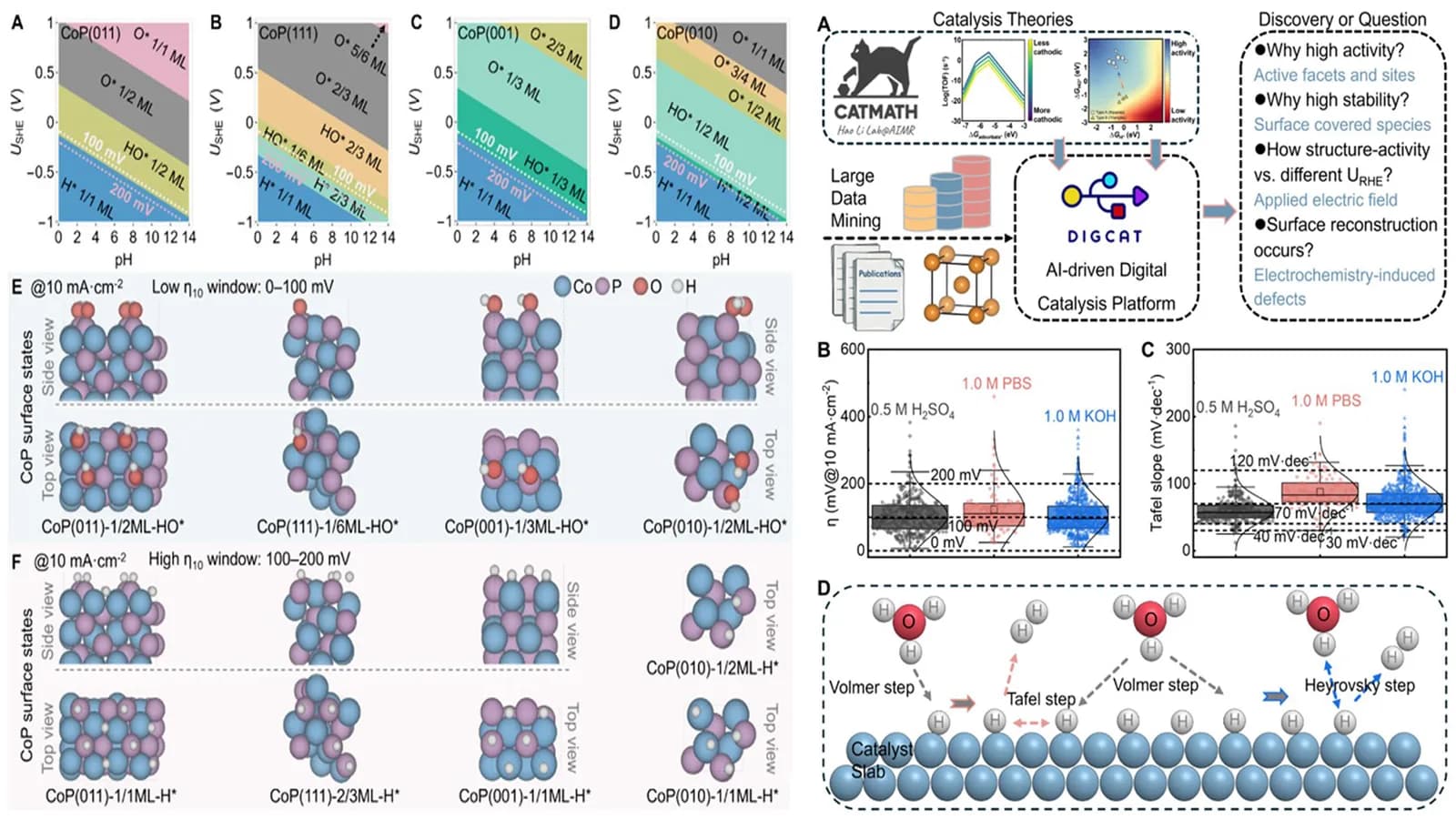
The study proposes that the CoP surface shifts with the voltage applied during electrolysis, according to Tohoku’s release. At lower voltages, hydroxyl groups (P-OH, linked oxygen and hydrogen atoms) form on phosphorus sites and help nearby cobalt atoms activate water and bind hydrogen.
At higher voltages, the surface fills with hydrogen-containing species (Co-H and P-H) on both cobalt and phosphorus. The team says this helps balance how strongly hydrogen binds and releases across a wide range of pH, a measure of acidity. The paper’s title calls this operando surface dynamics, meaning the surface changes while the catalyst is working, not before it.
Those surface species also appear to form a protective layer. According to the release, the layer limits oxidation and stops cobalt and phosphorus from dissolving. This helps explain, the team says, why CoP survives conditions that models predicted would break it down. Tohoku researchers described a separate surface reconstruction strategy for low-cost hydrogen cathodes in 2025.
Data mining and lab tests
The team analyzed 2,282 observations from about 886 CoP-based catalysts reported in roughly 700 publications, using AI-assisted data mining, computer simulations and lab experiments. It then tested its predictions on CoP nanosheets, ultrathin sheets of the material.
Spectroscopy confirmed the predicted surface species, and experiments with deuterium, a heavy form of hydrogen, supported hydrogen bonding to phosphorus. The catalyst performed strongly at all three pH levels and needed relatively little extra voltage, though the release gives no figure. It stayed stable for 24 hours at current densities above 1 ampere per square centimeter (about 6.5 amperes per square inch).
The results are early. The release describes the mechanism as a proposal, reports only a 24-hour test, and gives no voltage figure, cost data or funding source. It does not say how CoP performs in longer runs. A separate cobalt oxide catalyst built without precious metals ran for more than 100 hours at high current.
The authors suggest the findings could help develop cheaper, more versatile catalysts for green hydrogen, which is made with renewable electricity, and that designers should consider how surfaces change under real operating conditions.
Source: https://interestingengineering.com/science/cobalt-phosphide-catalyst-self-protecting-hydrogen
Get the latest news delivered to your inbox.
Related articles