China-made solar EV system packs 1,600W input and 2.5kWh battery for off-grid use
Chinese firm Gaotu Innovation has developed a portable, fold-out solar solution for electric-vehicle drivers, designed...
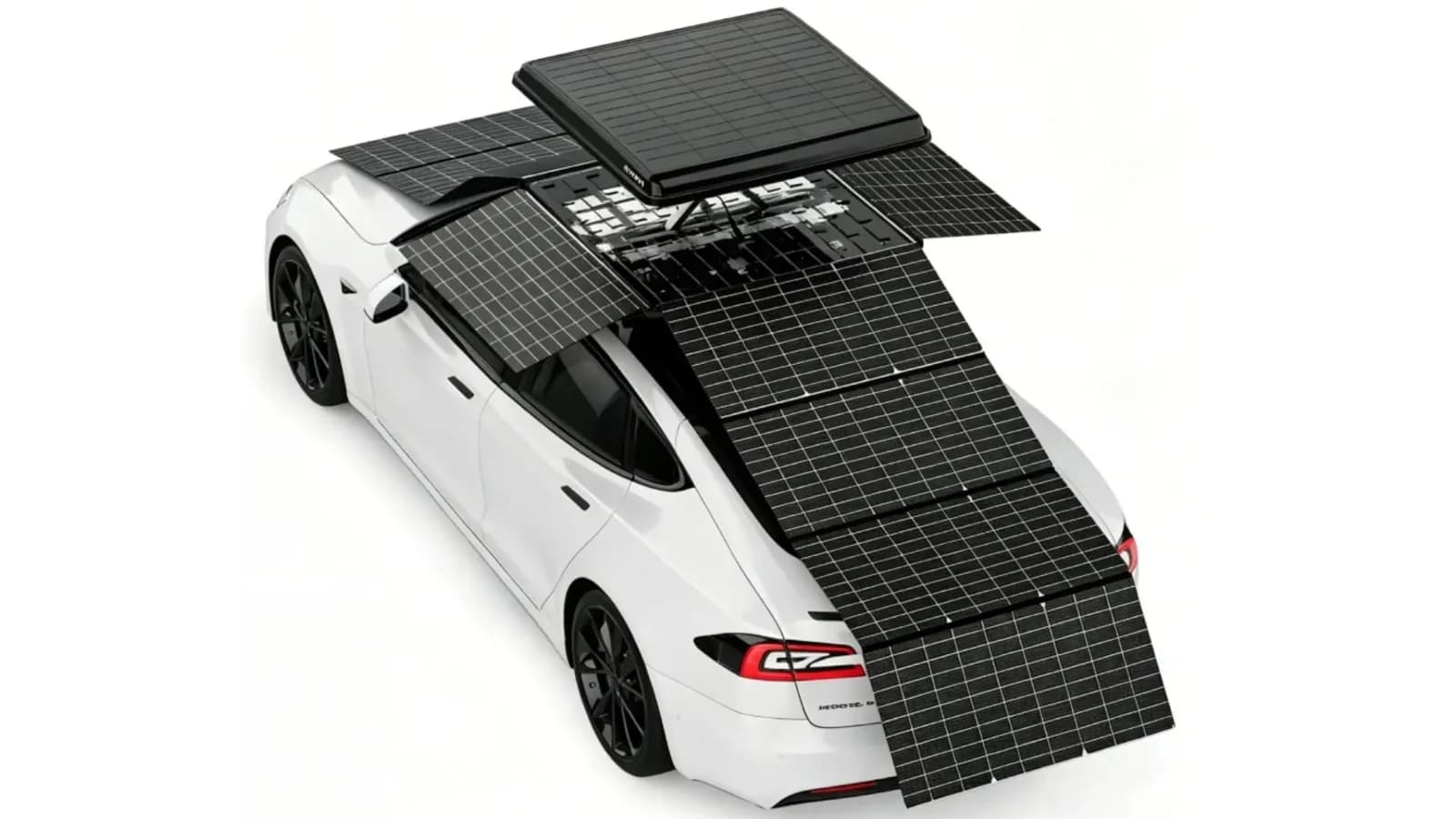
Chinese firm Gaotu Innovation has developed a portable, fold-out solar solution for electric-vehicle drivers, designed to be fitted to a car and used outside Australia’s existing charging infrastructure. The company claims it can harness solar energy, then store and use that electricity independently of any connection to the national grid.
The solution includes folding solar panels and an internal 2.5kWh lithium iron phosphate (LiFePO4) battery, and it can achieve a maximum solar power intake of 1,600W. Gaotu claims that, depending on factors including solar availability, panel orientation and vehicle power requirements, this can provide enough electricity to cover a distance of up to 50 miles (80km) per day.
The battery is not part of a vehicle’s primary traction battery, it is used to store the solar energy harvested by the panels. An internal charger then uses power electronics to distribute this power. While a car is stationary, the panels can be unfurled so they continue absorbing solar energy and recharging the system.
Gaotu is promoting the system to Australian drivers, for example those who wish to drive in more outback areas, stay at more secluded sites and/or frequently drive where public charging stations are not easily accessible.
Fold-out solar panels and 2.5kwh battery enable off-grid EV charging
The GT-EV16-PB-FD contains two maximum power point tracking (MPPT) controllers. Each can accept a solar power input of 800W, giving a total maximum of 1,600W. Gaotu claims the MPPT controllers are 99.9% efficient and the solar cells are 25% efficient.
Once harvested, solar electricity is sent to the internal 2.5kWh battery, which distributes it to a vehicle and also helps stabilize the solar supply. Alternating current (AC) power is distributed via the charger.
Owners can use a smartphone app, along with Bluetooth and Wi-Fi connectivity to the device, to view and control the charging process, removing the need to interact with the device directly.
The fold-out solar panels are housed in a case with an IP68 sealing standard. Alongside its streamlined shape, Gaotu says the device is robust and able to endure winds of up to around 100mph (160km/h). It is suitable for temperatures between -4°F and 131°F.
Built-in emergency backup power with 10ms response time
In addition to charging, the device can also serve as an off-grid uninterruptible power supply (UPS). Should there be an outage in a vehicle’s primary power source; it can supply secondary power to devices.
Gaotu claims it can begin distributing secondary power just 10 milliseconds after a primary power source is cut off. This may benefit those staying in isolated areas or places without easy access to steady power.
Gaotu states that the power supplied by the system falls by around 1% in the first year and then by a maximum of 0.4% in following years. These are manufacturer’sindicative figures.
Gaotu provides a five-year craftsmanship warranty and a two-year power performance warranty. It also intends to export fully assembled systems to Australian local distributors. Original equipment manufacturer (OEM) and original design manufacturer (ODM) adaptations can be requested by commercial partners. As noted, this approximate 50-mile per day figure depends on solar availability, installation and the vehicle’s power requirements.
Source: https://interestingengineering.com/energy/solar-ev-charger-battery-solar-power
Get the latest news delivered to your inbox.
Related articles