
China’s HALF fires first electron beam with 2.2 billion eV of energy
The Hefei Advanced Light Facility (HALF) in China has fired its first electron beam, which...
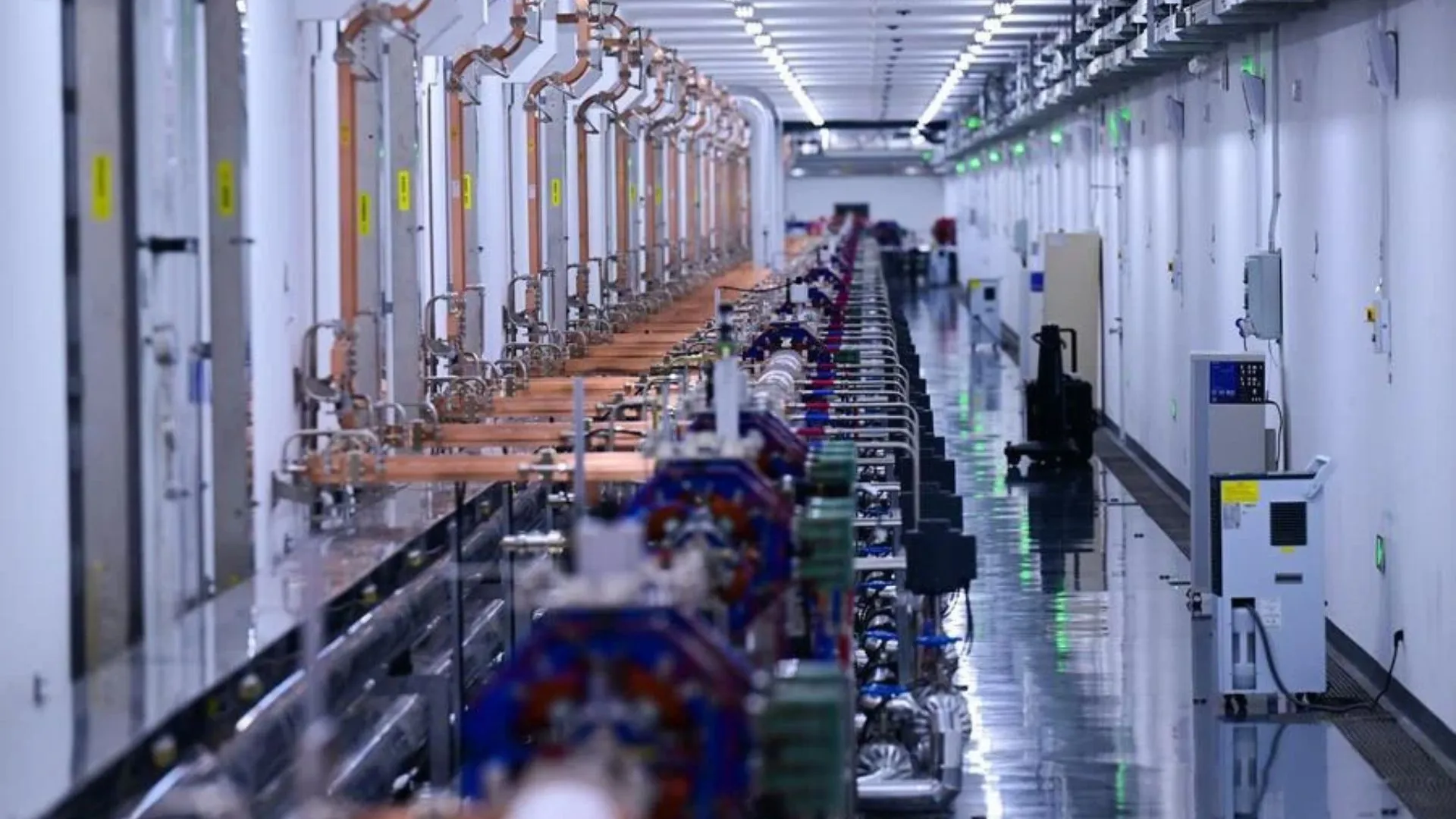
The Hefei Advanced Light Facility (HALF) in China has fired its first electron beam, which reached energy levels of 2.2 billion electron volts (eV), marking a major step toward China’s ambitious goal of building a fourth-generation light source. This opens up a myriad of research avenues from chip manufacturing to Alzheimer’s disease.
A synchrotron light source is electromagnetic radiation produced using particle accelerators or storage rings. Once a high-energy beam of light is produced, it can be bent using magnets and used to probe matter or living cells at sub-nanometer scales, making them quite effective as super microscopes.
Although generating light in this way is expensive, it is a highly reliable way to generate wideband radiation in the far-infrared wavelength range. These devices were first built for high-energy particle physics but later modified to serve as light sources. It was only in the third generation of these devices that low emittance was prioritized to generate highly focused and small beams of light.
Fourth generation light source
China built its first light source at Hefei in 1989 and deployed it for research for finding the structure of the Sars virus, for imaging a dinosaur inside 99-million-year-old amber and how arsenic could treat leukemia.
The Asian giant also boasts of the High Energy Photon Source in Beijing and Shanghai Synchrotron Radiation Facility and began construction of the Hefei Advanced Light Facility (HALF) in Anhui province in 2023. The project is expected to be completed by 2028 and together with the other two light sources, will help China cover high, medium and low-energy ranges for advanced light systems.
HALF is a fourth-generation light source and is designed to use extremely bright X-rays. These rays are generated by turning high-speed electrons in magnetic fields.
Fourth-generation light sources are better than third-generation sources such as the Advanced Photon Source at Argonne National Laboratory or the Advanced Light Source at Lawrence Berkeley National Laboratory since they produce finer beams that are more concentrated and generate brighter X-rays.
Light at HALF
HALF uses a 630-foot (192 m) long linear accelerator to accelerate electrons. In their recent run, the team achieved an energy of 2.2 billion eV, marking a major milestone for the project. X-rays produced at HALF are expected to be 100 times brighter and also more coherent than its predecessor and are claimed to be the brightest and most stable in the world.
The facility also features 35 experimental stations that will be deployed for research in high-temperature superconductivity, new energy batteries, materials as well as life sciences research.
The first batch of these stations will also feature a platform for extreme ultraviolet lithography, a technology key for making advanced semiconductors. This is currently part of the US’ strict export controls and will open doors for China to work with this technology.
“Producing a beam successfully means we’ve taken a key step towards our final goal,” said He Zhigang, a scientist working on the project, told state news agency Xinhua.
Source: https://interestingengineering.com/innovation/china-fires-first-electron-beam-2-billion-ev-energy
Related articles

Mapped: The Best Employer in Every U.S. State
Microsoft and Google dominate America’s best employers, but the company that ranks first varies widely from state to state.

SpaceX preps next-gen Starlink as Amazon’s competitor stalls
SpaceX is gearing up for a monumental flight today that's sure to be closely watched by Amazon.

Philips’ motion-tracking smart toothbrush uses AI to make you a better brusher
First announced in July with an expected limited launch later this year, the Philips Sonicare Next-Generation DiamondClean 9900 Prestige smart toothbrush is now available in Europe and the US, with a…

Nvidia says its new AI safety platform can contain rogue agents within ‘milliseconds’
Nvidia is launching a new safety platform designed to contain and monitor AI agents, a move that comes in response to a wave of rogue hacking incidents, as reported earlier by Reuters.
Scientists operate quantum computer in space for first time after launch challenges
Scientists at the University of Vienna have achieved a global first after operating a quantum...

US Air Force tests F-22 with stealthy sensor pods in aggressive flight near Edwards
The U.S. Air Force appears to be expanding flight testing of passive-sensing equipment for the...