
US Air Force tests F-22 with stealthy sensor pods in aggressive flight near Edwards
The U.S. Air Force appears to be expanding flight testing of passive-sensing equipment for the...
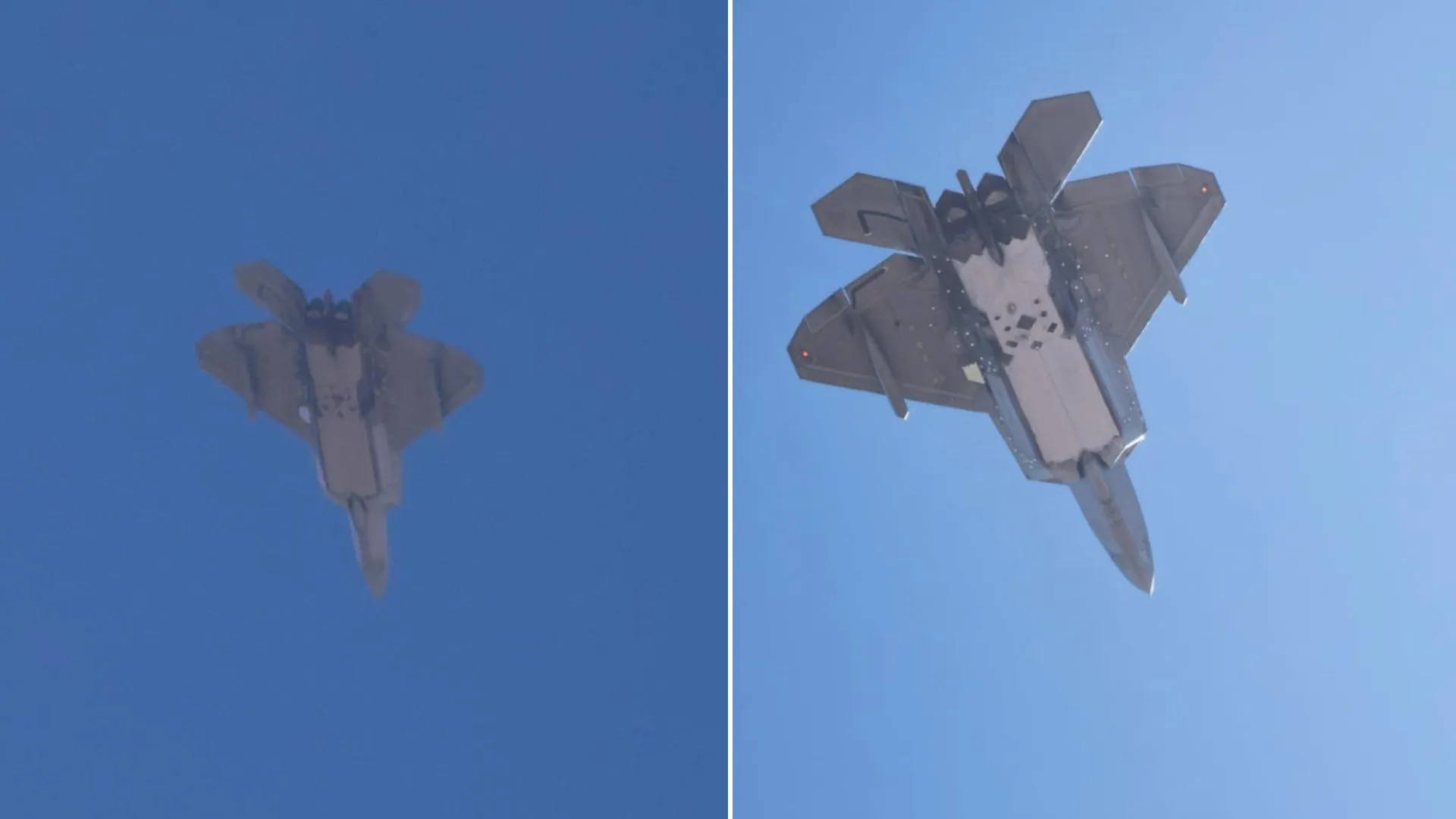
The U.S. Air Force appears to be expanding flight testing of passive-sensing equipment for the F-22A Raptor after a fighter carrying low-observable underwing pods was photographed during aggressive maneuvers near Edwards Air Force Base on September 25, 2026. Mojave Planespotting images show the Raptor flying with the pods seen days earlier.
The activity suggests testing has moved beyond basic carriage. The Air Force could be examining whether infrared or electro-optical sensors remain effective during demanding maneuvers. Such systems could help the F-22 detect and track threats without continuously using radar.
F-22 expands its flight-test envelope
The September 25 imagery followed photographs released on September 19 showing an F-22 using the callsign FEVER21 over California’s Aerospace Valley. The aircraft carried two angular pods beneath its outer wings. One appeared to feature a transparent aperture consistent with an infrared or electro-optical sensor.
The Air Force has not disclosed their functions.
Aggressive maneuvering exposes external equipment to aerodynamic loads, vibration, and changing airflow. Testing could examine sensor stability and performance as the aircraft rapidly changes attitude.
F-22 with stealth IRST pods does aggressive maneuvers over Edwards AFB. pic.twitter.com/UzhYXHw4WV
— Mojave Planespotting (@MojaveSpotter) September 25, 2026
Passive detection adds new options
An infrared search-and-track capability could give the F-22 another method for detecting airborne targets while limiting radar emissions. Infrared sensors detect thermal signatures and provide information based on a different physical phenomenon from radar.
That could be valuable against aircraft designed to reduce their radar signatures. IRST systems can be affected by atmospheric conditions and background clutter.
Combining infrared information with radar, electronic-support systems and offboard targeting data could give pilots a battlespace picture. It also fits the Air Force’s push toward networked, emission-controlled air combat.
Sensor program reaches key stage
The testing aligns with the F-22 Sensor Enhancements program. The Government Accountability Office said an earlier effort conducted six sensor-enhancement flight demonstrations in 2024 before the follow-on program was established.
In July 2026, GAO reported that the first F-22 flight test using sensor-enhancement hardware had slipped from March to May after a subcomponent failure delayed deliveries. The setback reduced testing time before the planned September 2026 completion of the program’s Middle Tier of Acquisition phase.
The Air Force also procured hardware in advance for 30 sensor-enhancement sets.
Raptor modernization meets F-47 era
Earlier 2026 imagery showed an F-22 carrying stealth-shaped external fuel tanks and faceted mission pods, suggesting work on range and passive sensing.
The latest testing comes as the Air Force develops the F-47 under its Next Generation Air Dominance program. Boeing was selected for the F-47 Engineering and Manufacturing Development contract in 2025.
There is no public evidence that the F-22 pods directly test F-47 hardware. The Raptor can provide a platform for developing passive detection and sensor fusion techniques.
The sightings do not establish what the pods contain, but the September 25 maneuvering indicates increasingly demanding flight testing.
Source: https://interestingengineering.com/military/f-22-spotted-with-stealthy-sensor-pods
Related articles

Mapped: The Best Employer in Every U.S. State
Microsoft and Google dominate America’s best employers, but the company that ranks first varies widely from state to state.

SpaceX preps next-gen Starlink as Amazon’s competitor stalls
SpaceX is gearing up for a monumental flight today that's sure to be closely watched by Amazon.

Philips’ motion-tracking smart toothbrush uses AI to make you a better brusher
First announced in July with an expected limited launch later this year, the Philips Sonicare Next-Generation DiamondClean 9900 Prestige smart toothbrush is now available in Europe and the US, with a…

Nvidia says its new AI safety platform can contain rogue agents within ‘milliseconds’
Nvidia is launching a new safety platform designed to contain and monitor AI agents, a move that comes in response to a wave of rogue hacking incidents, as reported earlier by Reuters.
Scientists operate quantum computer in space for first time after launch challenges
Scientists at the University of Vienna have achieved a global first after operating a quantum...

China’s HALF fires first electron beam with 2.2 billion eV of energy
The Hefei Advanced Light Facility (HALF) in China has fired its first electron beam, which...