
100x-brighter fourth-gen X-rays: China fires first 2.2-GeV electron beam at HALF
China has achieved a landmark milestone in the construction of its most advanced scientific instrument...
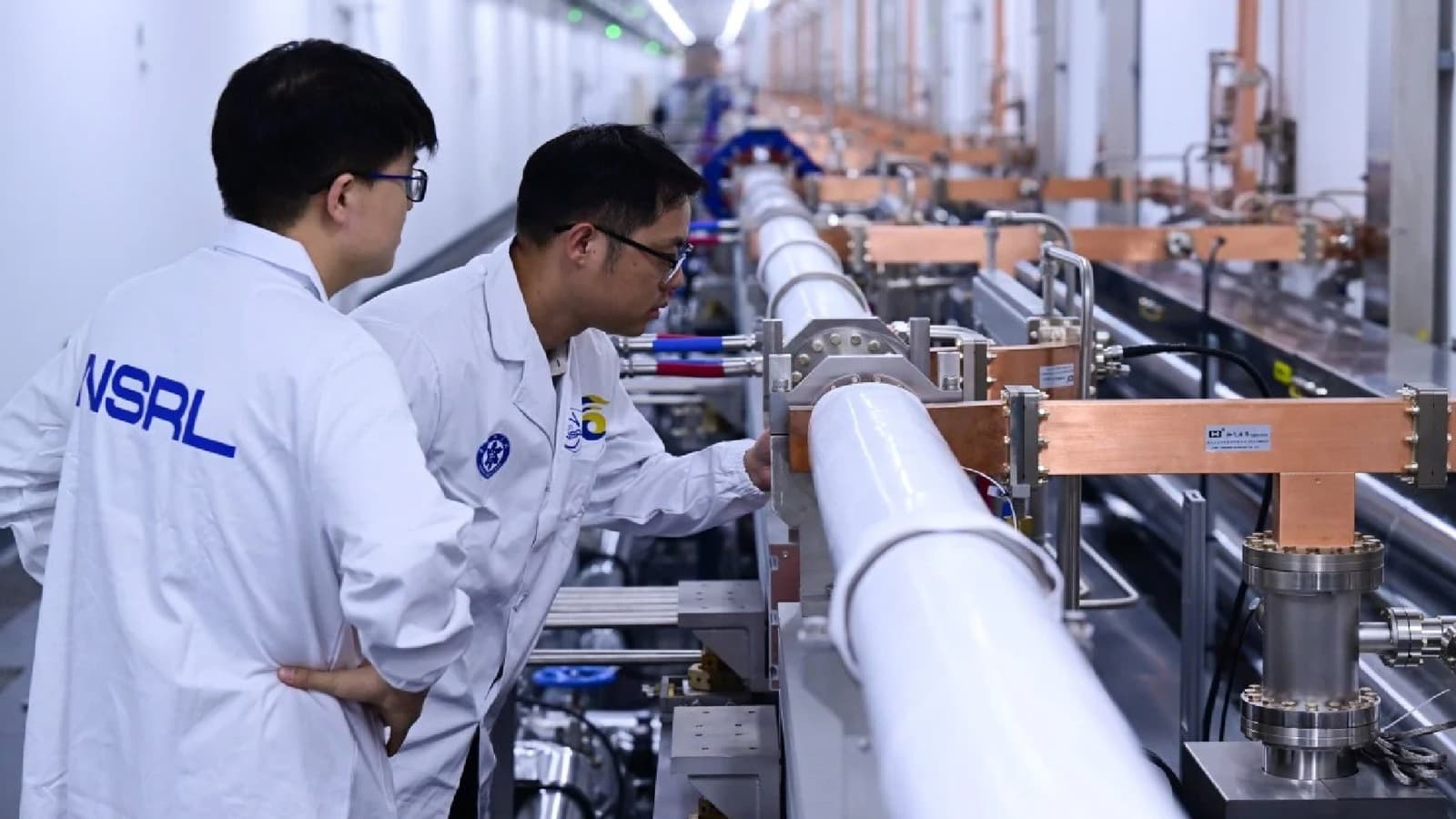
China has achieved a landmark milestone in the construction of its most advanced scientific instrument yet: the Hefei Advanced Light Facility fired its first electron beam, accelerating electrons to 2.2 billion electron volts through a 192-meter linear accelerator and opening the path to a new generation of X-ray science.
The achievement was announced by the University of Science and Technology of China, which oversees the project. HALF is a fourth-generation synchrotron light source — a class of facility that generates extraordinarily bright X-rays by steering high-speed electrons through magnetic fields, producing radiation powerful enough to image matter at the atomic scale. When complete, it will rank among the most capable scientific instruments on Earth.
Why generations matter
Each successive generation of synchrotron light source controls the electron beam more precisely than its predecessor. The beam becomes finer, more concentrated, and the resulting X-rays correspondingly brighter and more coherent. HALF’s X-rays will be more than 100 times brighter and more coherent than those from third-generation sources — a margin that is not incremental.
It opens experimental techniques that simply cannot be done at lower brightness levels, including imaging dynamics inside materials at atomic resolution and mapping structures too fragile or complex for earlier instruments to resolve.
According to the University of Science and Technology of China, HALF’s designed brightness and stability are the highest in the world. Feng Donglai, the project’s chief and an academician of the Chinese Academy of Sciences, confirmed that all key equipment for the linear accelerator was built domestically.
“Producing a beam successfully means we’ve taken a key step towards our final goal,” said He Zhigang, one of the scientists on the project. “The beam’s quality, stability and reliability have a major impact on the experiments conducted with HALF.”
What it will be used for
The facility will eventually host up to 35 experimental stations, open to scientists worldwide. The first batch of 10 stations covers a deliberately broad range of applications: high-temperature superconductivity research, new energy batteries, advanced materials, life sciences including Alzheimer’s disease research, and — critically — a platform for extreme ultraviolet lithography, a key process for manufacturing advanced semiconductors that is currently subject to strict US-led export controls.
Other stations in the first batch will focus on nano-devices. The inclusion of an EUV lithography research station is a direct signal that HALF is not purely a fundamental science instrument — it is also infrastructure for China’s semiconductor independence agenda.
China’s light source network takes shape
Construction of HALF began in 2023 and the full facility is expected to be completed by 2028, with a 480-meter circumference storage ring designed to operate at 350 milliamperes beam current. Once operational, it will join China’s High Energy Photon Source in Beijing and the Shanghai Synchrotron Radiation Facility to form a three-node national light source system covering high-, medium-, and low-energy X-ray ranges — a distributed scientific infrastructure with no equivalent in the West.
The HALF milestone also continues a story that began in 1989, when China built its first dedicated light source — the original Hefei Light Source — after overcoming formidable technical challenges.
That third-generation infrastructure went on to produce results that include discovering the molecular mechanism by which arsenic treats leukaemia, revealing the 3D structure of the SARS virus, and imaging a dinosaur fossil preserved inside 99-million-year-old amber. Its successor is now aiming considerably higher.
Related articles

3-foot claws, tons of teeth: ‘Anatomically bizarre’ giant dinosaur found by scientists
Paleontologists in China have described a newly identified dinosaur so unusual that researchers called it...

Scientists discover way to guide bouncing light, sound waves in complex spaces
Scientists found a way to stop light and sound waves from scattering chaotically inside complex,...
Cocaine plays with mind, hijacks brain circuit, drives increasingly rigid and repetitive behavior
Researchers have found that a hijacks brain circuit, which to drive increasingly rigid and repetitive...
Two labs independently measure quarter-electron charge in a rare quantum state
An electron cannot be split into smaller charged pieces. Yet under extreme conditions, electrons can...
Quantum simulator captures a strange process that can break quark strings
A quantum simulator has given physicists a new look at one of the strangest processes...
10x stronger super ice created, rivals concrete in strength, absorbs 70x more energy before breaking
Scientists have developed a new type of ice piece, which is about 10 times stronger...