Chinese startups collect human movements to train robots for real-world jobs
Artificial intelligence (AI) engineers in China are training robots with data captured by human workers...
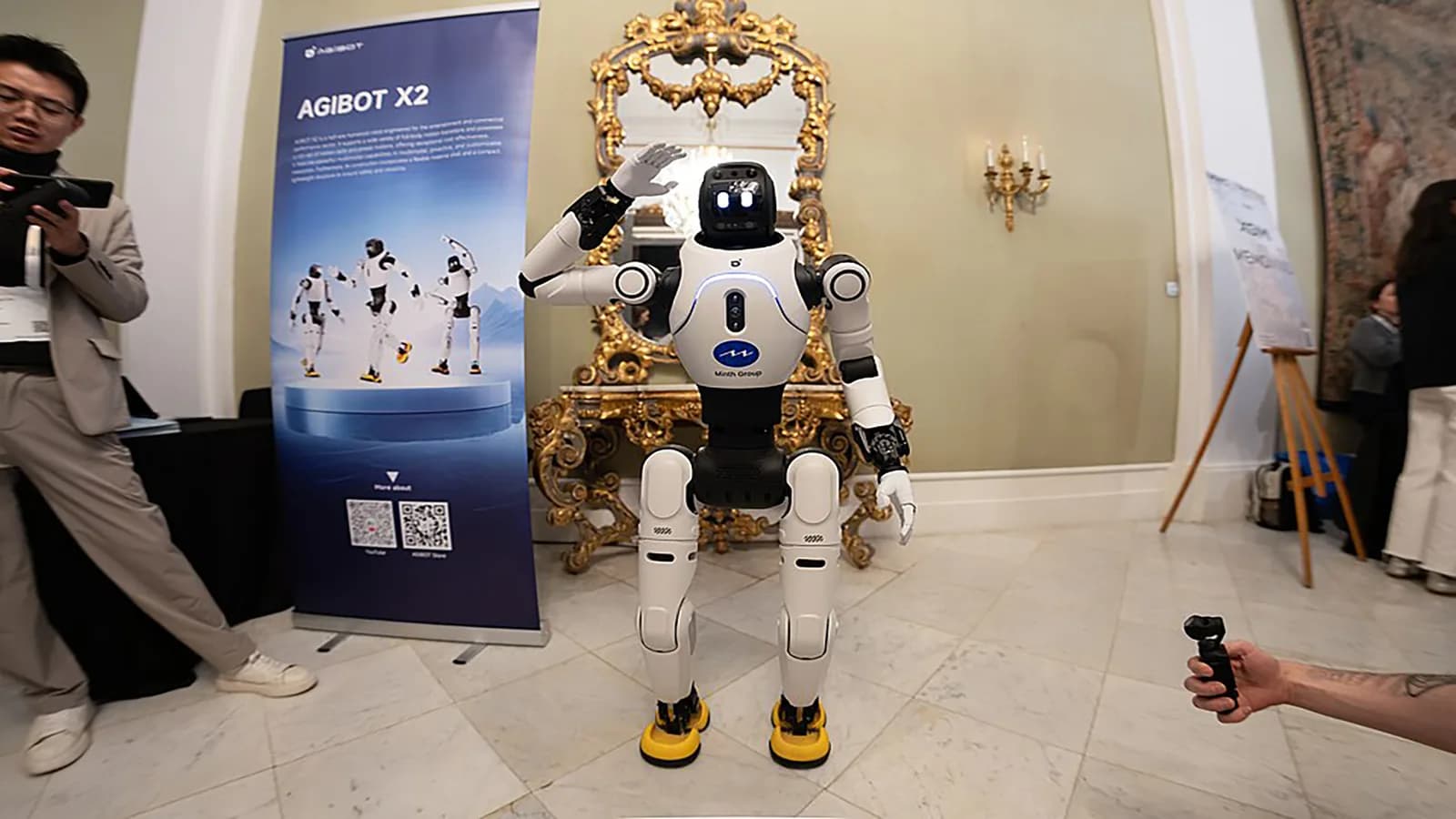
Artificial intelligence (AI) engineers in China are training robots with data captured by human workers wearing headcams, AFP reported. China’s robots are known for slick dance moves, but the goal now is a place in the workforce, as world leaders head to Shenzhen for the Asia-Pacific Economic Cooperation (APEC) summit.
At a park refreshment stand in Shenzhen, a humanoid robot grabs a cup, pulls a lever to form an ice cream spiral and hands over the order. A second humanoid makes coffee. The treats sell for around $4 each. A human must refill the beans and empty the grounds, but an AI model drives the robots’ movements, according to their maker, AI² Robotics.
AI² Robotics said 200 of its humanoid servers are deployed in China and up to 300 coffees sell each day at the park, the AFP dispatch said. The company has also unveiled a modular service space for its AlphaBot 2 humanoid.
Recordings of human work as training data
In a supermarket in Dongguan, near Shenzhen, 23-year-old Wang Lin stocked shelves wearing sensor gloves and a helmet fitted with a camera. Strange Attractor recorded and processed her movements. The startup is one of many in China that resell recordings like hers to companies building AI models that act as a robot’s brain.
Wang said robots can replace humans in “relatively dangerous and repetitive work,” such as in factories or at heights. Cobblers, hairdressers, florists, factory workers and cleaners are also recording their skills with similar equipment, in exchange for payment. Strange Attractor said it collects data in around 1,600 places in China and 1,000 abroad. Its founder, Kang Yu, called today’s robots “like babies.” A separate Shenzhen startup, MindOn, says it trains one model on human motion data from body trackers and first-person cameras instead of robot teleoperation.
Industrial spending in China on robots using embodied AI, which lets them perceive their surroundings and act accordingly, rose 230 percent year over year in January to May 2026, tax authorities said.
Supply chains and the limits of simple tasks
Dermot McGrath of advisory firm ZenGen Labs said Shenzhen, home to 18 million people, lets developers test a part and deploy it “faster than almost anywhere.” At a Shenzhen logistics center, two robotic arms from local startup X Square Robot handle parcels of different shapes and flip them so labels face up. At battery giant Contemporary Amperex Technology (CATL), Spirit AI humanoids already plug in high-voltage connectors.
Robots still struggle on their own with complex tasks like cleaning or ironing, the report said. Arnold Pei, X Square’s vice president, said robots find homes harder, where lighting, floors and objects vary. AI specialist Pavlo Zvenyhorodskyi of the Carnegie Endowment for International Peace said robots are mostly “confined to well-defined and repetitive” tasks. The report gives no figures on how much headcam data improves robot skills, or whether the coffee robots learned from it.
Kang foresees large-scale deployment of AI-powered robots in China next year, though he said they won’t be very intelligent at first.
Get the latest news delivered to your inbox.
Related articles