Ferroelectric memory capacitor switches at 0.6 volts and survives 1 trillion cycles
A team led by Seoul National University has built a ferroelectric memory capacitor that switches...
A team led by Seoul National University has built a ferroelectric memory capacitor that switches at 0.6 volts and showed no hard electrical breakdown, or permanent failure, after 1 trillion cycles, according to a paper in Nature Communications and a university release.
Dynamic random-access memory (DRAM), found in smartphones and AI servers, stores bits as electrical charge in tiny capacitors. The charge leaks, so it must be topped up regularly, which costs power. Ferroelectric memory instead stores bits in polarization, the electrical orientation of a material, which persists without power and may cut that refresh cost.
The material, hafnium zirconium oxide (HZO), combines two oxides already used in chip manufacturing, the release said. The hurdle is that making the material switch faster usually takes a higher voltage, and higher voltages shorten its life, according to the release. The team says its its design for the electrodes, the metal layers that sandwich the material, improves speed and lifespan together.
Reworking the electrode interface
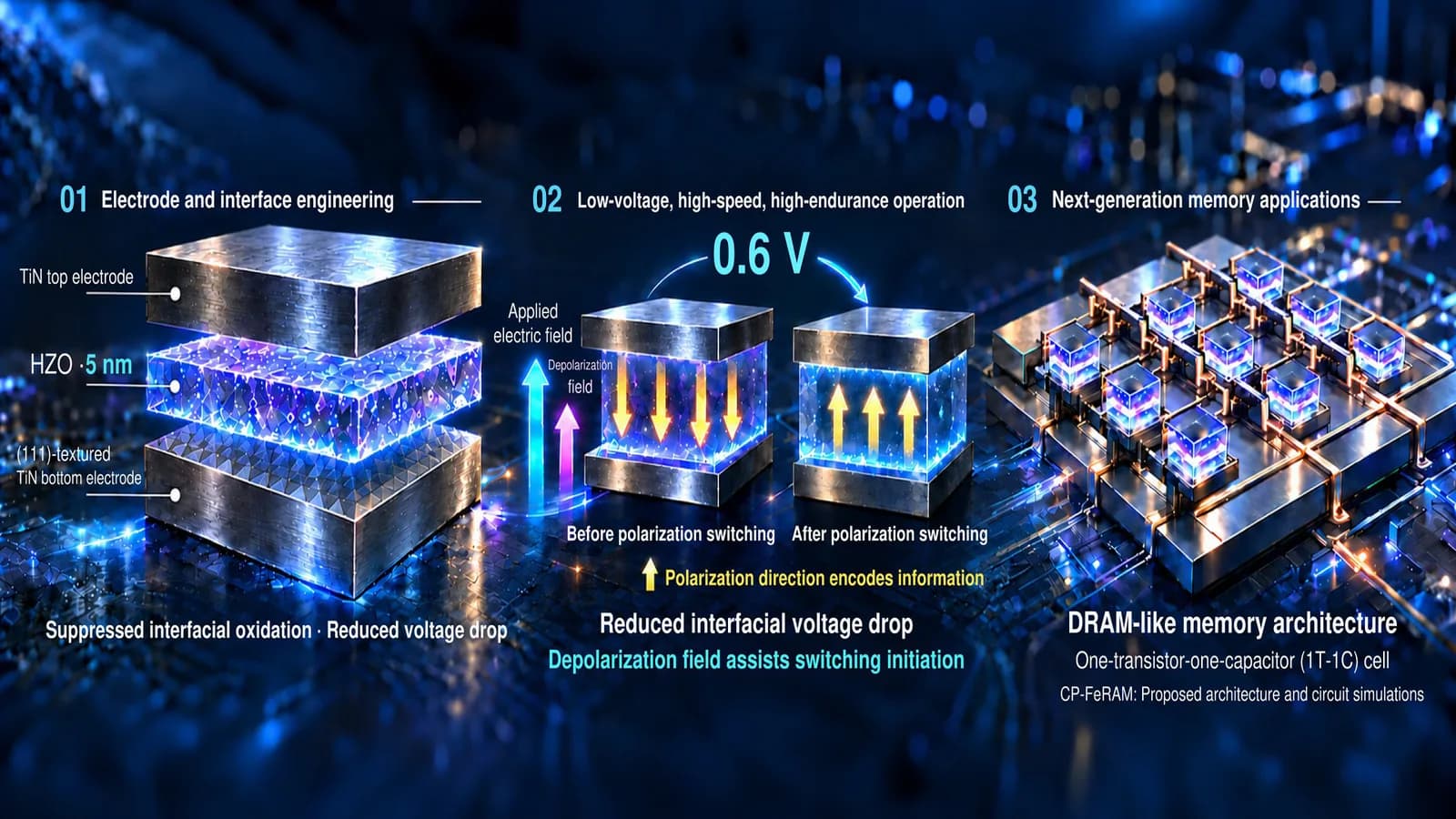
The researchers changed the interface between the electrode and a 5-nanometer HZO film. They controlled the crystal orientation and surface of titanium nitride electrodes and suppressed oxidation at the boundary, which the release said reduces voltage loss and lets the film switch uniformly. They also report that an internal field, normally a drawback because it can weaken stored polarization, helps switching start at lower voltage.
In tests reported in Nature Communications, the capacitor switched at 0.6 volts. Half the polarization flipped in about 42 nanoseconds at 0.6 volts and 8 nanoseconds at 1 volt, according to the release. A nanosecond is one billionth of a second. No hard electrical breakdown appeared after 1 trillion cycles at either voltage. Using a criterion of less than 20% polarization loss, the device endured 600 billion cycles at 0.6 volts and 1 trillion at 1 volt, the release said.
Projected speed and open questions
The measured speeds are well above a nanosecond. The researchers found switching tended to get faster as device area shrank, and the paper projects sub-nanosecond reversal at capacitor sizes relevant to DRAM. That figure is extrapolated from measurements, not measured directly.
The team also proposed a memory design called common-plate ferroelectric memory, built like a DRAM cell with one transistor and one capacitor. Circuit simulations based on measured polarization suggested a stored bit could stay readable even after charge dropped. A test array of capacitors sharing one electrode showed uniform behavior, with no significant polarization loss after neighboring devices were cycled, the release said.
A couple of points are unproven. Circuit results come from simulations and an array test, not a finished memory chip. Samsung Electronics researchers are coauthors and the company partly funded the work, according to the paper.
The researchers expect the design could work in dense DRAM-class memory and in low-power embedded memory built alongside computing circuits. Geun Hyeong Park, the paper’s first author, plans to keep developing low-power memory devices, according to the release. The study appeared Oct. 29 in Nature Communications.
Get the latest news delivered to your inbox.
Related articles