First home-built hydrogen train with 435-mile range set to enter service in Russia
Russia is shifting to cleaner alternatives for its rail system that currently relies on polluting...
Russia is shifting to cleaner alternatives for its rail system that currently relies on polluting diesel engines.
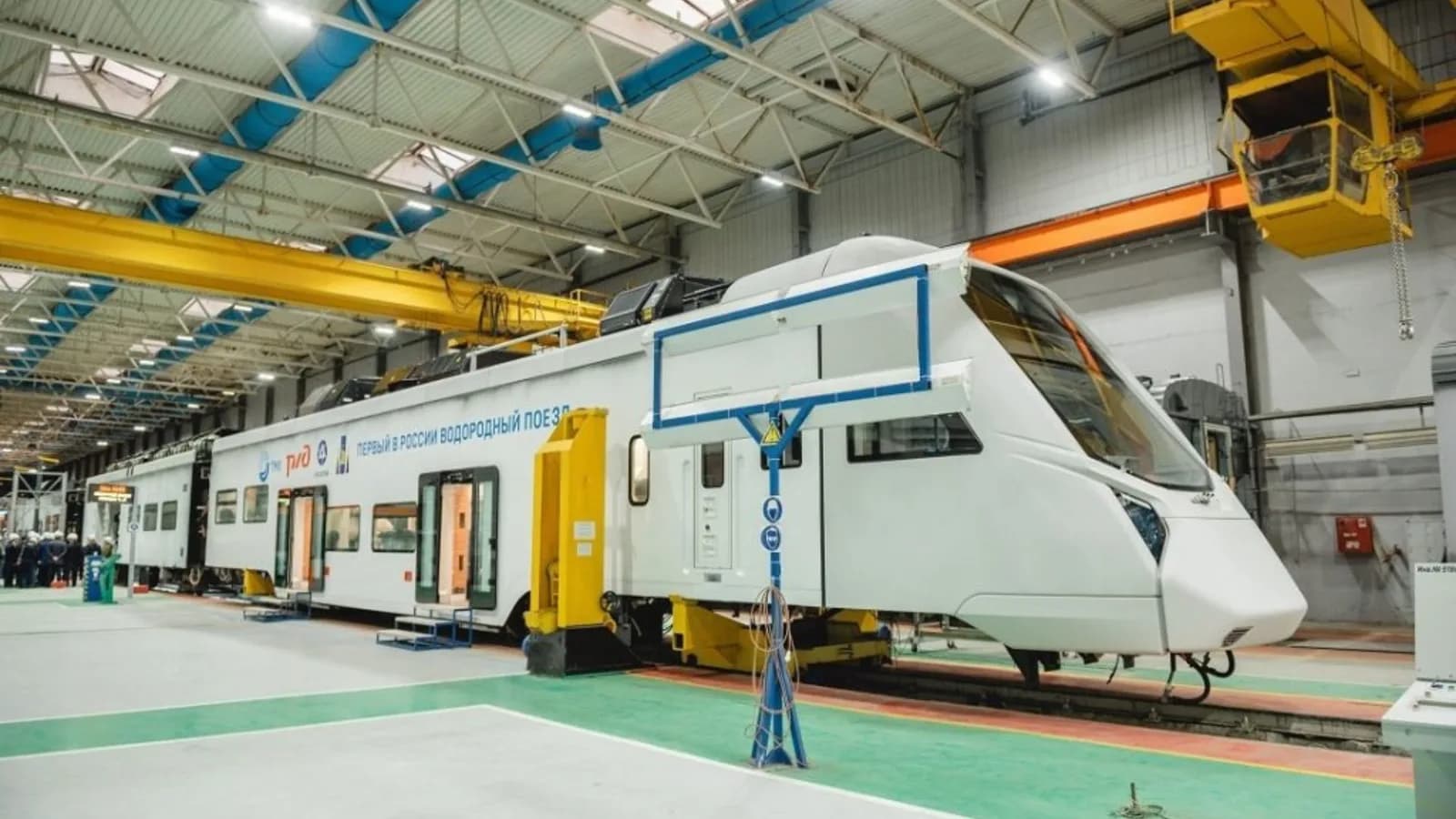
On Wednesday, October 28, Moscow announced that its first home-built hydrogen-powered passenger train, capable of traveling more than 435 miles (700 km) on hydrogen alone and up to 460 miles (740 km) with onboard battery support, was successfully assembled at a factory in Demikhovo.
The first set of these trains will operate on Sakhalin, a Russian island in the Pacific Ocean, north of Japan.
The assembled trains, designed for non-electrified railway lines, are the first low-floor passenger railcar model built in Russia to run be hydrogen fuel cells.
First Russian-made less polluting railcar
In the long run, they are expected to provide a cleaner alternative to diesel-powered locomotives that emit a toxic mix of pollutants during combustion. The hydrogen power system will emit water vapor rather than the exhaust fumes produced by diesel engines.
The inter-city hydrogen trains are being designed and built by Transmashholding (TMH), one of Russia’s largest manufacturers of railway rolling stock and urban transit equipment.
The company is working alongside Russian Railways, Rosatom and the Sakhalin regional government to develop hydrogen-powered trains under an agreement signed in 2019.
Work on Russia’s first hydrogen-powered train “has been underway for several years, and the assembly phase is due to be completed this year. In practice, the train has already been assembled and is moving into the testing phase,” said Valeri Limarenko, Governor of the Sakhalin Region.
Testing of the first hydrogen train, built with the new low-floor design, is scheduled to begin in November this year.
The governor added that dynamic tests in Moscow and the Moscow region will start in 2027 before the train is transferred to Sakhalin in the middle of the year.
According to reports, the first train sets were assembled at TMH’s Demikhovski Machine-Building Plant and Tver Railcar Works, a TMH subsidiary.
Two models, four distance ranges
The trains will be produced in two configurations. The two-car passenger units are expected to cover more than 435 miles (700 km) using the hydrogen power module alone, while onboard battery units can extend the range to about 460 miles (740 km).
A second configuration with three passenger coaches, powered by the same hydrogen module, is expected to travel nearly 300 miles (480 km). Its onboard energy storage system can provide an additional 50 miles of range.
Both configurations will include a separate technical railcar housing the hydrogen power system. The compartment will be equipped with hydrogen concentration and fire detection sensors to improve safety for passengers and railway staff.
According to reports, the hydrogen-powered trains are expected to enter commercial service by the end of 2027 following certification trials scheduled for the same year. They will initially operate on Sakhalin Island, where a dedicated hydrogen testing center is also under development.
Production of a second hydrogen fuel cell system is already underway as part of Moscow’s broader plan to create a unified platform for the next generation of urban, suburban and inter-regional trains operating on the 1,520 mm gauge railway network.
The green fuel train project also builds on a major modernization of Sakhalin’s railway infrastructure. Work to convert the island’s rail network to Russia’s broad-gauge standard began more than two decades ago, and Russian Railways completed it in 2020. The project replaced the 1,067 mm gauge that had been built in the region before World War II during Japanese rule, preparing the network for the introduction of modern rolling stock such as the new hydrogen-powered trains.
Get the latest news delivered to your inbox.
Related articles