Google shows quantum contextuality at 105 qubits as Willow chip beats classical limits
Google has demonstrated quantum contextuality on its Willow quantum processor, showing that the unusual property...
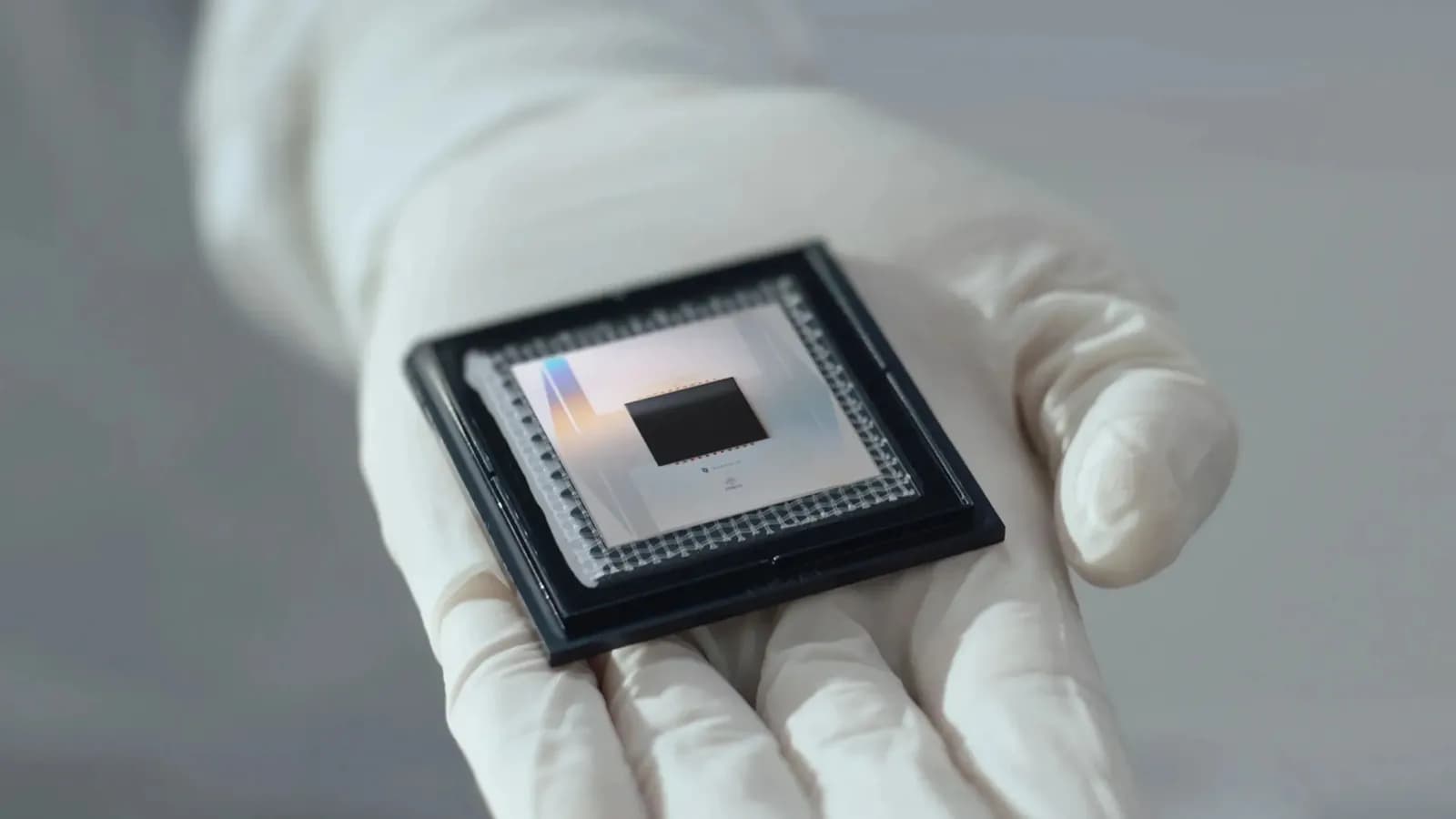
Google has demonstrated quantum contextuality on its Willow quantum processor, showing that the unusual property of quantum mechanics can persist across large systems and help benchmark hardware.
The experiments tested whether quantum processors could outperform classical strategies in several tasks, including a game built around a mathematical paradox. The results could help researchers understand what gives quantum computers an advantage and develop better ways to measure their performance.
In a paper published in Science, the Google Quantum AI team reported that its processor won the so-called magic square game 98.3 percent of the time, exceeding the maximum classical success rate of 88.89 percent. The researchers also demonstrated quantum-classical separation in tasks involving systems of up to 105 qubits.
A quantum advantage
Quantum contextuality describes how the outcome of a measurement can depend on which other compatible measurements are performed alongside it. In other words, a quantum system cannot always be described as having fixed properties waiting to be revealed by observation.
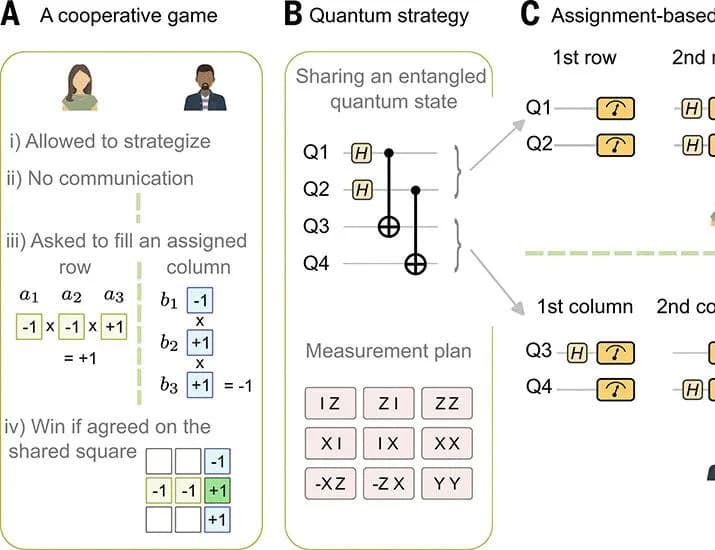
The team illustrated the concept using a 3-by-3 grid in which every row must multiply to positive one and every column to negative one. No grid can satisfy both rules because the total number of negative entries would have to be both even and odd.
In the magic square game, two players receive a row and a column and must provide matching values at their intersection without communicating. A prearranged classical strategy can win at most eight of nine rounds. Quantum correlations, however, allow the players to win every round in principle.
Google tested all nine versions of the game 100,000 times each. Its Willow processor achieved a 98.3 percent win rate, with hardware noise accounting for the remaining losses.
The researchers also measured contextuality using a Bell–Kochen–Specker inequality. The processor recorded a value of 5.590, comfortably above the classical limit of four and approaching the quantum limit of six.
Testing larger systems
The team then examined whether contextuality could survive as more qubits were added. In a separate Greenberger-Horne-Zeilinger (GHZ) parity game, the processor remained above the best classical performance as the number of participating qubits increased to 71.
Researchers also ran a hidden-linear-function problem using shallow quantum circuits across processor grids of up to 105 qubits. The system maintained success probabilities above the classical threshold, although performance declined as noise increased with system size.
Beyond demonstrating quantum behavior, the experiments revealed a practical use for contextuality tests. The team said the tasks exposed subtle coherent errors that conventional random-circuit benchmarks can overlook.
These tests could provide a more demanding measure of hardware quality by comparing a processor’s performance with fixed limits set by quantum mechanics. Such measurements may be useful for evaluating systems intended to run structured algorithms, including simulations relevant to chemistry and materials science.
The findings also connect contextuality with magic states, which are important resources for running full algorithms on error-corrected quantum computers. Google said its results offer a way to investigate how this property contributes to quantum computing’s potential advantage.
Get the latest news delivered to your inbox.
Related articles