
How Many Disaster Warnings Does It Take for People to Act?
How many disaster warnings does it take for people to act? Explore the link between warning channels and action in World Risk Poll data.
Published
October 13, 2026 8:42 am
By
Design
- Akhila Ayyalasomayajula
The following content is sponsored by Lloyd's Register Foundation
Save to Inbox
×
Save to Inbox
Sign me up for the free Visual Capitalist daily newsletter.
Send
Disaster Warnings: Do More Channels Mean More People Take Action?
Key Takeaways
People warned through three channels are nearly twice as likely to act as those warned through one.
The biggest overall jump happens by the time warnings reach a third channel.
More warning channels improve action across floods, hurricanes, droughts, and earthquakes.
In a disaster, speed matters. However, a warning only helps when people receive it clearly and in time.
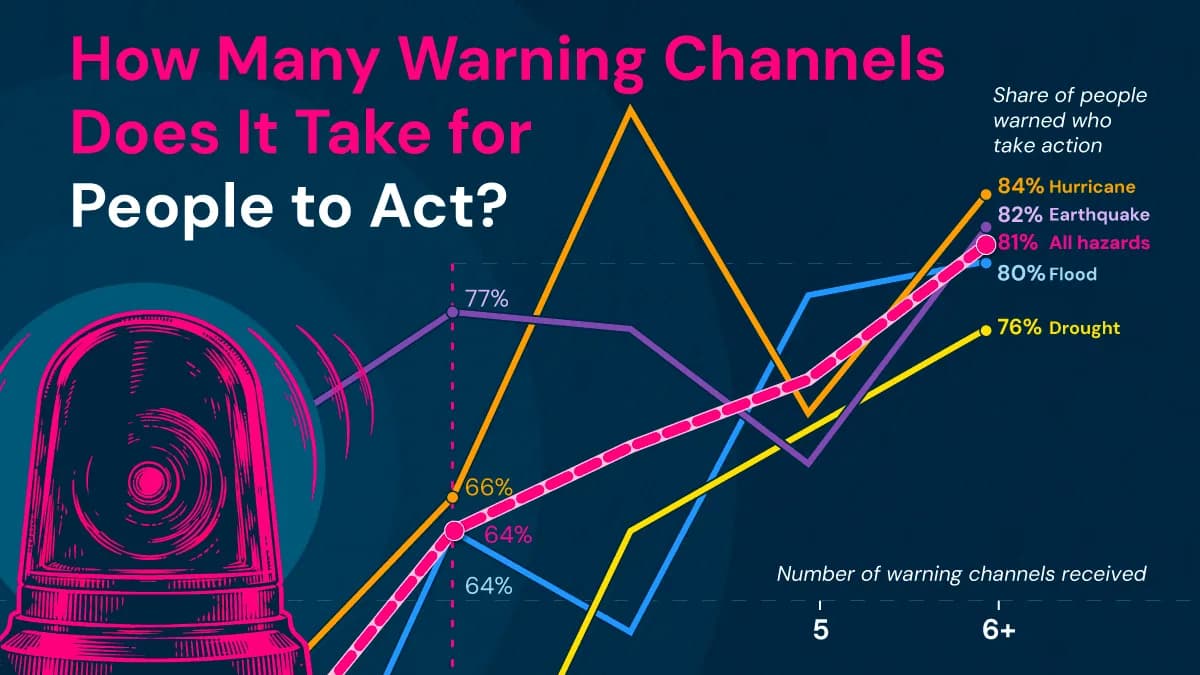
This graphic, in partnership with Lloyd’s Register Foundation, shows how the share of people able to take action rises with more warning channels, using data from the World Risk Poll.
Why Warning Channels Matter
Repetition helps people notice and trust a message. It also protects against outages, weak signal, or missed alerts.
Here is a table that shows how the ability to act changes as warning channels increase.
Number of warning channelsShare of people warned who take action — overallFlood / heavy rain / rainstormHurricane / cyclone / typhoonDroughtEarthquake
138%28%31%36%57%
251%41%55%42%70%
364%64%66%42%77%
469%58%89%64%76%
573%78%71%70%68%
6 or more81%80%84%76%82%
Overall, the share able to act rises from 38% with one channel to 64% with three. After that, gains continue, reaching 81% for those receiving six or more channels.
Three Channels Mark a Key Threshold
The data suggests three channels are a key threshold. People warned through three channels are nearly twice as likely to act as those warned through one.
Still, the returns moderate after that point. The overall average rises to 69% with four channels, 73% with five, and 81% with six or more.
That pattern shows why redundancy matters. As a result, multi-channel delivery can turn more warnings into action.
Hazard-by-Hazard Results
More channels generally help across each disaster type, though the pattern is not identical. Flood-related warnings rise from 28% with one channel to 80% with six or more.
Drought results improve more steadily, moving from 36% to 76%. Meanwhile, hurricane results jump sharply, climbing from 31% with one channel to 89% with four.
Earthquake warnings already start from a higher base, yet they still improve from 57% to 82%. That consistency strengthens the case for broader preparedness.
A Practical Lesson for Preparedness
Clear communication matters beyond immediate disaster warnings. For example, people in many countries underestimate others’ concern about climate change.
However, recognizing risk is only part of preparedness. For planners, that means pairing multiple warning channels with household disaster plans that help people act.
Discover what turns disaster warnings into action in the 2026 World Risk Poll Report, ‘From Alert to Agency’
You may also like
- Environment4 months ago Mapped: People Are Closer on Climate Than They Think People are closer on climate change views than they think, with the widest concern gaps in high-income countries.
- Water10 months ago Special Report: 8,500 Toxic Shipwrecks. Zero Global Framework. Shipwrecks from past wars threaten oceans with oil leaks and toxic hazards. What can leaders do to help endangered ecosystems and coastal nations?
- Environment2 years ago Are We United or Divided in The Fight Against Climate Change? Visual Capitalist partnered with Lloyd’s Register Foundation to determine which nations believe climate change is a threat.
- Business2 years ago Ranked: Which Industries Are the Most Dangerous? In this graphic, Visual Capitalist partnered with Lloyd’s Register Foundation to analyze workplace safety and determine the most dangerous industry.
- Environment2 years ago Visualized: How Do Countries Dispose of Their Household Waste? In this graphic, Visual Capitalist has partnered with Lloyd’s Register Foundation to explore the most common household waste disposal practices in 142 countries.
- Money2 years ago Visualized: How Long Can Each Generation Survive Without Income? Visual Capitalist has partnered with Lloyd’s Register Foundation to explore how long each generation can cover their needs without income.
- Green3 years ago World Risk Poll: How Do People Feel About Climate Change? This graphic explores 121 nations thoughts on climate change and ranks them by the volume of their population who views it as a threat.
- Economy3 years ago World Risk Poll: How Long Can People Survive Without Income? Income security is critical in resilience. In this graphic, we explore how secure people are and how long they could live without income.
- Misc3 years ago World Risk Poll: Visualizing Harassment and Violence in the Workplace This infographic shows the types of workplace violence and harassment faced by people in the global workplace.
- Technology3 years ago World Risk Poll: Mapping Global Sentiment on AI This infographic shows public perception of AI all over the globe and how this sentiment is affected by where you live.
Subscribe
Source: https://www.visualcapitalist.com/sp/lrf03-how-many-disaster-warnings-does-it-take-for-people-to-act/
Related articles
The Credit Rating Agencies Which Price the World
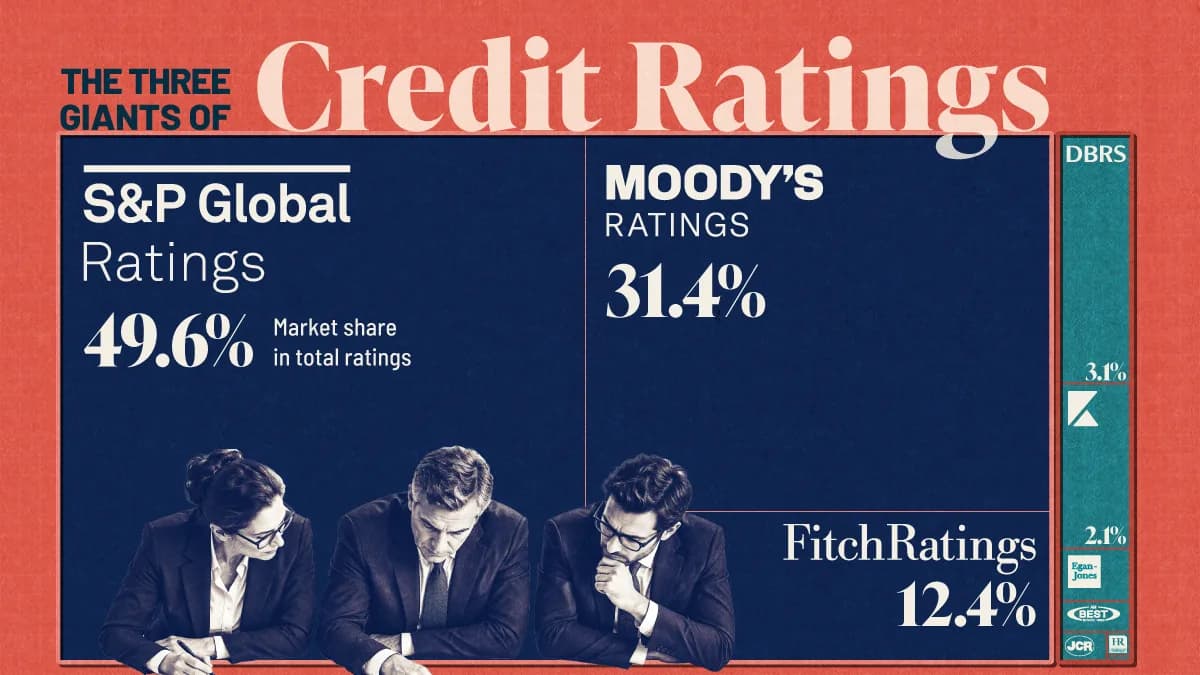
Companies and governments around the world tend to rely on just three big agencies to rate their debt and access capital markets.

Apple’s HomeView display is now available to preorder
Apple is getting into smart displays with its new HomeView. It has a seven-inch squircle design, looking similar to a gargantuan Apple Watch mounted to a speaker base.

Buying Apple’s wall-mounted HomeView? The mount costs extra
The HomeView smart home display announced by Apple today comes in two models that both cost $299: one with a speaker base, and the other being a self explanatory "Wall Mounted" version.

Google finally releases Gemini 4 Argon
After months sitting on the sidelines of the frontier AI race, Google has finally launched its long-awaited Gemini 4 Argon model, claiming it can compete with the best the industry has to offer.

Hands-on with the Apple Home Collection
We've just gotten a closer look at Apple's new video doorbell, security cameras, a door lock, and thermostats following the company's "Welcome Home" event on Tuesday.

Researchers demonstrate light-emission efficiency in chalcogenide perovskites
Researchers have experimentally shown that chalcogenide perovskites can emit light more efficiently than previous measurements...