
Where the World’s Biggest Arms Exporters Send Their Weapons
Explore who receives weapons from the world's biggest arms exporters, from U.S. shipments to Saudi Arabia to military aid for Ukraine.
Where the U.S., Russia, China, and Other Powers Send Weapons
Key Takeaways:
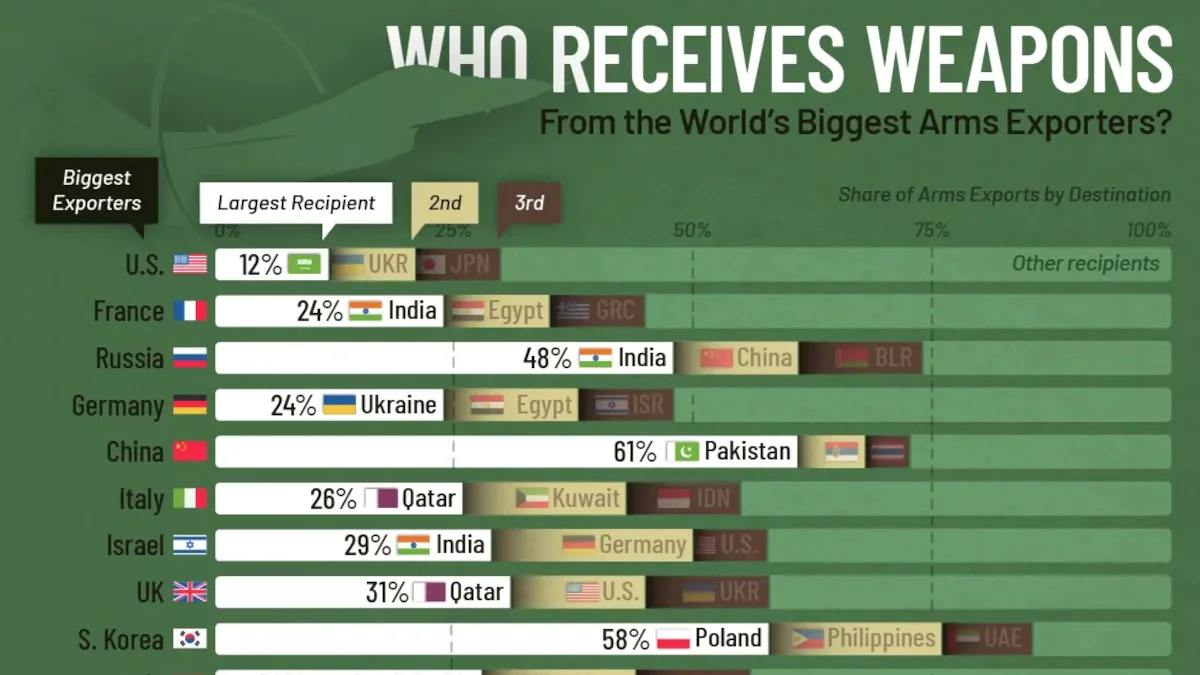
The U.S. accounted for 42% of global major arms exports in 2021–2025, with Saudi Arabia its largest recipient.
Ukraine received 94% of Poland’s arms exports, reflecting military support following Russia’s invasion.
China sent 61% of its arms exports to Pakistan, while India received 48% of Russia’s exports.
The world’s biggest weapons exporters supply countries across the globe, but their largest recipients reveal some of the most important relationships in international security.
According to the Stockholm International Peace Research Institute (SIPRI), international transfers of major weapons increased 9.2% between 2016–2020 and 2021–2025.
Who Receives Weapons From the Biggest Arms Exporters?
The following table ranks the world’s leading arms exporters and identifies their biggest recipients, using SIPRI’s 2021–2025 transfer-volume data.
The figures highlight how arms trade relationships reflect geopolitical alliances and regional security priorities. Some countries supply weapons to a broad network of partners, while others depend heavily on a handful of recipients.
RankArms ExporterShare of Global
Exports (%)Top Recipient2nd Recipient3rd Recipient
1 U.S.42.0 Saudi Arabia (12%) Ukraine (9.4%) Japan (8.9%)
2 France9.8 India (24%) Egypt (11%) Greece (10%)
3 Russia6.8 India (48%) China (13%) Belarus (13%)
4 Germany5.7 Ukraine (24%) Egypt (14%) Israel (10%)
5 China5.6 Pakistan (61%) Serbia (6.8%) Thailand (4.7%)
6 Italy5.1 Qatar (26%) Kuwait (17%) Indonesia (12%)
7 Israel4.4 India (29%) Germany (21%) U.S. (7.8%)
8 UK3.4 Qatar (31%) U.S. (14%) Ukraine (13%)
9 South Korea3.0 Poland (58%) Philippines (18%) UAE (9.5%)
10 Spain2.3 Saudi Arabia (28%) Türkiye (16%) Belgium (12%)
11 Türkiye1.8 Pakistan (16%) UAE (12%) Ukraine (8.4%)
12 Netherlands1.2 Ukraine (23%) U.S. (20%) Pakistan (16%)
13 Norway1.0 U.S. (33%) Ukraine (22%) Romania (16%)
14 Poland1.0 Ukraine (94%) Estonia (1.6%) Sweden (1.4%)
15 Sweden0.9 Brazil (24%) Ukraine (14%) Pakistan (12%)
16 Canada0.7 Ukraine (34%) Saudi Arabia (27%) U.S. (17%)
17 Czechia0.4 Ukraine (69%) Vietnam (14%) Hungary (9.0%)
18 South Africa0.4 UAE (39%) Singapore (19%) DRC (9.1%)
19 Denmark0.3 Ukraine (50%) Argentina (19%) Norway (7.7%)
20 Switzerland0.3 Spain (46%) Denmark (14%) Romania (12%)
21 Ukraine0.3 China (64%) India (23%) Qatar (5.8%)
22 Australia0.3 Ukraine (24%) Canada (23%) U.S. (21%)
23 Belgium0.3 Saudi Arabia (30%) Ukraine (23%) Canada (21%)
24 Brazil0.3 Portugal (45%) Hungary (26%) Nigeria (13%)
25 Iran0.3 Russia (73%) Venezuela (17%)Houthi rebels (9.1%)
The data reveals two distinct patterns. Major exporters such as the United States supply weapons to a wide range of countries, while others have more concentrated relationships, with a single recipient accounting for a majority of their exports.
These differences can reflect longstanding defense partnerships, regional security concerns, or the immediate demands of ongoing conflicts.
Why Does Saudi Arabia Buy So Many American Weapons?
Saudi Arabia was the world’s third-largest arms importer in 2021–2025, obtaining 77% of its imported major weapons from the United States.
The relationship spans decades of security cooperation. American-made aircraft, air-defense systems, and other advanced equipment play a central role in Saudi Arabia’s military capabilities, particularly as the country seeks to deter regional threats and protect critical infrastructure.
These purchases also sustain commercial relationships with American defense manufacturers, part of a broader global industry that includes some of the world’s largest arms companies.
Are Countries Buying Weapons or Receiving Military Aid?
Not every international weapons transfer represents a commercial purchase. Some weapons are provided as military assistance, particularly during active conflicts.
Ukraine was the world’s largest recipient of major arms in 2021–2025, following Russia’s full-scale invasion in 2022. Transfers from countries including the United States, Germany, and Poland reflect the scale of international military support.
Weapons can also serve different purposes. Some replenish equipment consumed in active conflicts, while others modernize militaries, strengthen deterrence, or build reserves against future threats.
This distinction matters when interpreting the rankings. SIPRI measures the volume of major weapons transferred, rather than their financial value or whether they were ultimately deployed.
Learn More on the Voronoi App
Explore how China’s nuclear weapons arsenal climbed 71% since 2020, highlighting another dimension of the changing global military balance.
Source: https://www.visualcapitalist.com/where-the-worlds-biggest-arms-exporters-send-their-weapons/
Related articles

Trump’s attempt to rename AI is looking awfully artificial
President Donald Trump has a knack for turning words against his enemies.

ICE detainees in Georgia used the facility’s video calling software to expose the conditions inside
Four men detained at an ICE detention center in rural Georgia used the facility's video conferencing software to expose both the conditions inside and President Donald Trump's hostile takeover of the…

Trump administration says Microsoft ‘abused’ worker visa program and is cutting off access
The Trump administration is suspending some tech companies, including Microsoft, from an immigration program that lets an employer hire foreign workers that can reside permanently in the US, as…

What The Social Reckoning gets right — and wrong
Aaron Sorkin's The Social Reckoning has its fair share of cinematic flair, but many details in the story hew closely to real life.
Which Age Groups Actually Vote in U.S. Midterms?
See how U.S. midterm voter turnout varies by age, and why older Americans make up a larger share of voters than eligible citizens.
Ranked: America’s Reddest and Bluest Major Cities
See America’s reddest and bluest major cities, ranked by county-level voting in the 2024 presidential election.