
Ranked: America’s Reddest and Bluest Major Cities
See America’s reddest and bluest major cities, ranked by county-level voting in the 2024 presidential election.
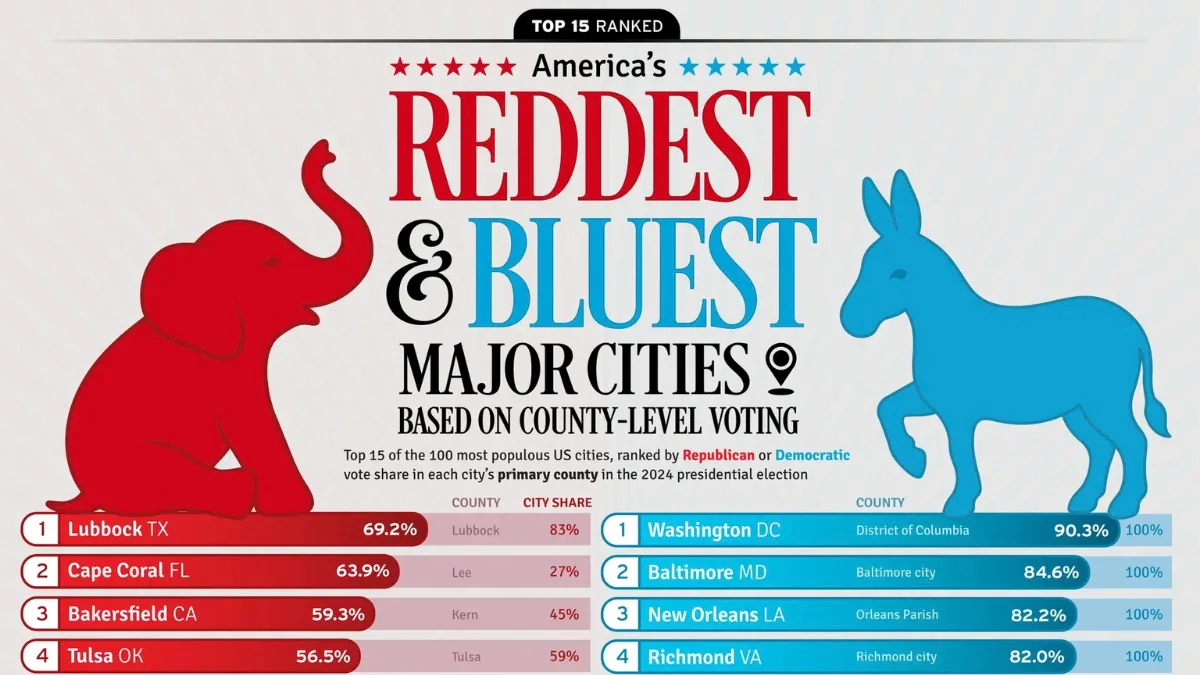
Which Major U.S. Cities Are the Reddest and Bluest?
Key Takeaways:
Washington, D.C. is the bluest major U.S. city by this measure, with 90.3% of votes cast for the Democratic presidential candidate in 2024.
Lubbock, Texas ranks as the reddest, with Lubbock County giving 69.2% of votes to the Republican candidate.
California appears on both sides of the ranking, highlighting substantial political variation within individual states.
This graphic, created by Julie R. Peasley, ranks cities among the 100 largest in the U.S. by 2024 population according to the Republican or Democratic presidential vote share in each city’s primary county.
Population data comes from the U.S. Census Bureau, while election results primarily come from the MIT Election Data and Science Lab.
America’s Reddest and Bluest Major Cities
The table below shows the 15 most Democratic major cities.
RankCityPrimary CountyDemocratic %City Share of County Population
1Washington, DCDistrict of Columbia90.3%100%
2Baltimore, MDBaltimore city84.6%100%
3New Orleans, LAOrleans Parish82.2%100%
4Richmond, VARichmond city82.0%100%
5St. Louis, MOSt. Louis city81.2%100%
6San Francisco, CASan Francisco County80.3%100%
7Durham, NCDurham County79.8%88%
8Philadelphia, PAPhiladelphia County78.8%100%
9Portland, ORMultnomah County78.7%80%
10Denver, CODenver County76.7%100%
11Madison, WIDane County74.9%49%
12Oakland, CAAlameda County74.6%27%
13Boston, MASuffolk County74.3%85%
14Seattle, WAKing County73.6%33%
15Atlanta, GAFulton County71.9%44%
And here are the 15 most Republican major cities:
RankCityPrimary CountyRepublican %City Share of County Population
1Lubbock, TXLubbock County69.2%83%
2Cape Coral, FLLee County63.9%27%
3Bakersfield, CAKern County59.3%45%
4Tulsa, OKTulsa County56.5%59%
5Wichita, KSSedgwick County56.1%75%
6Miami, FLMiami-Dade County55.4%17%
7Fort Wayne, INAllen County55.3%68%
8Corpus Christi, TXNueces County55.2%90%
9Frisco/McKinney/Plano, TXCollin County54.2%52%
10Port St. Lucie, FLSt. Lucie County54.2%66%
11Boise, IDAda County53.8%44%
12Colorado Springs, COEl Paso County53.6%66%
13Huntsville, ALMadison County53.4%53%
14St. Petersburg, FLPinellas County52.1%28%
15Fort Worth/Arlington, TXTarrant County51.8%62%
Washington, D.C. leads the blue side at 90.3%, followed by Baltimore at 84.6%. On the red side, Lubbock leads at 69.2%, followed by Cape Coral at 63.9% and Bakersfield at 59.3%.
One important caveat is that these are county-level election results, not city-level results. While Washington, Baltimore, Philadelphia, and Denver account for their entire county or county-equivalent, Oakland represents just 27% of Alameda County’s population and St. Petersburg 28% of Pinellas County.
The Red-Blue Divide Goes Beyond State Lines
The rankings show why broad state-level labels can obscure substantial local variation. California is a clear example: San Francisco and Oakland appear among the bluest major cities in the ranking, while Bakersfield lands on the red side, with Kern County voting 59.3% Republican.
Florida shows a different pattern. Cape Coral, Miami, Port St. Lucie, and St. Petersburg all appear among the 15 reddest major cities by this measure. Together, the results show how political geography can vary considerably within states and why county-level results can reveal patterns that statewide results do not.
Geography is only one way to examine America’s political divide. Age is another, with notable differences in political affiliation by generation in the U.S.
Learn More on the Voronoi App
To explore another angle on the 2024 election, see How Americans Voted Based on Their View of the Economy on the Voronoi app.
Related articles
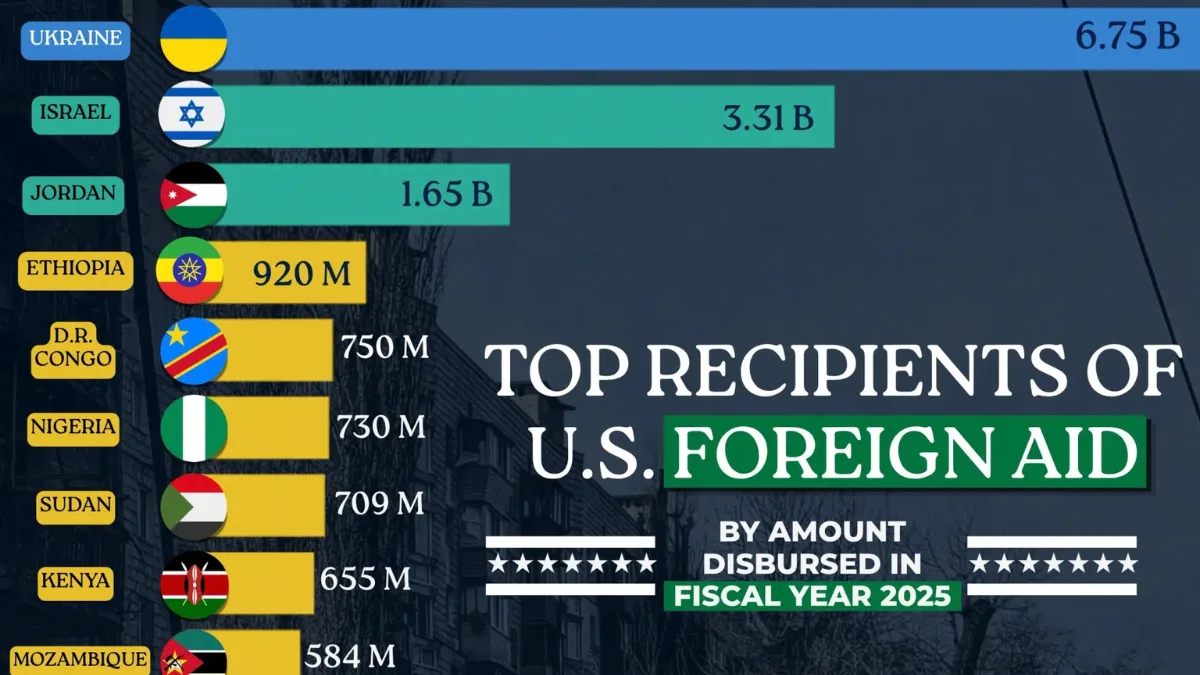
Ranked: Countries Receiving the Most U.S. Foreign Aid
Where does U.S. foreign aid go? See the top recipient countries in 2025 and how much assistance they received.
How Cambodia’s law on ‘freedom parks’ curtailed people’s right to protest
"It has not only been used to confine peaceful gatherings and demonstrations to Freedom Park, but increasingly, the very use of Freedom Park has been restricted and denied."

Trump orders US government to call AI ‘Super Intelligence’
The US executive branch is no longer acknowledging the existence of "artificial intelligence.

Will Chinese AI companies slow down? A top House Democrat wants answers
As President Donald Trump prepares to meet tech and AI CEOs in Washington, Rep. Ro Khanna (D-CA) is calling for a treaty between the US and China to keep AI from wreaking havoc on the world.

Movement from behind your gadget
The growth of online activism has given different colors in the movement agendas. There is a debate on how effective it is, and how it could complement each other.

Young Japanese find new outlets for peace activism amid rising tensions in the Pacific
GV observed Japanese peace activism shifting from an ideological, often confrontational and hierarchical approach among the older generation to a more individualised, accessible, pop-style approach…