
The Credit Rating Agencies Which Price the World
Companies and governments around the world tend to rely on just three big agencies to rate their debt and access capital markets.
How Three Companies Dominate Credit Ratings
Key Takeaways
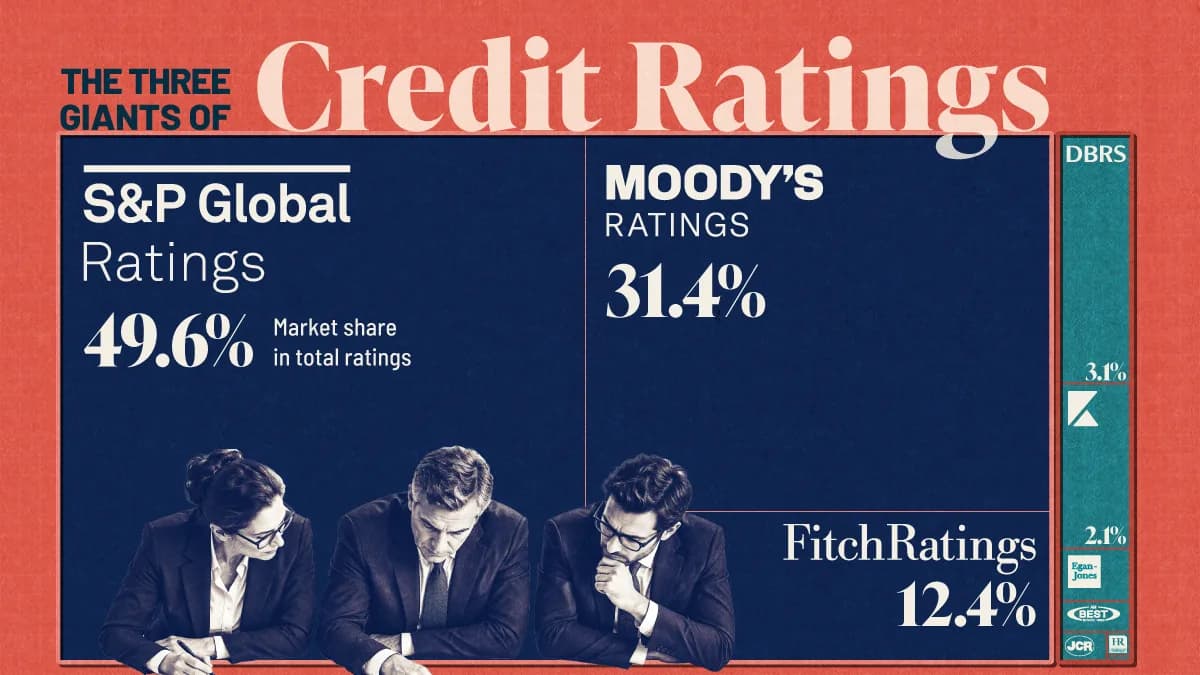
Three U.S. companies account for 93.4% of outstanding credit ratings reported to U.S. regulators.
S&P Global Ratings leads the market with a 49.6% share, followed by Moody’s and Fitch.
Credit ratings can influence how much governments and companies pay to borrow money.
A few letters beside a bond can influence how much a company pays to borrow money from investors. Behind those grades is an industry dominated by just three firms: S&P Global Ratings, Moody’s, and Fitch.
This graphic shows the share of outstanding credit ratings reported by agencies registered with the Securities and Exchange Commission (SEC) as of the end of 2024. These ratings assess the ability of companies, governments, and other borrowers to repay their debts.
The Big Three Rating Agencies
S&P, Moody’s, and Fitch together account for 93.4% of outstanding ratings, leaving just 6.6% for seven smaller competitors. S&P (Standard & Poor’s) alone holds nearly half the market.
Their dominance has proved remarkably durable. In 2007, the Big Three held a combined 98.8% share. Smaller competitors have gained ground since then, particularly Morningstar DBRS, but the industry’s balance of power has changed only gradually.
RankCredit Rating AgencyRatings Market Share
1 S&P Global Ratings49.6%
2 Moody's Ratings31.4%
3 Fitch Ratings12.4%
4 Morningstar DBRS3.1%
5 KBRA2.1%
6 Egan-Jones Ratings Company0.66%
7 AM Best0.39%
8 Japan Credit Rating Agency0.24%
9 HR Ratings0.10%
10 Demotech0.02%
For borrowers, these assessments have financial consequences. Bonds rated below investment grade, commonly known as junk bonds, typically offer higher yields to compensate investors for greater default risk. For governments and large corporations borrowing billions of dollars, even a small increase in interest rates can translate into substantial additional costs.
The influence of the Big Three extends to the U.S. government. S&P stripped the country of its highest-grade credit rating in 2011, Fitch followed in 2023, and Moody’s lowered its rating from Aaa to Aa1 in May 2025. The agencies cited concerns including persistent fiscal deficits, rising debt burdens, and political gridlock.
Why Rivals Struggle to Break In
Challenging the Big Three requires more than producing good research. Many pension funds and other institutional investors operate under investment rules that specify which rating agencies they can rely on. Historically, those agencies have often been S&P, Moody’s, and Fitch, giving borrowers a strong reason to seek their ratings.
Bond indexes reinforce that advantage. Some require ratings from specified agencies before a bond can qualify for inclusion. These requirements matter because funds tracking the indexes invest in the bonds they contain, creating another incentive for borrowers to use established rating agencies.
Together, these practices help explain why the market is difficult to disrupt. Borrowers seek ratings that investors already accept, while investors continue relying on familiar providers. A newcomer must win recognition on both sides, not simply offer a cheaper service.
Paid by the Borrowers They Rate
One of the industry’s most persistent controversies is how credit rating agencies make money. The largest firms generally collect fees from the borrowers whose creditworthiness they assess, creating a potential conflict of interest. Investors expect independent judgments, but the paying clients benefit from favorable ratings.
This arrangement matters because ratings influence investment decisions across a global bond market worth roughly $160 trillion.
Those tensions came into focus after the 2008 financial crisis. S&P agreed to a $1.375 billion settlement in 2015, while Moody’s reached an $864 million settlement in 2017, resolving allegations involving their ratings of mortgage-related investments before the crisis.
Post-crisis reforms strengthened safeguards intended to separate credit analysis from sales activities and reduce commercial pressure on ratings decisions. With so much of the market relying on three agencies, the independence of those judgments matters far beyond the firms themselves.
Learn More on the Voronoi App
To explore how the U.S. government spends its revenue, check out Breaking Down One U.S. Tax Dollar on Voronoi.
Source: https://www.visualcapitalist.com/the-credit-rating-agencies-which-price-the-world/
Related articles
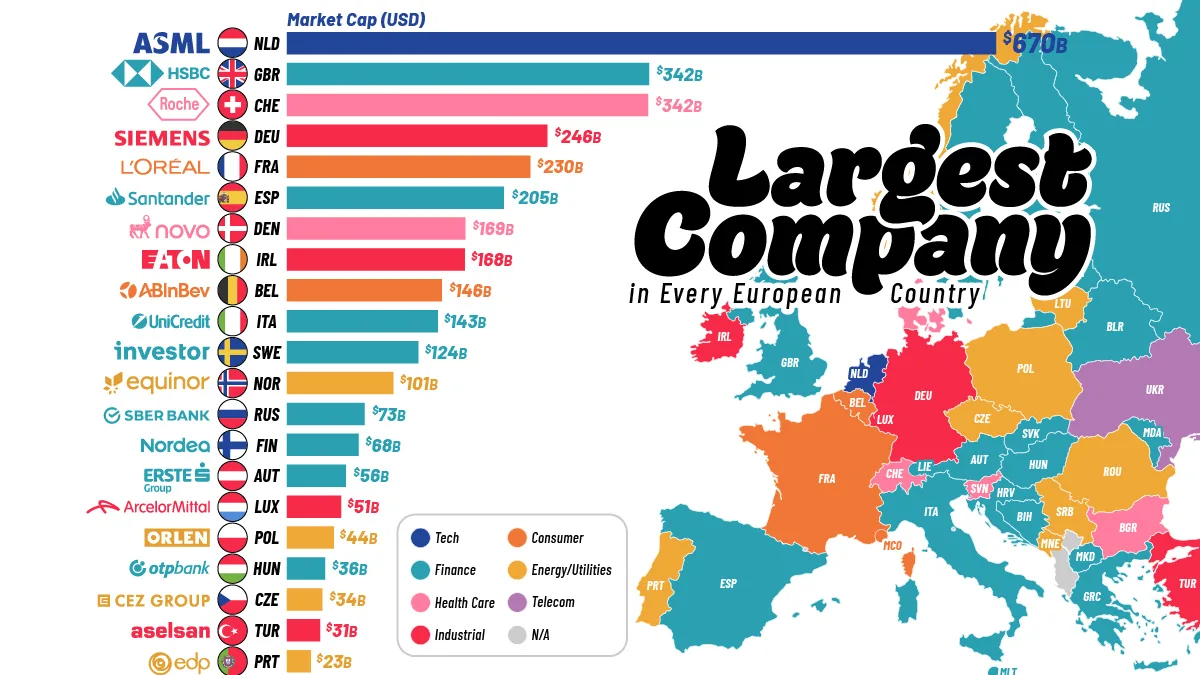
Ranked: The Most Valuable Company in Every European Country
ASML is Europe’s most valuable listed company at $670 billion, but banks lead in 15 of the 42 countries covered.
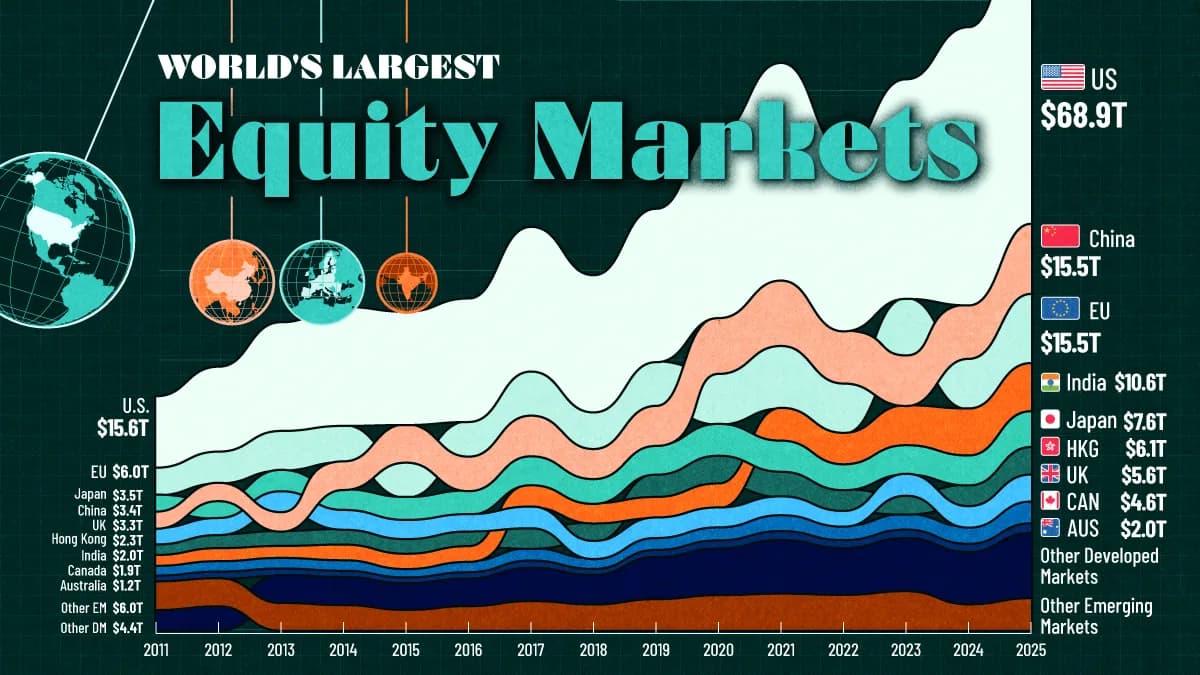
The Global Stock Market Boom, by Country (2011–2025)
Global equities more than tripled in total market capitalization between 2011 and 2025. One country's stocks powered most of this growth.
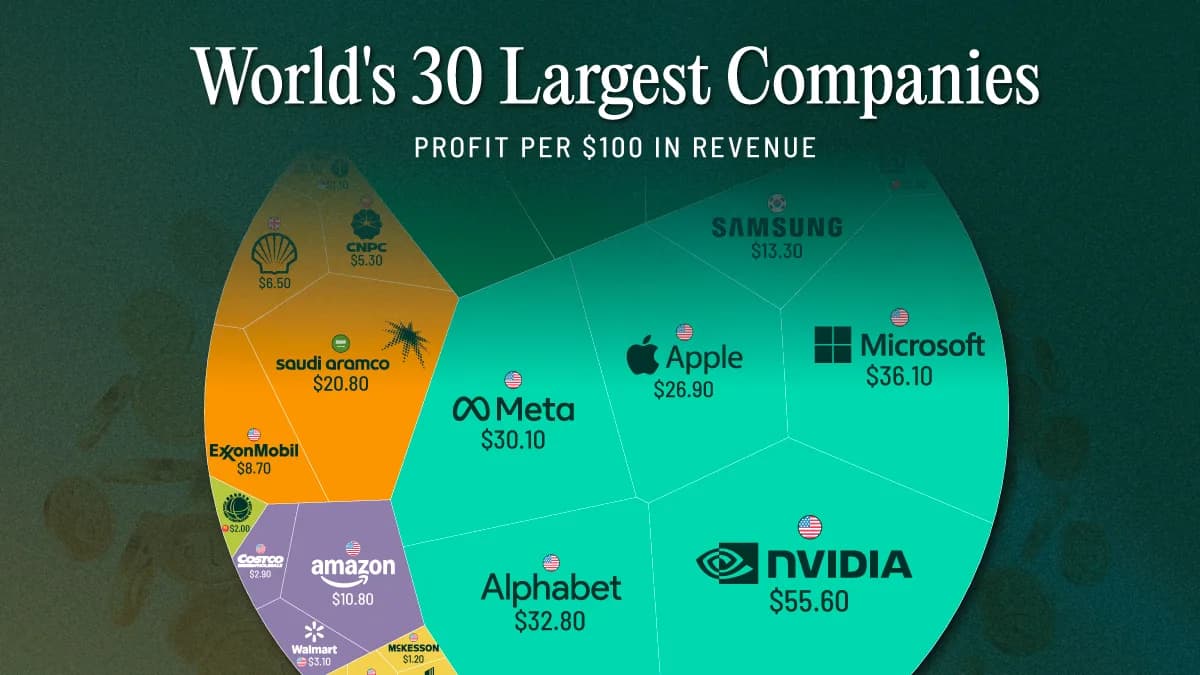
Ranked: Profit Margins of the World’s Largest Companies
Nvidia keeps nearly $56 of every $100 in revenue as profit. For some of the world’s largest companies, it’s less than $1.
Mapped: The Most Expensive ZIP Code in Every State
Which ZIP codes have America’s priciest homes? See the most expensive location in every state based on median list prices.
Ranked: America’s Highest-Paid CEOs in 2025
See America's highest-paid CEOs in 2025, led by Elon Musk's record $132.3 billion compensation package.
Where Work-Life Balance Is Best and Worst in the U.S.
Maine ranks first for work-life balance, while nine of the 10 lowest-ranked states are in the South. See how all 50 states compare.