Mapped: How Many Starbucks Stores Are in Each Country?
Which countries have the most Starbucks stores in 2026? Explore global rankings, expansion trends, and store closures.
This story was prepared automatically by software.
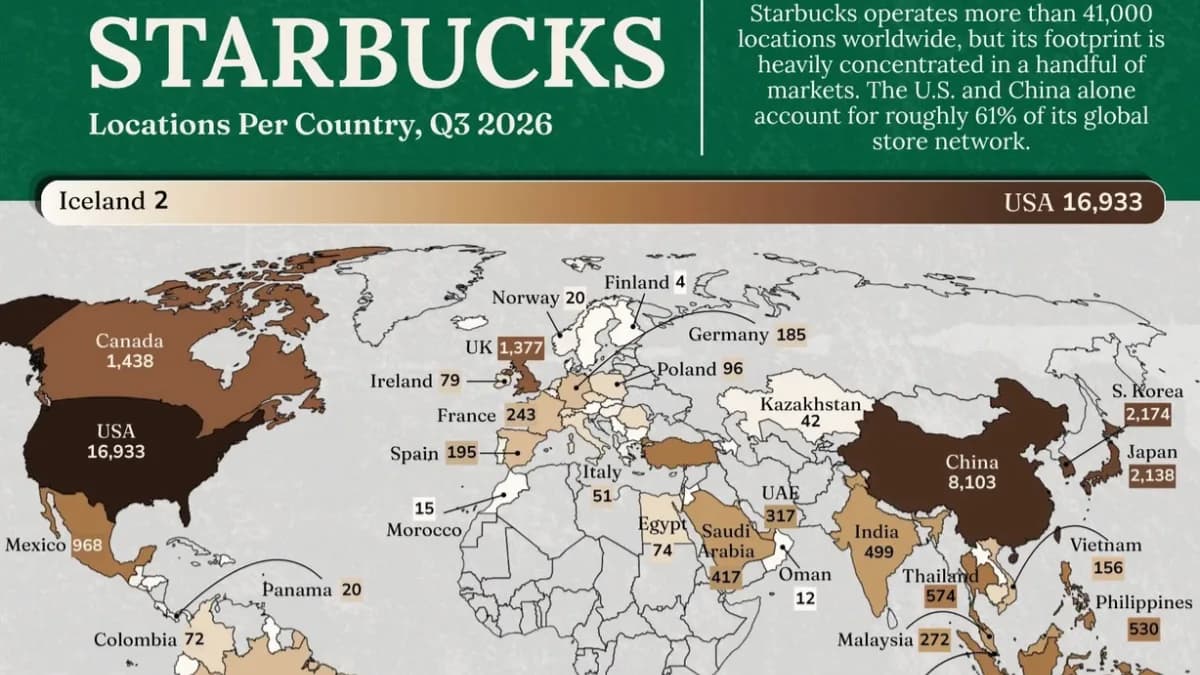
Where Are Starbucks Stores Located Around the World?
Key Takeaways:
Starbucks operates 41,304 stores worldwide, with the U.S. and China accounting for roughly 61% of locations.
China added 797 stores between Q3 2024 and Q3 2026, the largest increase of any country.
Malaysia recorded the biggest decline (-136 stores) amid consumer boycotts and growing competition.
From major cities to smaller markets, Starbucks has built a global presence spanning nearly 90 markets.
This visualization, created by Iswardi Ishak, maps Starbucks locations worldwide using the company’s Q3 2026 figures, including licensed and company-operated stores.
Which Countries Have the Most Starbucks Stores?
The following table ranks countries by Starbucks locations, based on Starbucks’ Quarterly Results and Supplemental Data.
MarketStore Count
(Q3 FY24)Store Count
(Q3 FY26)Two-Year Change
U.S.16,73016,933203
China7,3068,103797
South Korea1,9372,174237
Japan1,9482,138190
Canada1,4681,438(30)
United Kingdom1,3271,37750
Mexico850968118
Turkey71678064
Taiwan56761447
Indonesia609592(17)
Thailand50157473
Philippines46053070
India43849961
Saudi Arabia476417(59)
UAE - Dubai3163171
Malaysia408272(136)
France252243(9)
Spain17319522
Kuwait206195(11)
Germany16318522
Chile16718013
Hong Kong/Macau183177(6)
Vietnam11215644
Singapore152138(14)
Argentina1321353
Peru11812911
Brazil128112(16)
Australia709828
Poland769620
Netherlands10293(9)
Ireland8979(10)
South Africa69756
Egypt7974(5)
Colombia71721
Romania60644
Czech Republic56615
Cambodia465913
Qatar6858(10)
Switzerland5654(2)
Italy405111
Bahrain5046(4)
Kazakhstan38424
New Zealand38424
Greece3939-
Hungary3939-
Puerto Rico33363
Portugal28346
Lebanon3934(5)
El Salvador24339
Costa Rica26326
Belgium3632(4)
Guatemala21276
Panama16204
Trinidad and Tobago17203
Norway2220(2)
Uruguay16193
Austria2319(4)
Bulgaria16182
Cyprus17181
Malta17181
Slovakia12175
Denmark1717-
Dominican Republic8168
Bahamas14162
Morocco1815(3)
Jordan2815(13)
Jamaica1414-
Oman1912(7)
Azerbaijan792
Serbia792
Ecuador-88
Barbados572
Bolivia77-
Laos561
Paraguay352
Aruba55-
Honduras-44
Finland54(1)
Luxembourg54(1)
Andorra231
Sweden33-
Gibraltar-22
Iceland-22
Cayman Islands22-
Curacao22-
Guyana22-
Monaco22-
Brunei42(2)
Turks and Caicos11-
The U.S. leads with 16,933 stores, followed by China with 8,103. South Korea (2,174) and Japan (2,138) rank next, while Canada rounds out the top five with 1,438 locations.
Together, the U.S., Canada, and Mexico account for nearly half of Starbucks’ global footprint, reflecting the chain’s North American roots and decades of expansion. Meanwhile, South Korea and Japan each have more stores than any individual European market, highlighting Starbucks’ strong presence in Asia.
Where Is Starbucks Growing and Shrinking?
China led Starbucks’ expansion between Q3 2024 and Q3 2026, adding 797 locations despite fierce competition from domestic coffee chains. That’s nearly four times the increase recorded in the U.S. (+203). South Korea (+237) and Japan (+190) also posted substantial gains.
Meanwhile, Malaysia (-136), Saudi Arabia (-59), and Canada (-30) experienced the largest declines. Boycotts linked to the Gaza conflict have pressured Starbucks in Malaysia and parts of the Middle East, including Jordan and Kuwait. However, store closures cannot be attributed solely to boycotts.
In Canada, intensifying competition from independent cafés and lower-priced alternatives has challenged Starbucks’ traditional position as a community gathering place.
Is Starbucks Still Profitable?
Despite store closures in certain markets, Starbucks remains profitable. Its Q3 2026 financial results reported $9.3 billion in quarterly revenue, with global comparable-store sales increasing 7.9%.
However, revenue declined 1.4% year-over-year, partly reflecting the transition of its Chinese operations to a licensed joint-venture model. With 67% of stores now licensed, Starbucks increasingly relies on partners to operate locations, reducing its direct involvement in day-to-day store operations.
As the global coffee industry evolves, Starbucks’ future growth will depend on balancing international expansion, local competition, and changing consumer preferences.
Learn More on the Voronoi App
For another perspective on consumer spending, check out Ranked: Where Eating Out Costs the Most and Least, which compares dining costs across different markets.
Related articles