Ranked: The Top Currencies Used in Global Payments
The U.S. dollar dominates SWIFT payments with a 52% share. See how the euro, pound, yuan, and other currencies compare globally.
This story was prepared automatically by software.
Which Currencies Lead Global Payments?
Key Takeaways:
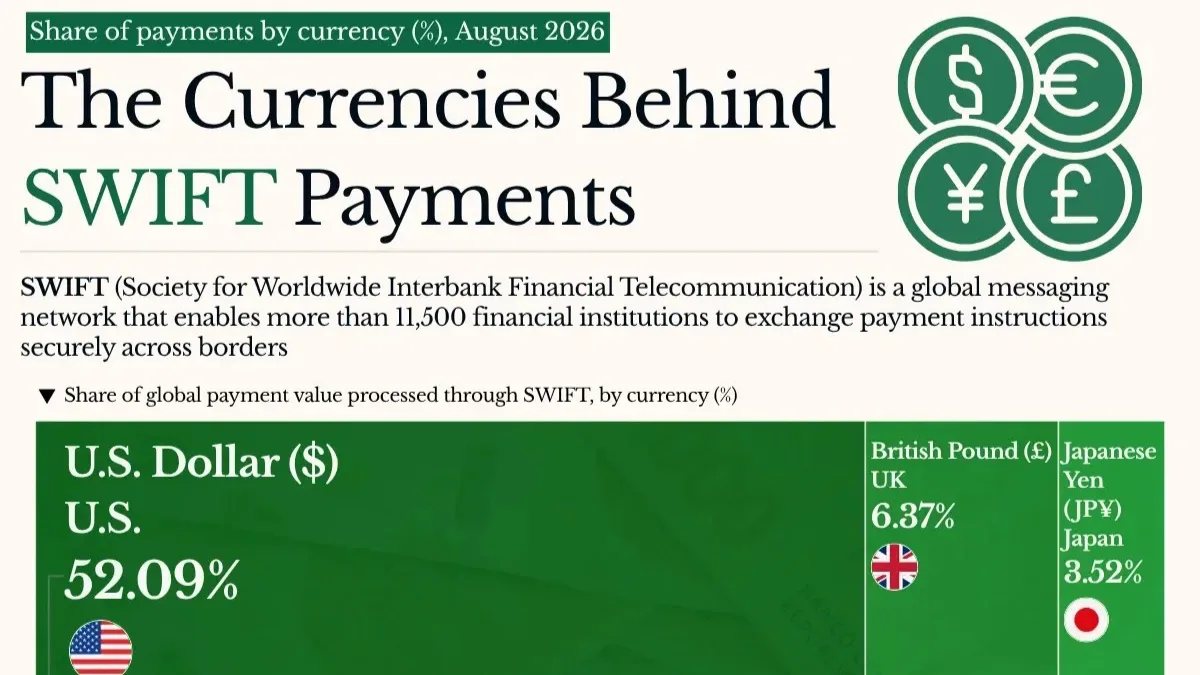
The U.S. dollar accounts for 52.09% of global payment value processed through SWIFT, more than all other currencies combined.
The euro ranks second at 21.37%, followed by the British pound at 6.37%.
China’s yuan ranks fifth at just 3.26%, behind the Japanese yen despite China’s economic size.
The U.S. dollar remains the dominant currency in international finance, but how far ahead is it of its closest competitors?
This visualization, created by Aneesh, ranks currencies by their share of global payment value processed through SWIFT in August 2026, using data from SWIFT’s Global Currency Tracker – September 2026.
The U.S. Dollar Dominates SWIFT Payments
The following table shows each currency’s share of global payment value processed through SWIFT in August 2026.
CurrencyShare (%) of global payment value processed through SWIFT
U.S. dollar52.09
Euro21.37
British pound6.37
Japanese yen3.52
Chinese yuan3.26
Canadian dollar2.65
Others10.74
Together, the dollar and euro account for 73.46% of payment value processed through SWIFT, leaving just over one-quarter for all other currencies combined.
Beyond these two leaders, the ranking becomes considerably more fragmented. The British pound, Japanese yen, and Chinese yuan each hold single-digit shares, highlighting the substantial gap between the two leading currencies and the rest.
The dollar’s dominance reflects its central role in global trade, financial markets, and international banking. The depth of U.S. capital markets and widespread use of dollar-denominated transactions reinforce its position.
What Is SWIFT, and Who Controls It?
SWIFT, the Society for Worldwide Interbank Financial Telecommunication, is a secure financial messaging network connecting more than 11,500 financial institutions worldwide. It transmits payment instructions rather than directly moving money.
Headquartered in Belgium, SWIFT is a cooperative owned by its member financial institutions, not a single country. Its standardized messaging and extensive network make it widely adopted, although participation is subject to regulatory requirements and sanctions.
While SWIFT plays a central role in international banking, it does not capture payments made through every financial network. Its currency rankings therefore provide an important snapshot of international payment activity rather than a complete picture of all global transactions.
Is SWIFT’s Dominance Being Challenged?
Alternative payment networks, including China’s Cross-Border Interbank Payment System (CIPS), are expanding as countries seek greater flexibility in cross-border transactions.
However, the yuan’s relatively small share of SWIFT payment value illustrates the gap between China’s economic influence and the international use of its currency within this network.
The dollar also benefits from its established role in global foreign exchange reserves, which support international liquidity and settlement.
Importantly, these figures measure payment value rather than transaction counts. They also exclude activity outside SWIFT, meaning the ranking cannot establish the dollar’s share of all global payments or whether alternative networks are gaining ground over time.
Learn More on the Voronoi App
For another perspective on the evolving financial landscape, explore The UAE Has the Highest Rate of Cryptocurrency Ownership on Voronoi.
Related articles