
Stablecoin Card Spending Has Surged to $1 Billion a Month
Stablecoin card spending has grown nearly 2,000-fold since 2023. See what’s fueling their rise and why the market may just be getting started.
Published
October 9, 2026 8:28 am
By
Design
- Athul Alexander
The following content is sponsored by Plasma
Save to Inbox
×
Save to Inbox
Sign me up for the free Visual Capitalist daily newsletter.
Send
Stablecoin Card Spending is Taking Off
Key Takeaways
Stablecoin card spending was under $1 million per month in October 2023.
Since July 2026, it has surged to over $1 billion per month.
Infrastructure that directly integrates stablecoin cards with major payment networks, like Visa, has been a major contributor to this growth.
Stablecoins are increasingly moving beyond their crypto trading roots and into everyday spending. Since July 2026, stablecoin card spending has topped $1 billion a month, marking a new milestone.
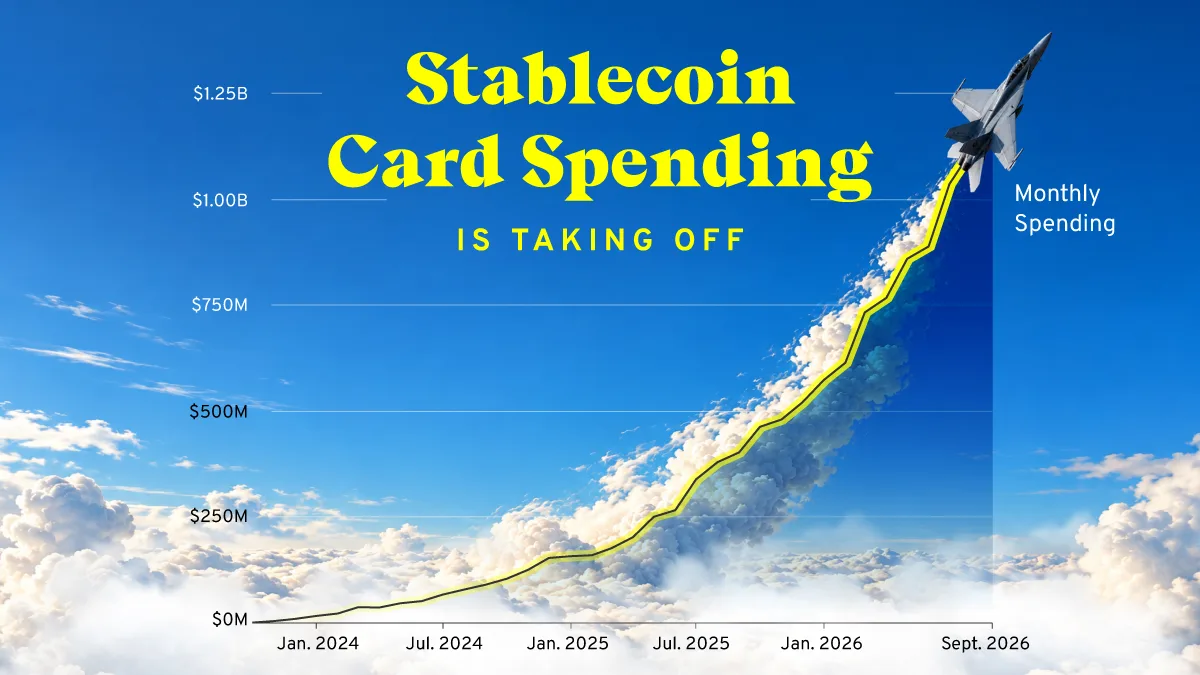
This graphic, created in partnership with Plasma, shows monthly spending volume since 2023.
Stablecoin Card Spending Over Time
In October 2023, stablecoin card spending was under $1 million per month. By September 2026, it had grown nearly 2,000-fold, reaching over $1.2 billion per month.
DateMonthly Stablecoin Card Spending (Millions of Dollars)
Oct-2023$0.6
Nov-2023$4.2
Dec-2023$9.3
Jan-2024$16.3
Feb-2024$22.1
Mar-2024$36.9
Apr-2024$36.4
May-2024$46.3
Jun-2024$51.4
Jul-2024$66.8
Aug-2024$78.8
Sep-2024$90.2
Oct-2024$104.1
Nov-2024$125.4
Dec-2024$153.4
Jan-2025$157.6
Feb-2025$159.9
Mar-2025$176.4
Apr-2025$202.4
May-2025$250.7
Jun-2025$266.3
Jul-2025$339.4
Aug-2025$380.1
Sep-2025$403.1
Oct-2025$463.6
Nov-2025$480.8
Dec-2025$521.2
Jan-2026$574.3
Feb-2026$615.0
Mar-2026$734.2
Apr-2026$768.4
May-2026$860.8
Jun-2026$890.2
Jul-2026$1,038.0
Aug-2026$1,115.0
Sep-2026$1,224.0
Source: Paymentscan. Volume reflects true spend volume and excludes top-up deposits into a neobank. Values include offchain data, and account for 26/28 tracked programs.
A major factor influencing this growth has been the development of stablecoin payment infrastructure. Visa first began testing stablecoins in 2021 and has since set up programs that directly integrate stablecoin cards with its global network.
This means people can easily spend stablecoins at millions of merchants worldwide, wherever Visa is accepted.
The Future of Global Money Movement
Stablecoin cards bridge the gap between digital dollars and everyday spending. While they work much like traditional cards at checkout, the funds behind them are held in stablecoins.
They have many benefits:
Spend digital dollars directly: Stablecoin holders can make everyday purchases without first manually converting their balance and transferring it to a bank account.
Hold dollars, spend locally: Dollar-denominated stablecoins can be held digitally and spent in local currencies through existing card networks. This helps people in high-inflation countries retain purchasing power.
Connect onchain money to everyday purchases: Merchants don’t need to accept stablecoins themselves. The conversion happens behind the scenes, allowing them to receive a conventional card payment.
Despite the rapid growth, the category remains small compared with the wider card market. Stablecoin-linked cards processed just 0.04% of Visa’s total payment volume in 2025.
That suggests stablecoin cards could still have considerable room to grow as more people discover their benefits.
Spend in over 180 countries and earn up to 4% cashback with a Plasma One card.
You may also like
- Wealth1 week ago Ranked: Where Are Ultra-Rich Populations Forecast to Grow the Fastest? Global wealth is expanding beyond traditional hubs. Through 2031, Indonesia is forecast to see the fastest ultra-rich population growth.
- Cryptocurrency4 months ago Gold and U.S. Debt: Will Tether Be a Mega-Holder by 2030? By 2030, Tether’s gold and U.S. debt holdings could rival what major countries currently own. See how the projections break down.
- Housing4 months ago The States Where Housing Prices Have Surged the Most (2021–2026) Maine and Vermont lead the nation in home price growth. Explore the latest data shaping the U.S. housing market.
- Inflation4 months ago How Much Value $100 Loses in the World’s Highest-Inflation Countries in 2026 In Venezuela, $100 could be worth just $31 by year-end. See where inflation is eroding money’s value fastest in 2026.
- Personal Finance7 months ago Where $2.6T in Daily Cross-Border Currency Trades Happen Foreign exchange markets are the backbone of global trade and finance. Where do the $2.6 trillion in daily cross-border currency trades originate?
- Personal Finance11 months ago Inflation Watch: Countries Losing the Most Purchasing Power in 2025 When prices rise, money’s value melts away. See how inflation could shrink the value of $100 by the end of 2025 in the hardest-hit countries.
- Technology11 months ago Unbanked in a Connected World: Account Ownership vs Phone Ownership In many unbanked countries, fewer than one in three adults have a financial account, but most own a mobile phone.
- Technology1 year ago Ranked: The Biggest Buyers of U.S. Debt Stablecoin Week: See how stablecoin issuers stack up against countries like Japan and Singapore as major buyers of U.S. debt.
- Technology1 year ago Mapped: Stablecoin Regulation Globally Which countries have stablecoin regulation proposed or in place, and which have no tailored laws? Find out in this Stablecoin Week piece.
- Technology1 year ago Stablecoin Evolution: Milestones of the New Payment Rail The GENIUS Act marks a turning point for stablecoin. Explore 8 key milestones in the digital dollar’s rise to mainstream finance.
- Technology1 year ago Is the U.S. Dollar Primed for a Digital Rebound? U.S. dollar influence is shrinking in some spaces, but stablecoins could give the currency a new chapter of global dominance.
- Money1 year ago Ranked: The Biggest Currency Drops So Far in 2025 In the first half of 2025, one currency dropped over 50% against the U.S. dollar. What led to the decline?
- Technology1 year ago Ranked: Countries With the Highest Remittance Costs To send money across borders, workers can be charged high remittance fees—over 50% of the amount transferred in some cases.