
World’s first offshore mega-hub to bury 109 million tons of CO2 beneath seabed
The UK has recently installed the world’s first purpose-built offshore hub in order to transport...
The UK has recently installed the world’s first purpose-built offshore hub in order to transport and store carbon dioxide (CO2) from industrial facilities beneath the seabed.
The massive structure was set in Liverpool Bay, in the Irish Sea between England and Wales on Thursday, October 8. It weighs approximately 4,817 US tons (4,370 metric tons) and will move captured CO2 into underground reservoirs that once held natural gas.
The hub was completed by Liverpool Bay CCS, a project operated by Rome-based Eni CCUS Holding. The firm is jointly owned by Italian energy giant Eni and Global Infrastructure Partners (GIP), which is part of BlackRock, the world’s largest asset manager.
Known as Douglas CCS, the structure is expected to support the HyNet industrial decarbonization cluster. The low-carbon and hydrogen energy project will unlock a low-carbon economy and slash emissions from industries in northwest England and north Wales.
Storing CO2 beneath the seabed
The novel offshore facility is part of the wider Liverpool Bay CCS project, which is now 50 percent complete. The structure will receive CO2 captured from industrial sites and send it through existing pipelines beneath the sea.
The pipelines were previously utilized to transport natural gas. They will now carry captured carbon dioxide into depleted gas reservoirs beneath the seabed for safe, long-term storage. According to Eni, reusing the existing infrastructure will reduce the need for new construction.
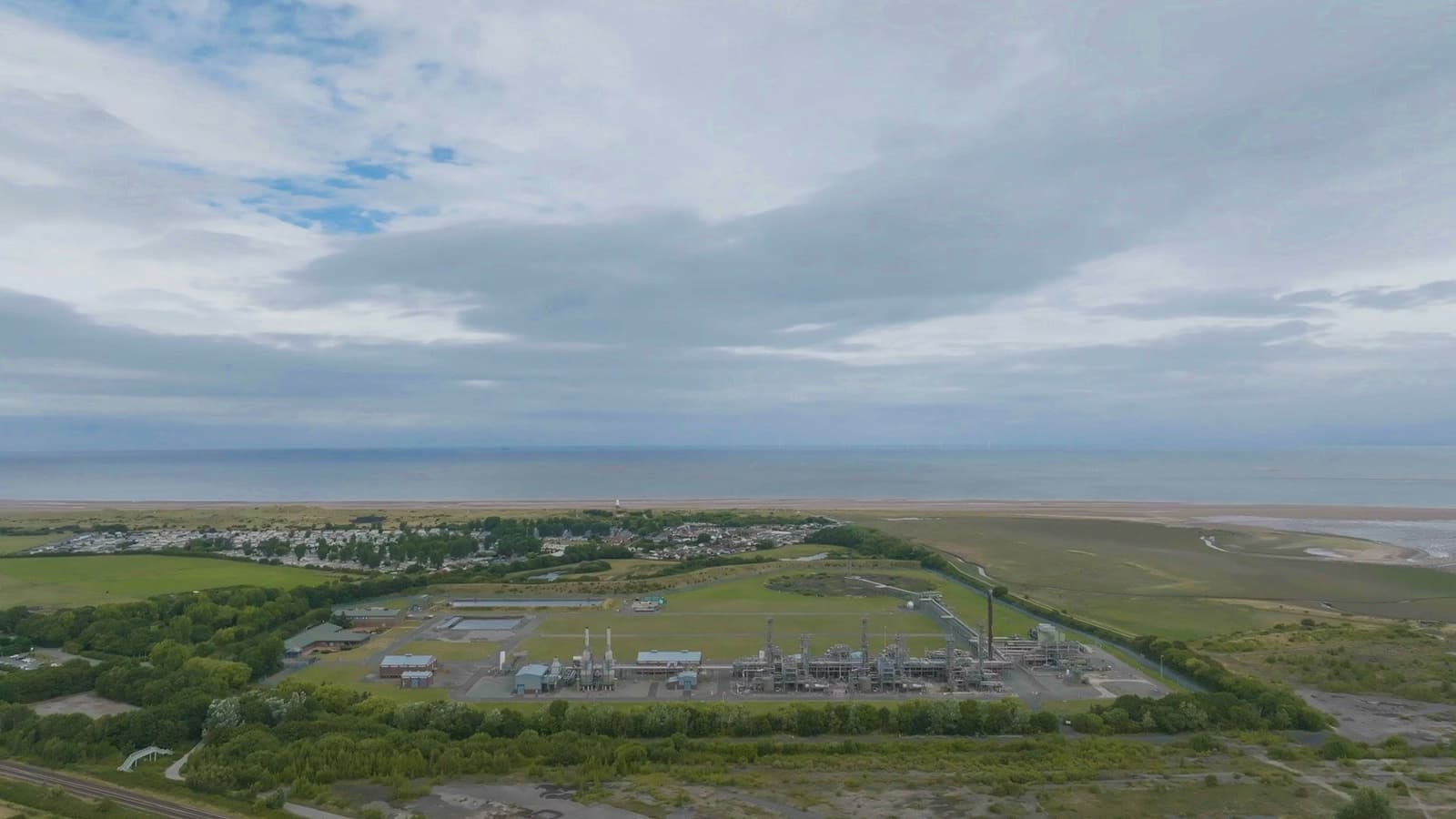
An aerial view of a coastal industrial facility near Liverpool Bay, England. Credit: The Crown Estate
The Douglas CCS platform was delivered in less than 18 months after the contract was awarded. It is made up of topside facilities that weigh roughly 2,078 US tons (1,885 metric tons) and a supporting jacket structure of another 1,935 US tons (1,755 metric tons).
In addition, it is secured to the seabed by eight foundation piles with a combined weight of 805 US tons (730 metric tons). Together, these components add up to approximately 4,817 US tons (4,370 metric tons). “The new Douglas CCS is the first purpose-built offshore platform dedicated to Carbon Capture and Storage (CCS) for industrial decarbonization in the world,” company officials said.
Supporting domestic employment
The installation represents a crucial achievement in the Liverpool Bay CCS project. Around 60 percent of its total investment expenditure is being delivered through UK-based supply chains.
What’s more, its construction is supporting over 2,000 jobs. Overall, the project is set to create up to 300 long-term roles, over an operational period exceeding 25 years. Its first phase is expected to store 109 million tons of CO2 over its lifetime. Annual capacity will initially reach 4.5 million tons, with plans to expand to 10 million tons after 2030.
“Liverpool Bay CCS forms part of Eni CCUS Holding’s portfolio of CCS initiatives and represents a key project in the company’s strategy to develop CO2 transportation and storage infrastructure to support industrial decarbonization at scale,” Eni concluded in a press release.
Carbon capture and storage (CCS) technology captures CO2 from power plants and industrial facilities before it actually enters the atmosphere. The gas is then transported deep underground for long-term storage. It is particularly beneficial for industries where switching to electricity or renewable energy alone cannot easily reduce emissions.
Related articles

Apple and LG leak shows new ‘tap to control’ HomeKit features
A post on X from "pdfu," who has previously posted leaks and renders of suspected Apple features and LG smart home gear, shows new details of rumored Apple Home accessories from LG.

Frances Haugen hopes The Social Reckoning will inspire more whistleblowers
Facebook whistleblower Frances Haugen was mostly unfazed watching Oscar-winning actress Mikey Madison play a character named after her in The Social Reckoning, except for one thing: the wrist warmers.

Microsoft tries to spark new life into Windows
When Microsoft released Windows 11 five years ago, it felt like an operating system that was still being renovated, a work in progress.

Stablecoin Card Spending Has Surged to $1 Billion a Month
Stablecoin card spending has grown nearly 2,000-fold since 2023. See what’s fueling their rise and why the market may just be getting started.

Where the World’s Biggest Arms Exporters Send Their Weapons
Explore who receives weapons from the world's biggest arms exporters, from U.S. shipments to Saudi Arabia to military aid for Ukraine.

Trump’s attempt to rename AI is looking awfully artificial
President Donald Trump has a knack for turning words against his enemies.