New laser technique triggers 75% stronger magnetic changes in ultra-thin iron layers
Researchers have confirmed that the ultrashort laser pulse alters the magnetic order of an iron...
This story was prepared automatically by software.
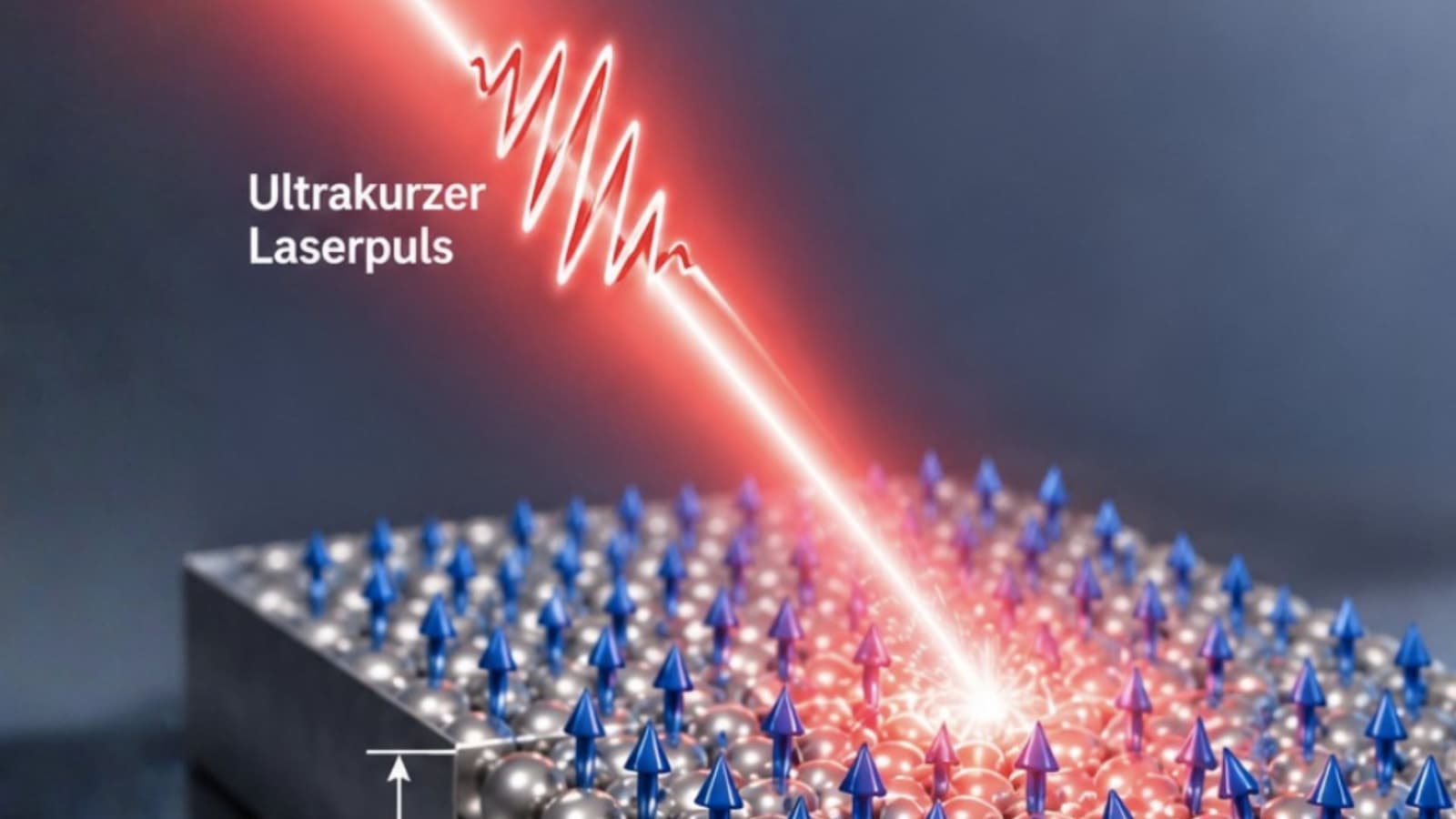
Researchers have confirmed that the ultrashort laser pulse alters the magnetic order of an iron layer. The team claimed that the thinner the layer, the greater the demagnetization. They revealed that their laser technique triggers stronger magnetic changes in ultra-thin iron layers.
The study, conducted by researchers from University of Duisburg-Essen, together with the Helmholtz Centre Berlin and other partners, could contribute to the development of new technologies for magnetic data storage in the long term.
The team highlighted that whether photos, videos, or documents; in large data centers, enormous amounts of data are stored on hard drives. These drives utilize tiny magnetic regions whose orientation determines the stored information. But how can data be stored even faster in the future? One possible approach involves ultrashort laser pulses, which can alter the magnetic order of materials in a fraction of a second.
Researchers investigated influence of an iron layer’s thickness
Therefore, researchers investigated the influence of an iron layer’s thickness on its so-called ultrafast demagnetization. In this process, the material loses a portion of its magnetic order within a very short time due to a laser pulse.
The findings revealed that the thinner the iron layer, the stronger this effect is found. With a layer thickness of just two nanometers – equivalent to two millionths of a millimeter – the demagnetization was around 75 percent stronger than with a 16-nanometer-thick layer. And this was despite the laser excitation intensity remaining the same.
Magnetic storage media
Published in the journal Advanced Science, the results could contribute in the long term to the development of magnetic storage media in which information is written using ultrashort laser pulses. However, several challenges remain before practical application. For example, suitable laser sources would need to be integrated into electronic components, and very small areas would need to be precisely targeted to enable high storage density.
But why do thinner layers react more strongly? The decisive factor is the so-called electron spins, whose alignment is responsible for the magnetism of iron, according to a press release.
“In particularly thin iron layers, a larger proportion of these spins are located at the material’s interfaces. There, they have fewer neighbors with whom they can interact magnetically,” explains Dr. Andrea Eschenlohr from the Faculty of Physics.
“Figuratively speaking, the spins can cling to fewer neighbors. This makes it easier to disrupt their magnetic order with a laser pulse.”
It had already been suspected that layer thickness might influence demagnetization. However, the strength of this effect and the fact that it is due to the magnetic properties of the material—and not to differences in light absorption or vibrations of the atomic lattice—were surprising, according to the study.
Source: https://interestingengineering.com/science/laser-technique-stronger-magnetic-changes
Related articles