France’s unrest explained: from school protests to nationwide riots, what happened and what comes next
Between 550,000 and 800,000 people marched across France on October 17 before looting and arson spread to dozens of cities and about 1,200 people were arrested. Here is what triggered the unrest, why it escalated, where things stand and what comes next, and how French and international media and X are framing it.
This story was prepared automatically by software.
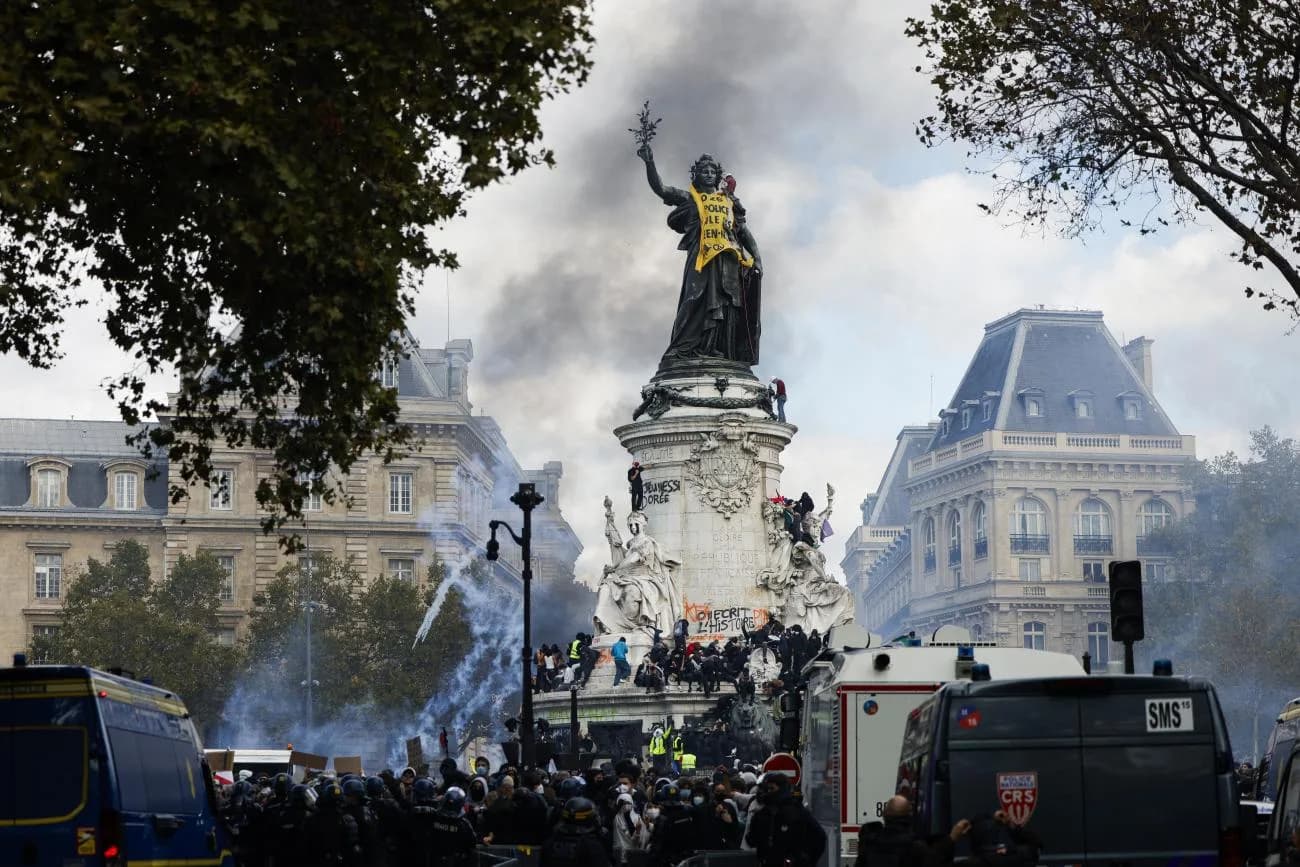
Nationwide protests against the rising cost of living in France on Saturday, October 17, turned into looting, arson and clashes with police in many cities, as egov.mn reported this morning. Prime Minister Sébastien Lecornu said about 1,200 people had been arrested and 150 police officers and gendarmes injured, figures carried by AFP, the BBC, CBC and TF1. This explainer pulls together how French and international outlets, and the main voices on X, are reading the crisis: what triggered it, why it escalated, what is happening now and what may come next. It reflects information available as of 1 p.m. Ulaanbaatar time (UTC+8) on October 18, 2026.
What triggered it?
A high school revolt. The movement began in late September at lycées (upper secondary schools) in the poor northern suburbs of Paris. According to The Guardian, anger over teacher absences and shabby facilities quickly became a nationwide movement against inequality, weak public spending and falling standards. Students blockaded school gates, complaining of large classes, a lack of substitute teachers and underfunding (The Connexion).
The Lens injury. On October 5, a 15-year-old lost a hand when a police stun grenade exploded outside the Auguste-Béhal lycée in Lens. The Béthune prosecutor said the grenade had been fired in line with procedure; the boy’s lawyer said he denies picking it up (franceinfo, France 3). Interior Minister Laurent Nuñez suspended the use of that type of grenade against young demonstrators, but said it could be used on Saturday (The Guardian).
A “yellow vest” call. Calls on social media to revive the “gilets jaunes” movement, which erupted in 2018 over fuel taxes, set October 17 as a day of action over fuel prices. The original founders said they were not behind the call, but the CGT union, La France Insoumise (LFI), the Greens and the Communist Party said they would join (The Connexion). Organisers hoped to build a “convergence of struggles” between the students and former yellow vests, AFP reported.
Why did it escalate?
Reporters and analysts point to several pressures arriving at once.
1. Prices, especially fuel. Final data from the statistics institute INSEE show annual inflation reached 3.1% in September, the highest since January 2024, driven by energy prices up 21.3% and petroleum products up 36.2% (franceinfo). Diesel averaged €2.36 a litre on October 15, and Euronews ranks French pump prices among the highest in the EU. On October 12 the government announced it would release 10 million barrels of diesel from strategic reserves, cutting prices by 12 to 18 cents a litre from November 1 to the end of January (Euronews).
2. An austerity budget and debt worries. Lecornu’s minority government presented a 2027 budget with €43 billion in savings in early October. At the time, Politico Europe reported, French borrowing costs were at their highest since 2008 and the spread over German bonds had topped 150 basis points. An opinion piece in Le Monde argued that the handling of the student movement and the 2027 budget showed that those in power were not grasping “the upheavals our country is going through.”
3. Policing. Since Lens, police violence has become a rallying cry. The Guardian reports that the police watchdog IGPN is investigating at least two dozen allegations, while the prime minister says more than 900 officers have been injured over the course of the movement. Historian Stéphane Sirot, who studies social movements, told the DNA newspaper that “when successive movements hit a wall every time, it only stokes the desire to fight,” arguing that Macron’s governments have tended to ignore demands rather than seek compromise.
4. A polarised pre-election climate. The presidential election is due in April 2027, and several recent polls suggest a run-off between the National Rally’s Marine Le Pen and LFI’s Jean-Luc Mélenchon, AFP reported. Politico Europe describes a “battle over the narrative” between the two extremes; an Odoxa poll found the French disapprove both of the government’s handling of the school protests and of LFI’s involvement.
What is happening now?
Key figures (official sources, times in Ulaanbaatar time, UTC+8):
- Turnout: The interior ministry counted 550,000 people at 110 marches nationwide, including 110,000 in Paris. Organisers and the CGT said 800,000.
- Arrests: 272 by 9 p.m. on October 17 (3 p.m. in Paris); about 400 according to Nuñez at around 2 a.m. on October 18; and 1,200 according to Lecornu at around 5:40 a.m. on October 18. BFMTV notes the toll is still provisional. Nuñez said most of those detained were adults with no link to the student movement.
- Injuries: The interior ministry first reported 60 officers hurt; Lecornu later put the figure at 150 police and gendarmes, two of whom were taken to hospital unconscious (BBC). In Saint-Étienne, a 17-year-old protester lost his right hand to a police grenade; the prosecutor has opened an investigation and handed it to the IGPN.
- Deployment: France 2 reported that 10,000 police and gendarmes were deployed nationwide and that reinforcements had to be called in during the day.
Where. TF1 says shops were ransacked and looted in more than 20 cities. AFP journalists saw dozens of shops looted in Paris, Marseille, Nice, Bordeaux and Lille, where an Apple store was stripped, and Nuñez also cited Rouen, Nantes, Toulouse, Strasbourg, Rennes, Pau and Valence. Protesters broke into town halls or prefectures in Marseille, Lille, Angers and Bordeaux. Limoges’ 143-year-old town hall was largely destroyed by fire, a “catastrophe for heritage,” according to regional prefect Maurice Barate (more here). A branch of Lyon’s tourist office was set alight, and the windows of broadcasters CNews and Europe 1 were smashed in Paris (DW). AFP reporters on the ground said the scenes appeared more intense and widespread than the 2023 riots or the yellow vest protests of 2018–19.
The government. President Emmanuel Macron wrote on X that there was “no place for violence in our Republic” and promised that vandals and looters would be prosecuted and punished. Lecornu blamed “ultra-left groups” joined by criminals, warned that the bill for the damage “will be heavy,” and told LFI it was time to “choose your side” between the Republic and its police, and the rioters. He defended his “casseur-payeur” (“you break it, you pay”) bill, tabled in the Senate on September 16, which would make people knowingly present during violent gatherings jointly liable for damage up to €10,000. Justice Minister Gérald Darmanin instructed prosecutors to seek pre-trial detention for those who attacked police, firefighters, public buildings and shops. Nuñez said there were no plans to declare a state of emergency (The Guardian). Commerce Minister Serge Papin pledged help for affected shopkeepers, and the mayors of Paris, Lyon and Marseille have asked to meet Lecornu early this week (AFP).
The opposition. Mélenchon blamed police commanders in Paris but told supporters that “those who share our fight have no business looting and ransacking.” Le Pen said “legitimate social demands” had been “taken hostage by the far left,” and National Rally president Jordan Bardella promised to suspend family benefits for repeat offenders. Former prime minister Édouard Philippe demanded that the perpetrators be “hunted down and punished with great severity,” while Gabriel Attal called the looting “shameful” (LCP).
How X and the media are framing it
A political duel on X. Macron’s post was by far the most viewed, while the clash between the prime minister and the LFI leader played out entirely on the platform: after Mélenchon blamed police commanders, Lecornu replied directly, writing, “It is YOUR political responsibility.” Darmanin’s instructions to prosecutors were also published on X. Metrics are as of 1 p.m. Ulaanbaatar time on October 18.

Aucune place pour la violence dans notre République. Ceux qui ont cassé, attaqué les préfectures comme les commerces, pillé jusqu’à nos mairies, seront poursuivis et punis. Aux forces de l’ordre, garantes du droit à manifester, je dis le soutien de la Nation. Nous ferons tous
Show moreRead 49,396 replies on X
Dans Paris, le commandement aberrant a ouvert la porte au chaos. Les chefs ne savent plus que faire, la troupe a peur et se déchaîne. Je ne sais pas qui entendra ma voix dans de telles circonstances, mais mon message est clair : ceux qui partagent notre combat n'ont rien à faire
Show moreRead 6,394 replies on X
Faire porter aux chefs de la police la responsabilité des violences, c’est une inversion dangereuse et cynique des responsabilités. Vous appelez celles et ceux qui partagent votre combat à ne pas participer aux pillages. Commencez donc par désigner clairement les responsables,
Show moreRead 1,809 replies on X
Des violences urbaines d'une gravité inouïe se sont déroulées aujourd'hui et se déroulent encore actuellement. Dès ce soir, dans la continuité de mes instructions des dernières 48 heures, j’ai redit à l'ensemble des procureurs généraux et des procureurs d’apporter une réponse
Show moreRead 1,595 replies on XVoices from abroad. U.S. Vice President JD Vance, quoting a video of the Limoges town hall fire, blamed the violence on immigration and failures of “assimilation” in a post that drew more than 74,000 likes and 1.6 million views, as AFP, France 24 and BFMTV reported. The French government, by contrast, has attributed the violence to ultra-left groups and opportunistic criminals.
Unverified and false claims. AFP’s fact-checkers found that videos from a Kurdish protest in Paris in December 2022 and from Paris Saint-Germain’s Champions League celebrations in May 2026 had been shared as footage of the current school protests. X summaries also linked the death of a 22-year-old who fell from the Arc de Triomphe to the protests, but Le Figaro, citing the Paris prefecture, reported the death was unrelated to the demonstrations; an inquiry into the cause of death has been opened.
Right and left in the French press. The centre-right Le Figaro described “scenes of urban guerrilla warfare and looting on a conveyor belt,” and an October 1 editorial in the paper accused Mélenchon of a “burnt school strategy.” Le Parisien ran “We have entered a different world,” focusing on criticism of the executive, while Le Monde reported that “the government, under pressure, targets LFI” and published an opinion piece on how the phrase “police violence” has become taboo for those in power. Public broadcaster France 2 highlighted peaceful marchers who could not reach the processions after police announced the two Paris routes late on Friday and about 30 metro stations were closed. LFI’s Manuel Bompard accused television channels of showing images of violence rather than the size of the marches.
International outlets. BBC Verify counted at least 11 baton blows aimed at five protesters by several officers in a 57-second video from central Paris. The Guardian tied the protests to a fraying welfare system and a polarised electorate, DW to “rising social polarization,” and Politico Europe to the presidential race. AP and CBC reported the largely peaceful marches by hundreds of thousands alongside the violence on their fringes.
What comes next?
Key dates:
- October 19–20: The mayors of Paris, Lyon and Marseille have requested a meeting with the prime minister. On October 20 the National Assembly votes on the first part of the 2027 budget; the social security budget is debated from October 20 to 26, with a vote on October 27 (National Assembly calendar).
- October 21: Trucking and coach operators’ organisations have called for a vehicle blockade of Paris over fuel costs, possibly lasting several days (The Connexion).
- November 1: Diesel price cuts from the strategic reserve release take effect.
- November 5: Trade unions have called a “general mobilisation” of public and private sector workers, retirees and students.
- November 17: Final Assembly vote on the 2027 budget. Without a majority, the government’s options include forcing it through under Article 49.3 of the constitution or adopting it by ordinance (Sud Ouest).
- April 2027: Presidential election.
Scenarios. Drawing on reporting and analysis:
- It fades. Saturday’s violence may discredit the movement, and the autumn school holidays that began on October 17 could pause school blockades. Sirot warns, however, that conflating peaceful protest with violence is a familiar way for governments to delegitimise a movement, and that ignoring demands risks reigniting it.
- It flares again. Another serious injury, findings in the Lens and Saint-Étienne investigations, the truckers’ blockade, the November 5 mobilisation or a forced budget vote under Article 49.3 could all trigger a new wave.
- It is absorbed into the campaign. Politico Europe reports that the National Rally is pressing its law-and-order message while LFI courts young people and social anger, and centrists are struggling to break through. One government adviser summed up the situation to Politico as “maxi merde”; a centrist adviser said: “Lecornu is always running behind the crises.”
Editor’s note
France’s crisis resists a single label: peaceful marches by hundreds of thousands of people and the violence and looting on their fringes need to be seen separately. Arrest and injury tolls are provisional, and government and union turnout figures differ. On X, French politicians and foreign figures alike are reading the events through their own lenses, and old footage keeps being recycled as new, so relying on verified sources matters.
For Mongolia the direct link is limited, but there is a lesson: the fuel price shock linked to the war in Iran is hitting every country that imports its fuel, and France shows how quickly price pressure, youth frustration and weak public services can combine into unrest. Mongolian citizens in France would do well to avoid protest areas and follow local authorities’ instructions.
Related:
- French protests turn to rioting and looting as 1,200 are arrested and 150 police injured
- Limoges’ 143-year-old town hall largely destroyed by fire during French cost-of-living protests
Sources: AFP, BBC, CBC, TF1, franceinfo / France 2, France 24, BFMTV, 20 Minutes, Le Monde, Le Figaro, Le Parisien, LCP, DNA, The Guardian, DW, AP, Politico Europe, Euronews, The Connexion, INSEE, the French National Assembly, AFP Fact Check and official accounts on X. Views expressed by individuals on X do not represent the position of egov.mn.
Related articles