
Mapped: Youth Unemployment Rates Across Europe in 2026
A third of young Romanians are out of work, as are a fifth of Spaniards. Germany offers one potential solution.
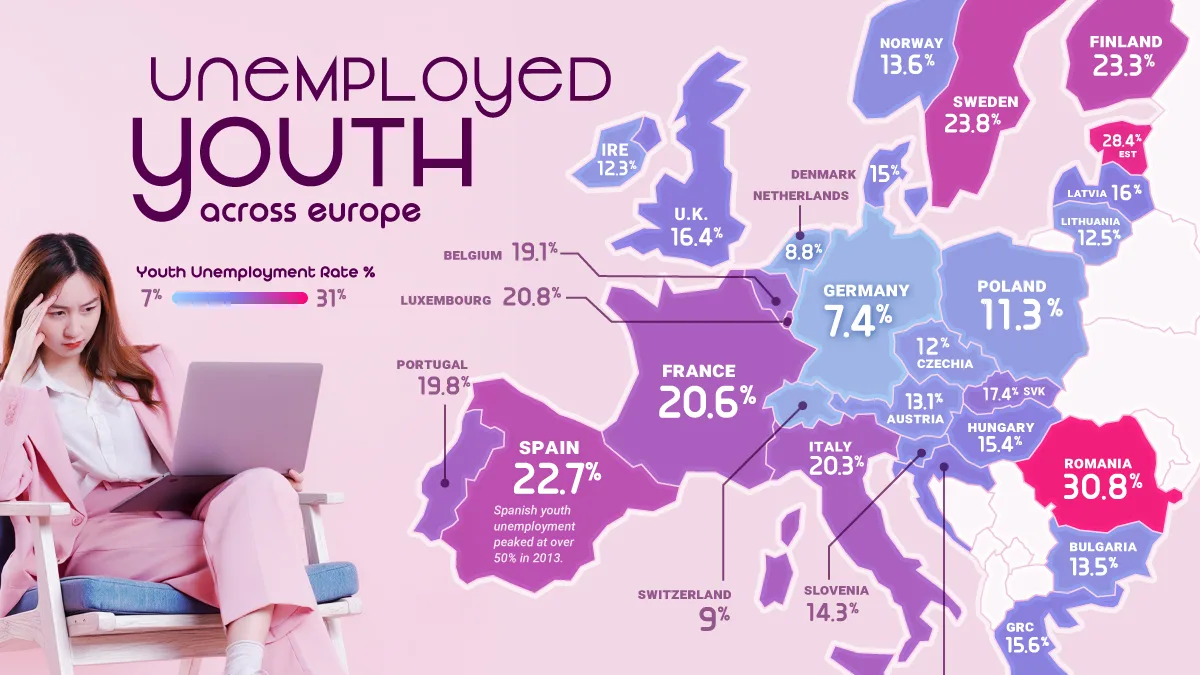
How Youth Unemployment Compares Across Europe
Key Takeaways
Romania has Europe’s highest youth unemployment rate at 30.8%, while Germany has the lowest at 7.4%.
Sweden (23.8%) and Finland (23.3%) both have higher youth unemployment rates than Spain (22.7%).
Spain’s youth unemployment rate has more than halved since its peak above 50% in 2013.
The first job is often the hardest one to find. Nearly 3 million people under 25 were unemployed across the European Union in August 2026, with significant differences in job prospects from country to country.
This map compares youth unemployment rates across 31 European countries using August 2026 data from Eurostat and the Institute of Employment Rights.
Rates measure unemployment among economically active people ages 15–24, or 16–24 in the United Kingdom, rather than the entire youth population.
Europe’s Uneven Start to Working Life
The map reveals a striking gap in job prospects for young Europeans. Romania’s youth unemployment rate is more than four times Germany’s, while France and Italy also report rates above 20%.
Some of the most surprising figures come from Northern Europe. Sweden and Finland both rank among the countries with the highest youth unemployment rates, challenging the traditional perception of Southern Europe as the region facing the greatest difficulties in youth employment.
RankCountryYouth Unemployment Rate in Aug 2026 (%)
1Romania30.8
2Estonia28.4
3Sweden23.8
4Finland23.3
5Spain22.7
6Luxembourg20.8
7France20.6
8Italy20.3
9Portugal19.8
10Belgium19.1
11Slovakia17.4
12Croatia16.4
12United Kingdom16.4
14Latvia16.0
15Greece15.6
16Hungary15.4
17Denmark15.0
18Slovenia14.3
19Norway13.6
20Bulgaria13.5
21Austria13.1
22Lithuania12.5
23Ireland12.3
24Czechia12.0
25Cyprus11.9
26Poland11.3
27Iceland11.0
28Malta9.7
29Switzerland9.0
30Netherlands8.8
31Germany7.4
The latest figures also reveal diverging trends among Europe’s major economies. Spain’s youth unemployment rate fell 2.3 percentage points over the last year, while France’s rose 1.2 points. Although their current rates are similar, the two countries are moving in opposite directions.
The cost of a difficult start can last well beyond the job search. Research using UK employment records found that unemployment early in adulthood reduced earnings later in life, with the strongest effects when it occurred between ages 18 and 20.
Germany’s Apprenticeship Solution
Germany’s dual vocational training system gives young people an early route into employment. Apprentices divide their training between a company and a vocational school, gaining paid work experience while continuing their education.
Around half of Germany’s school leavers choose this route, which spans more than 300 recognized occupations. Instead of entering the job market with classroom learning alone, participants build practical experience and relationships with employers during their training.
The employment outcomes illustrate the strength of Germany’s vocational pathway. In 2025, 89% of Germans ages 25–34 with vocational qualifications were employed, slightly above the rate among degree holders. While apprenticeships are not the only factor behind Germany’s low youth unemployment, they provide a well-established route from education into paid work.
Spain’s Shift Toward More Stable Jobs
Spain’s youth unemployment rate has more than halved from its crisis-era high, when it exceeded 50% in 2013. Alongside that recovery, the country has been tackling another longstanding problem: the instability of jobs available to younger workers.
Before the latest major labor reform, short-term contracts were deeply embedded in Spain’s youth labor market. In 2021, nearly a third of employment contracts for people under 25 lasted two weeks or less, limiting opportunities to build experience and progress into better-paying roles.
A 2021 reform restricted temporary hiring, helping reduce temporary employment across the economy from 25.4% at the end of 2021 to around 16% in 2024. For younger workers, greater job stability can provide a more dependable foundation for building their careers.
Learn More on the Voronoi App
To see how men and women fare differently in the job market, check out Mapped: The World’s Unemployment Gender Gap on Voronoi.
Related articles

Mapped: Where Millennials Own vs. Rent in America
Explore millennial homeownership rates across U.S. cities, from Provo's 71% ownership rate to Los Angeles' 69% rental rate.
Ranked: America’s Biggest Farm Economies in 2025
California is America's largest agricultural economy, but the Midwest as a region produces nearly half of U.S. agricultural production value.
Mapped: America’s Fastest-Growing Major Cities
Explore the fastest-growing cities in America. Miami leads 45 major urban areas in population growth from 2022 to 2024.
Ranked: Countries That Owe the Most Money to the IMF
Argentina used to be richer than Europe and has not faced war in decades. Today it owes more to the IMF than any other country.
Charted: The Three Waves of the U.S. Trade Deficit (1990–2026)
The U.S. trade deficit in semiconductors and AI hardware hit an annualized $546 billion in Q2 2026, overtaking machinery and oil's 2008 peak.