
Directed-energy weapon that can neutralize threats in seconds integrated on unmanned ground vehicle
A San Francisco-based company has showcased that laser-based counter-drone weapon can easily offer aerial protection...
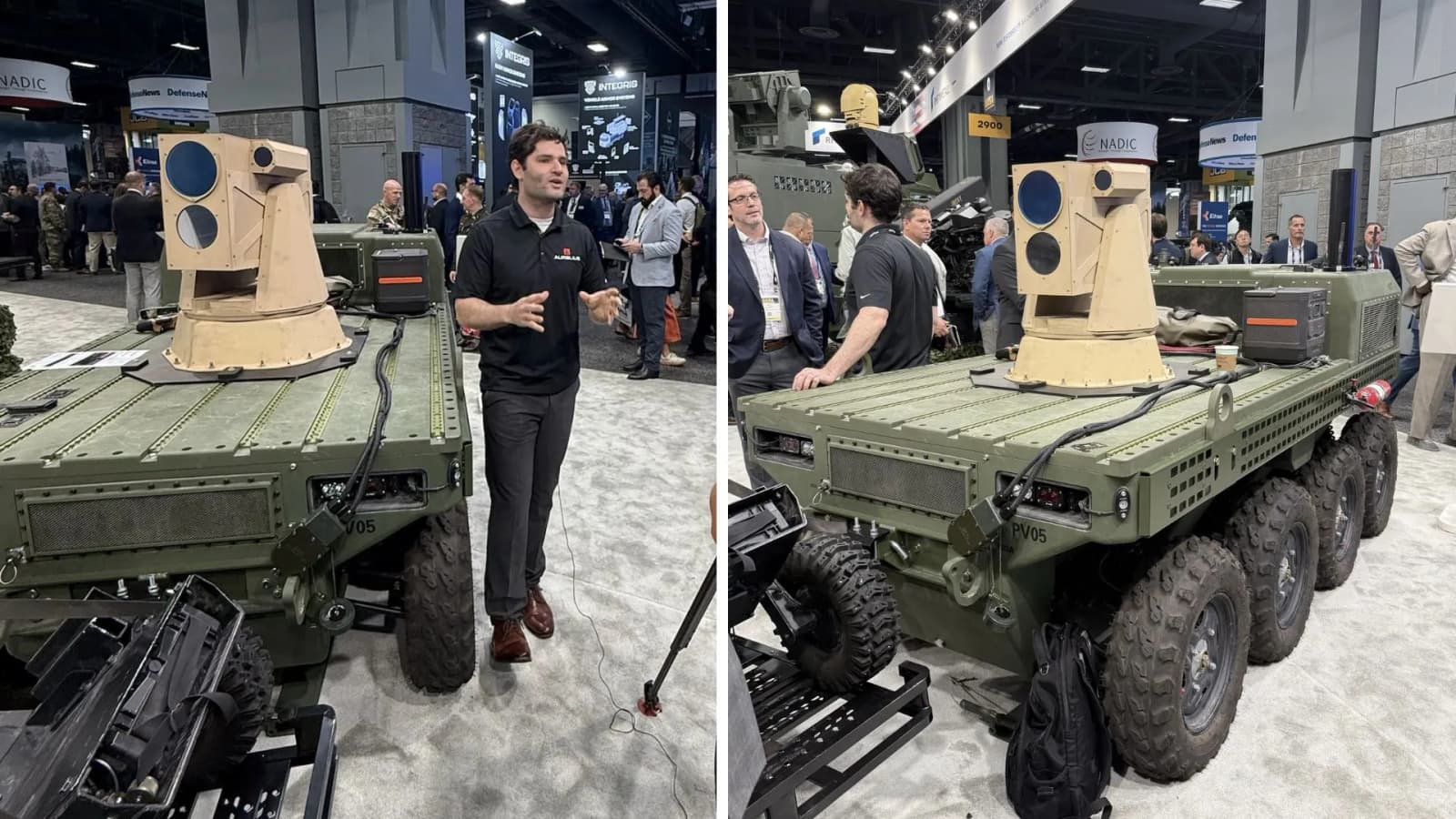
A San Francisco-based company has showcased that laser-based counter-drone weapon can easily offer aerial protection for autonomous military logistics vehicles. Aurelius Systems recently mounted its Archimedes autonomous laser weapon on an American Rheinmetall unmanned ground vehicle at AUSA 2026.
Aurelius Systems revealed that by combining high-power directed energy lasers, advanced sensors, and AI autonomy, Archimedes tracks, targets, and neutralizes aerial threats in seconds. When deployed in numbers, Archimedes units form a resilient defense grid, creating persistent protection for forces, facilities, and critical infrastructure.
Directed-energy counter-UAS systems offer precise engagement
The integration brings together an autonomous ground platform and a directed-energy weapon designed to detect, track and engage small aerial targets. The concept addresses an increasingly important battlefield challenge: how to sustain military forces when conventional supply vehicles and personnel face persistent surveillance and attacks from inexpensive drones.
Directed-energy counter-UAS systems offer precise engagement with multi-drone threats. They provide a compact, low-SWaP-C platform that reduces costs and logistical burden compared to traditional systems.
Built for rapid deployment without heavy logistics
The system is small, compact, and field-portable and built for rapid deployment without heavy logistics. It also integrates optical sensing paired with machine learning for real-time detection and targeting — no operator required.
Aurelius Systems’ partnership with Rheinmetall was announced in July. The partnership brings together Aurelius’ directed-energy platform, Archimedes, with American Rheinmetall’s robotic combat vehicles to address one of the most urgent challenges in modern defense: mobile, cost-effective, scalable protection against multi-drone threats.
Archimedes is being integrated first on the Ox, the unmanned ground vehicle American Rheinmetall has entered in the U.S. Army’s Ground Optionally Autonomous Transport competition for a vehicle that hauls supplies and equipment over rough terrain. With a laser on board, a cargo-carrying vehicle can defend itself against drones during resupply runs, a role Rheinmetall has described as protection for autonomous logistics missions.
“The battlefield demands mobility, autonomy, and resilience. By integrating autonomous directed-energy with robotic combat vehicles, we’re delivering force-multiplying technologies that operate in the most dangerous environments, helping protect warfighters while enhancing mission effectiveness,” said CEO of Aurelius Systems Michael LaFramboise in July, .
“This partnership with American Rheinmetall supports a future where forces can sustain operations in contested environments, reduce warfighter risk, and maintain freedom of movement.”
The laser is being integrated with American Rheinmetall’s Ox unmanned ground vehicle, a platform entered in the U.S. Army’s Ground Optionally Autonomous Transport competition.
The vehicle is intended to transport supplies and equipment across difficult terrain, supporting military logistics operations where sending crewed vehicles could expose personnel to unnecessary danger.
Integrating Archimedes could expand the Ox’s role beyond transporting cargo. Equipped with a counter-drone capability, the platform could potentially detect and engage aerial threats while supporting supply movements.
This would be particularly relevant in contested environments where drones can observe roads, locate logistics convoys and attack vehicles carrying ammunition, fuel, food and other essential supplies.
Related articles
New nuclear waste sensor detects 100 kHz vibrations, could help spot canister cracks
Researchers at the University of Pittsburgh have demonstrated a fiber-optic sensing system capable of detecting...
World’s first fast-spectrum molten chloride reactor experiment nears critical testing
A nuclear experiment backed by the U.S. Department of Energy could deliver crucial operating data...
US Military drones tap 150,000 radios in push to beat battlefield jamming threats
L3Harris Technologies and Skydio are integrating military drones with tactical radio technology to help U.S....


Anthropic grants METR researchers employee-like access for independent AI evaluations
Anthropic said on October 15 it has onboarded six METR employees with company hardware, office space and internal-tool access roughly on par with its own risk teams, and that METR can publish assessments Anthropic cannot veto.

Google DeepMind shows Antigravity finding a novel antimicrobial peptide candidate
In an October 15 technical walkthrough, Google DeepMind described how biologists used the Antigravity agentic science workbench to identify a 97-amino-acid bacteriocin candidate now entering wet-lab validation.