Mapped: How Much of Each Country Is Online?
See which countries lead in internet access in 2025, where connectivity lags, and why the global digital divide persists.
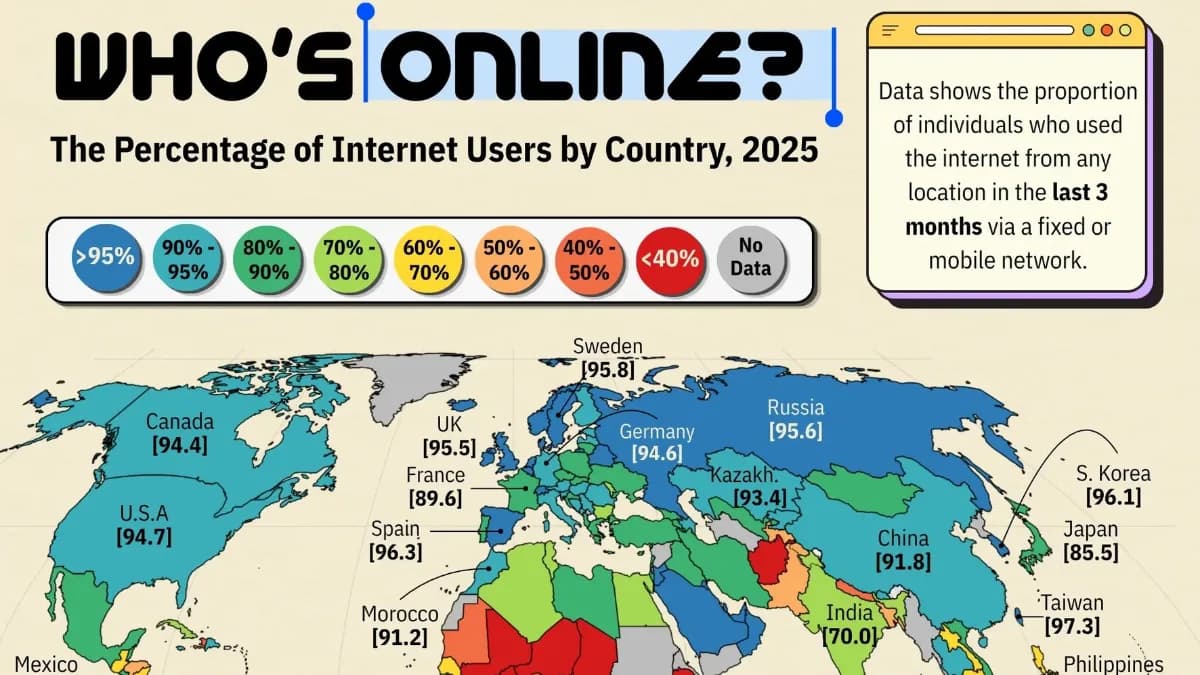
How Internet Usage Compares Around the World
Key Takeaways:
Four countries—Bahrain, Kuwait, Saudi Arabia, and the UAE—report 100% internet usage.
Africa has some of the lowest internet adoption rates, with just 35.0% of Kenyans and 41.2% of Nigerians online.
Europe, North America, and Australia have widespread internet adoption, while parts of Asia and South America show substantial disparities.
Internet access has become essential to modern life, but billions of people remain disconnected from the digital world.
This visualization, created by Iswardi Ishak, maps internet usage across countries using 2025 data from the International Telecommunication Union (ITU), with 2024 figures substituted where unavailable.
Internet Usage by Country in 2025
The following table shows the percentage of individuals who used the internet within the previous three months, according to the ITU’s Individuals Using the Internet dataset.
Country/Territory% of Internet Users
Afghanistan16.09%
Albania85.86%
Algeria77.42%
Andorra94.40%
Angola40.70%
Antigua and Barbuda72.73%
Argentina89.67%
Armenia83.43%
Australia96.13%
Austria91.93%
Azerbaijan90.80%
Bahamas92.47%
Bahrain100%
Bangladesh53.42%
Barbados70.36%
Belarus95.53%
Belgium96.46%
Belize80.01%
Benin33.98%
Bhutan91.28%
Bolivia (Plurinational State of)79.70%
Bosnia and Herzegovina90.11%
Botswana57.46%
Brazil84.92%
Brunei Darussalam96.30%
Bulgaria79.68%
Burkina Faso28.25%
Burundi8.60%
Cabo Verde74.74%
Cambodia68.48%
Cameroon46.26%
Canada94.35%
Central African Rep.13.78%
Chad12.63%
Chile95.59%
China91.80%
Colombia79.35%
Comoros32.52%
Congo (Rep. of the)47.25%
Costa Rica89.95%
Côte d'Ivoire41.43%
Croatia85.90%
Cuba70.48%
Cyprus89.60%
Czech Republic88.47%
Dem. Rep. of the Congo19.67%
Denmark99.77%
Djibouti65.30%
Dominica82.05%
Dominican Rep.91.00%
Ecuador80.07%
Egypt74.65%
El Salvador82.24%
Equatorial Guinea63.30%
Eritrea-
Estonia92.24%
Eswatini63.40%
Ethiopia21.94%
Fiji74.71%
Finland94.13%
France89.59%
Gabon68.72%
Gambia57.10%
Georgia83.80%
Germany94.58%
Ghana72.18%
Greece89.15%
Grenada70.16%
Guatemala60.22%
Guinea33.30%
Guinea-Bissau29.78%
Guyana83.00%
Haiti47.86%
Honduras58.62%
Hong Kong, China95.76%
Hungary92.80%
Iceland98.21%
India70%
Indonesia77.63%
Iran (Islamic Republic of)85.34%
Iraq81.47%
Ireland97.19%
Israel88.18%
Italy90.32%
Jamaica90.11%
Japan85.54%
Jordan95.62%
Kazakhstan93.39%
Kenya34.98%
Kiribati89.44%
Korea (Rep. of)96.09%
Kosovo-
Kuwait100%
Kyrgyzstan92.03%
Lao P.D.R.65.59%
Latvia94.43%
Lebanon80.63%
Lesotho51.80%
Liberia32.23%
Libya81.95%
Liechtenstein98.26%
Lithuania89.16%
Luxembourg99.13%
Macao, China89.83%
Madagascar18.68%
Malawi18.96%
Malaysia98.28%
Maldives85.24%
Mali36.80%
Malta93.86%
Marshall Islands65.92%
Mauritania45.78%
Mauritius73.31%
Mexico83.12%
Micronesia39.52%
Moldova77.37%
Monaco99.04%
Mongolia85.12%
Montenegro94.11%
Morocco91.18%
Mozambique20.53%
Myanmar-
Namibia64.87%
Naoero83.01%
Nepal (Republic of)46.32%
Netherlands97.01%
New Zealand93.52%
Nicaragua61.40%
Niger39.47%
Nigeria41.21%
North Macedonia93.60%
Norway99%
Oman95.25%
Pakistan57.25%
Palau83.93%
Palestine-
Panama72.77%
Papua New Guinea18.81%
Paraguay85.36%
Peru81.96%
Philippines67.26%
Poland89.65%
Portugal89.45%
Puerto Rico-
Qatar98.09%
Romania93.15%
Russian Federation95.57%
Rwanda31.70%
Saint Kitts and Nevis76.88%
Saint Lucia68.21%
Saint Vincent and the Grenadines76.19%
San Marino97.35%
Sao Tome and Principe59.12%
Saudi Arabia100%
Senegal62.26%
Serbia90.04%
Seychelles87.82%
Sierra Leone25.10%
Singapore97.37%
Slovakia89.83%
Slovenia91.57%
Solomon Islands29.04%
Somalia27.94%
South Africa78.36%
South Sudan-
Spain96.31%
Sri Lanka49.90%
Suriname-
Sweden95.77%
Switzerland97.32%
Syrian Arab Republic-
Taiwan, Province of China97.29%
Tajikistan55.79%
Tanzania31.16%
Thailand92.26%
Timor-Leste-
Togo39.48%
Tonga67.44%
Trinidad and Tobago82.16%
Tunisia77.70%
Türkiye89.77%
Uganda8.95%
Ukraine82.47%
United Arab Emirates100%
United Kingdom95.47%
United States94.69%
Uruguay91.99%
Uzbekistan89.51%
Vatican89.22%
Venezuela76.68%
Viet Nam87.12%
Yemen-
Zambia29.70%
Zimbabwe41.64%
Denmark (99.8%) and Luxembourg (99.1%) are also approaching universal internet usage. At the opposite extreme, Afghanistan has just 16.1% internet usage, highlighting the enormous gap between the world’s most and least connected populations.
Why Is Internet Usage Lower in Parts of Africa?
Some of the world’s largest connectivity gaps are found in sub-Saharan Africa. Internet usage stands at 41.2% in Nigeria, 35.0% in Kenya, and just 29.7% in Zambia.
Limited telecommunications infrastructure and high mobile data costs remain major obstacles, particularly in rural communities where extending networks can be expensive.
Closing these gaps requires more than expanding network coverage. Making internet access affordable is equally important.
Asia’s Digital Divide Goes Beyond Network Coverage
Asia is home to some of the world’s most connected populations, including Malaysia (98.3%), Singapore (97.4%), and South Korea (96.1%). Meanwhile, internet usage is substantially lower in India (70.0%) and the Philippines (67.3%).
According to the GSMA, 1.2 billion people across developing Asia-Pacific remained offline despite widespread mobile network coverage. This highlights how device affordability, digital literacy, and mobile data costs can be just as important as network availability.
Europe and North America Lead, While South America Catches Up
Europe benefits from mature telecommunications infrastructure and coordinated connectivity policies. Meanwhile, Canada (94.4%), the U.S. (94.7%), and Australia (96.1%) demonstrate similarly high adoption rates. These countries also rank among the world’s digital leaders, although rural connectivity gaps persist.
South America presents a mixed picture. Chile (95.6%) and Uruguay (92.0%) have high internet adoption rates, while Colombia (79.4%) trails behind. Geographic and income barriers, along with the high cost of broadband infrastructure, continue to constrain access across parts of the region.
Learn More on the Voronoi App
For another perspective on global connectivity, explore A Day of Activity on the Internet to discover what happens across the digital world every day.
Get the latest news delivered to your inbox.
Related articles