US researchers build first-ever chip that separates mixed laser light into beams
Stanford engineers and colleagues built a fingernail-sized chip that sorts mixed laser light into separate,...
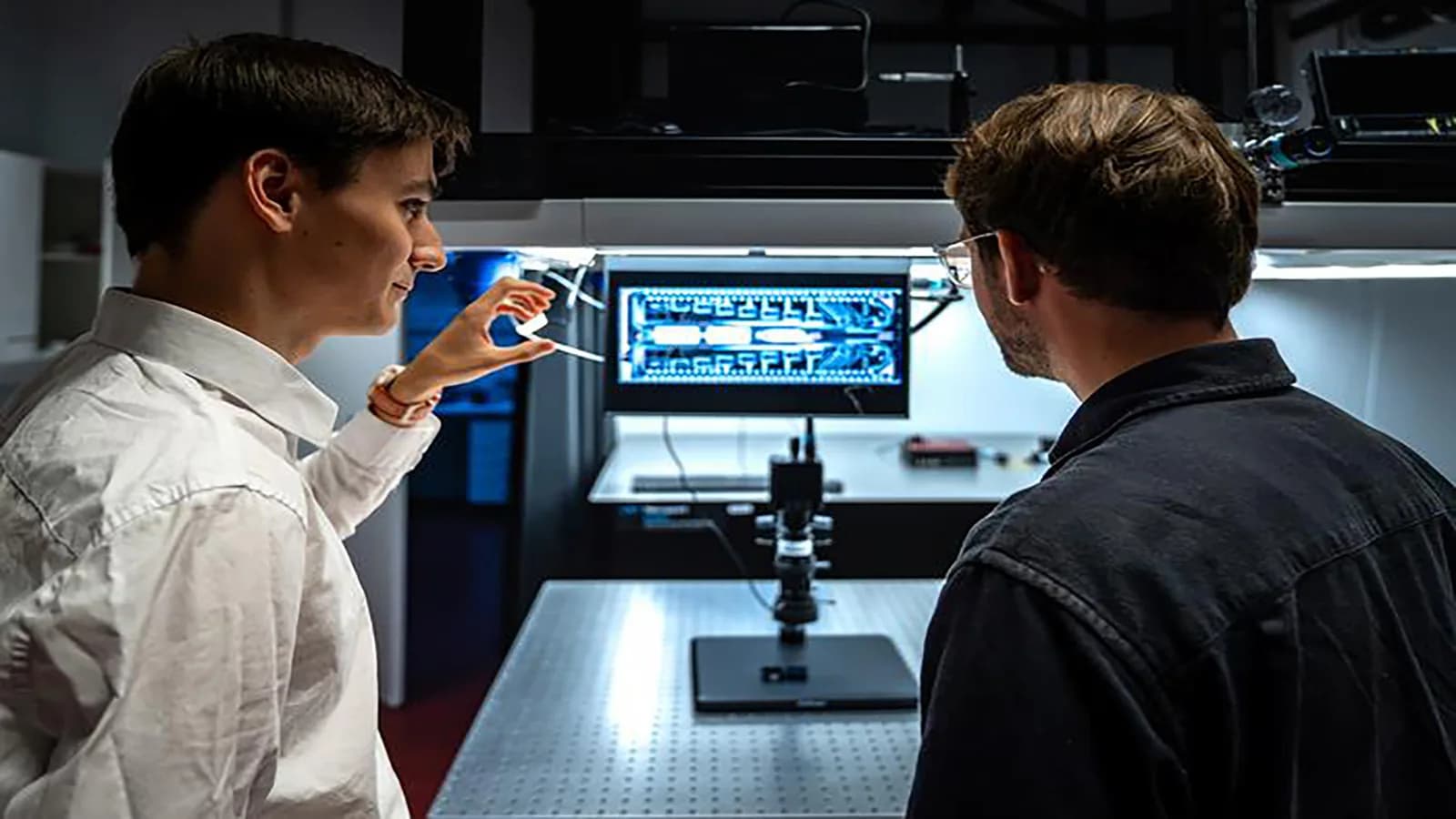
Stanford engineers and colleagues built a fingernail-sized chip that sorts mixed laser light into separate, independent beams, according to a study published Oct. 30 in Nature Photonics. Stanford said it is the first time researchers have shown a device that does this with partially coherent light, meaning light whose waves line up only briefly.
Laser light is coherent: its photons oscillate together, said Annie Kroo, a Stanford PhD student in electrical engineering and co-lead author. Light from a bulb is incoherent, she said, with photons out of sync. Light’s true nature is partially coherent, said co-author Charles Roques-Carmes, an assistant professor at the Institute of Science and Technology Austria (ISTA). He said researchers want to split that mixed light into independent parts, which could enable new kinds of communication, computing and sensing.
Kroo said the underlying ideas date to the 1980s but had never been tested in an experiment.
How the chip sorts light
The team sent two infrared lasers into a photonic chip, a device that steers light for data processing much as laptop chips steer electrons, according to Stanford.
Stanford said the combined beam was partially coherent and that the chip’s algorithms sorted it into separate outputs. The paper measures this as vanishing fringe visibility. In a separate test on a different circuit, adding a third laser also worked, the paper said. Co-lead author, Paul-Alexis Mor, an academic visitor at ISTA, said the outputs show “absolutely no correlation anymore.”
Co-author Shanhui Fan, a Stanford professor, said the chip learns the separate components of an unknown light field, called coherence modes, and sends each to its own output. Photonic chips have grown smaller and more powerful in recent years, Stanford said, but controlling the light inside remains hard.
What it could do next
A camera flattens light into a two dimensional image, so overlapping sources tend to blur together, Stanford said. Under a microscope, two overlapping fluorescent particles might look like one, the release said. A chip like this could, in principle, tell them apart, Kroo said, because the light itself carries signs of separate sources.
It’s worth noting that the release describes tests with infrared lasers, not starlight or microscope samples, and presents the imaging uses as potential. The chip is tuned by a feedback loop that runs on external control electronic, the paper said.
The paper describes a nine-input chip that separated the two strongest components of light from two lasers. The authors reported crosstalk, a measure of how much light leaks between outputs, as low as minus 13 decibels. The paper said the chip recovers the original lasers only when their beam patterns are spatially orthogonal, meaning mathematically independent.
Kroo, David Miller and Olav Solgaard, both Stanford professors, are now working with NASA to test whether the technology could probe light from distant galaxies, Stanford said. Light that looks like one blob in a telescope might hold separate strands from stars and exoplanets, the release said.
Get the latest news delivered to your inbox.
Related articles