
Mapped: The World’s Military Alliances in 2026
This map shows five major mutual defense alliances around the world, including NATO, the Rio Pact, CSTO, GCC, and the new Mecca Defence Alliance.
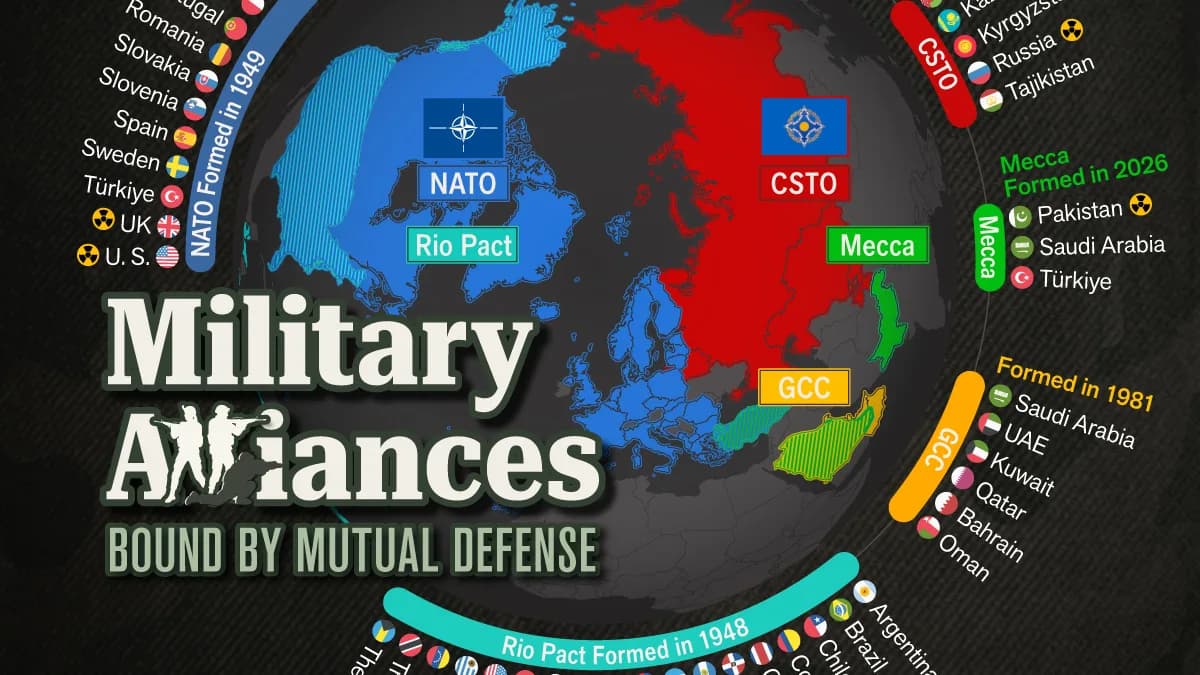
How the World’s Mutual Defense Alliances Look in 2026
Key Takeaways
The Mecca Defence Alliance, formed in August 2026, is the newest pact shown, linking Saudi Arabia, Türkiye, and Pakistan.
The Rio Pact is the oldest alliance shown, predating NATO by two years, while NATO is the largest alliance on the map.
The U.S., Türkiye, and Saudi Arabia each belong to two alliances shown, creating overlaps between regional defense networks.
Mutual defense treaties are built around a simple principle: an attack on one member is treated as an attack on the wider group.
NATO is one prominent example, but similar arrangements stretch across the Americas, Eurasia, and the Gulf. This visualization maps five major multilateral defense alliances currently in force and shows where their memberships overlap.
Five Major Mutual Defense Alliances
The map draws on data from NATO, the Organization of American States, the Gulf Cooperation Council, the CSTO, and reporting from Al Jazeera and the Atlantic Council.
The visualization focuses specifically on formal multilateral agreements containing mutual defense commitments. Broader military partnerships without an equivalent collective-defense provision are not included.
NATO is by far the largest alliance shown, with 32 members across Europe and North America. The Rio Pact covers much of the Americas, while the GCC links the six Gulf monarchies. The CSTO spans Russia and several former Soviet states, while the three-member Mecca Defence Alliance is the newest pact on the map.
AllianceFormedCountries shownRegionOverlapping membership
NATO194932Europe & North America United States, Türkiye
Rio Pact194718Americas United States
CSTO19925Eurasia—
GCC19816Gulf Saudi Arabia
Mecca Defence Alliance20263Middle East & South Asia Türkiye, Saudi Arabia
The Rio Pact Is Older Than NATO
The oldest alliance shown is the Inter-American Treaty of Reciprocal Assistance, commonly known as the Rio Pact. It was signed in 1947, two years before NATO was established in 1949.
The treaty established a collective-defense framework across the Americas, although its membership has changed substantially over the decades. The United States remains a party to the Rio Pact while also belonging to NATO, making it one of three countries on the map covered by two of the alliances shown.
NATO has expanded from 12 founding members to 32, with Finland joining in 2023 and Sweden in 2024. The alliance has also seen a sharp rise in military spending in recent years, though the United States still accounts for an outsized share of NATO defense spending.
The New Mecca Defence Alliance Connects Three Security Blocs
The biggest recent change to the map came in August 2026, when Saudi Arabia, Türkiye, and Pakistan signed the Makkah Joint Defence Agreement. The pact states that an armed attack against one of the three countries will be considered an attack against them all.
Its three members bring different existing security relationships. Türkiye has belonged to NATO since 1952, while Saudi Arabia is part of the six-member Gulf Cooperation Council. Pakistan belongs to neither alliance and is a nuclear-armed state.
The agreement creates a new point of overlap between security arrangements that previously occupied largely separate regions.
The CSTO Has Seen Its Membership Shrink
While the newest alliance on the map is expanding the network of mutual-defense commitments, the CSTO has moved in the opposite direction.
The Russia-led alliance currently has five active members: Belarus, Kazakhstan, Kyrgyzstan, Russia, and Tajikistan. Armenia, which joined the organization at its founding, suspended its participation in 2024 but has not formally withdrawn.
That leaves the CSTO with a smaller active footprint than it had for much of its history and makes Armenia an unusual case on the map: still formally tied to the alliance, but no longer participating in its activities.
Why Other Major Security Partnerships Aren’t Shown
Several well-known security groupings are absent because they do not meet the definition used for this visualization.
AUKUS, for example, is a defense and technology partnership rather than a treaty containing an Article 5-style collective-defense commitment. Other arrangements may require members to consult following an attack without explicitly committing them to mutual defense.
The map therefore focuses on a narrower category: formal multilateral agreements with mutual defense language currently in force, where a majority of the original signatories remain bound.
Learn More on the Voronoi App
If you enjoyed today’s post, check out 75 Years of NATO on Voronoi, the app from Visual Capitalist.
Related articles

An exiled Myanmar journalist’s story: Echoing public’s voice and resilience
“When our journalism produces positive outcomes, the sense of fulfilment is difficult to compare with anything else.”

UK blinds enemy spy satellites with ground-based lasers to shield military secrets
Britain has been using a ground-based laser system to disrupt adversary spy satellites, temporarily blinding...
China’s 339m nuclear carrier could hold 90 aircraft, beating world’s largest US warship
China appears to be building an aircraft carrier that could rival the US Navy’s largest...

Technology-facilitated trafficking: How Bangladeshi migrants become victims of recruitment in Cambodia
Thousands of Bangladeshis travelled to Cambodia for promised jobs, only to encounter Technology-facilitated trafficking and cyber-scamming networks, with 98 percent reportedly failing to receive the work they were promised.

China showcases Type 99B tank in live-fire drills after 2025 parade debut
China has released footage of live-fire drills of its Type 99B main battle tank roughly...

China fears US deployment of space weapons raises risks of fresh arms race: Report
The United States has publicly acknowledged that it has weapons deployed in orbit, marking a...