Mock pollination: 1.29-gram insect-scale flapping robot dodges obstacles, lands on sunflower
A flapping-wing robot weighing 1.29 grams (0.045 ounces) has hovered, tracked trajectories, and flown through...
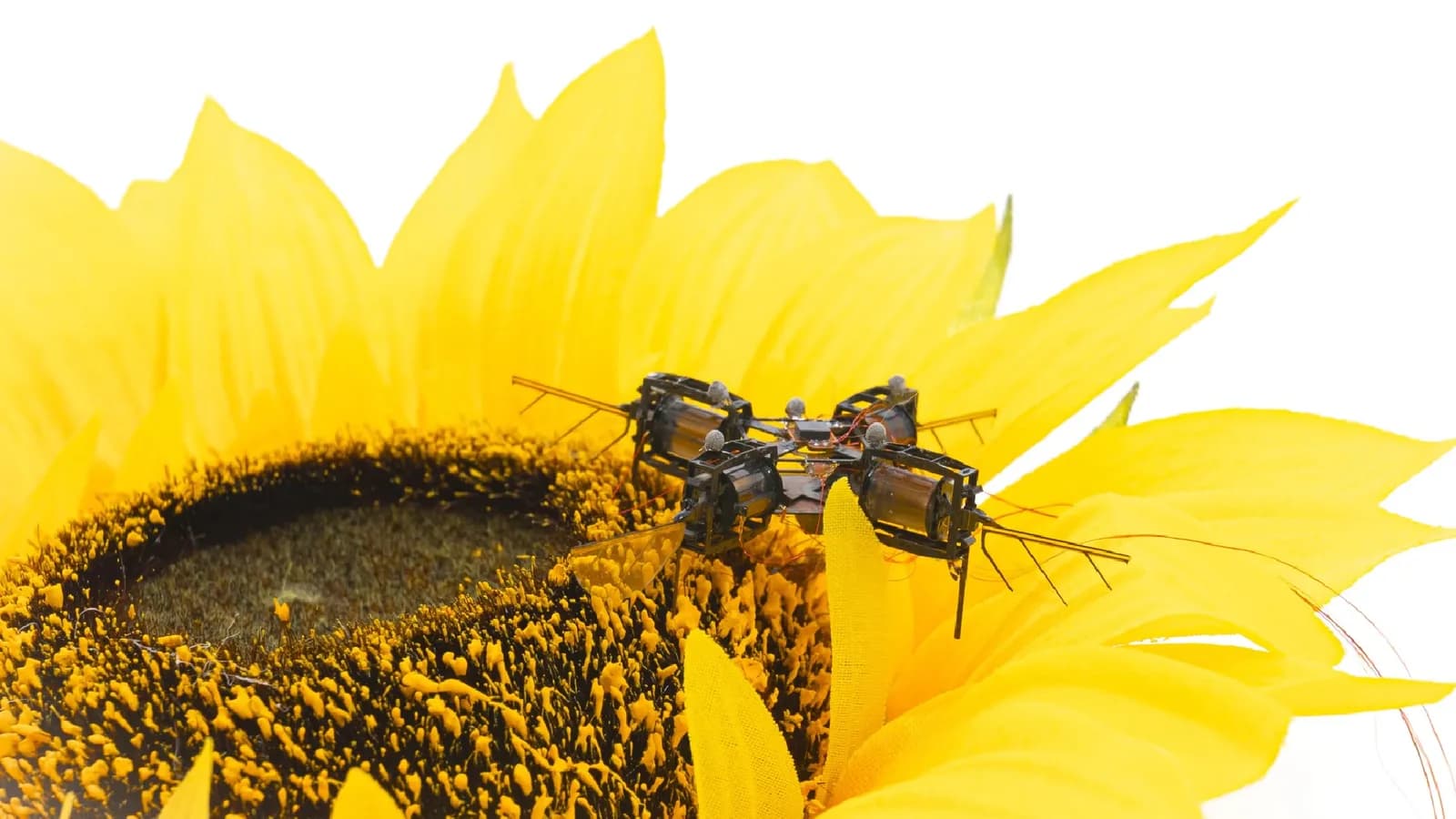
A flapping-wing robot weighing 1.29 grams (0.045 ounces) has hovered, tracked trajectories, and flown through a cluttered artificial garden using onboard sensing. The insect-scale micro aerial vehicle (IMAV) achieved centimeter-level accuracy, according to a study in Science Robotics from Yi-Hsuan Hsiao and colleagues.
In flights guided by a human operator, the robot made multiple 15- to 30-second trips, dodged obstacles, and eventually landed on a sunflower in a mock pollination maneuver.
Balancing mass and computation
Fully sensor-guided flight at this scale is a balancing act. It requires trading off sensor mass, computation cost, and measurement drift during real-time flight.
Aerial insects can navigate dense vegetation with ease, while similarly sized robots typically depend on offboard sensors and computation, the authors note. That limits them to motion-capture environments and restricts tasks such as search and rescue or precision agriculture.
The team’s framework combines an onboard inertial measurement unit (IMU), a time-of-flight sensor, an optical flow sensor, and a dual-core microcontroller unit (MCU). An IMU measures acceleration and rotation, a time-of-flight sensor estimates height by timing reflected light, and an optical flow sensor tracks motion across the ground.
Its estimator and controller run on a single MCU core, leaving room for future communication, image processing, and motion planning. The estimator fuses sensor readings into a position and orientation estimate that the controller uses to steer.
Human commands, onboard control
The combination of a sensor suite, estimators, and a low-level controller achieved centimeter-scale positional accuracy, the preprint says. In a 30-second flight outside a motion-capture system, the robot avoided obstacles and ultimately landed on a sunflower.
The sunflower served as a mock pollination target, a nod to proposed uses of robotic insects in agriculture.
The researchers also built a hierarchical controller that lets a human operator send high-level commands to direct the robot’s motion. The robot still relies on a human for high-level direction, and the authors say onboard planning and power autonomy remain areas to explore.
The authors wrote that this level of sensing and computational autonomy is “a notable advancement for the aerial microrobotics community.”
The paper, “Controlled Flight of an Insect-Scale Flapping-Wing Robot via Integrated Onboard Sensing and Computation,” is by Hsiao, Jonathan P. How, Elizabeth Farrell Helbling, YuFeng Chen and colleagues.
A growing microrobot field
Insect-scale flapping-wing robots have advanced quickly. MIT researchers earlier reported robotic insects that hovered for 1,000 seconds and flipped twice in the air, and Harvard’s RoboBee gained insect-inspired landing gear. Small size makes tiny flyers sensitive to air effects, such as the ground effect near surfaces that complicates landing, as Harvard researchers have noted.
MIT’s earlier insect-style microrobot performed somersaults and rapid navigation after gains in speed, acceleration, and hardware durability. Hovering and trajectory tracking, rather than only brief hops, are the baseline skills any free-flying microrobot needs before it can attempt tasks outdoors.
Onboard sensing is a key step toward taking such robots out of motion-capture rooms and toward uses such as search and rescue and precision agriculture.
Source: https://interestingengineering.com/ai-robotics/insect-scale-flapping-wing-robot-onboard
Get the latest news delivered to your inbox.
Related articles