New collision-proof drone bounces off obstacles without losing speed and agility
ETH Zurich researchers have developed FlexiQuad, a flexible four-rotor drone designed to withstand collisions while...
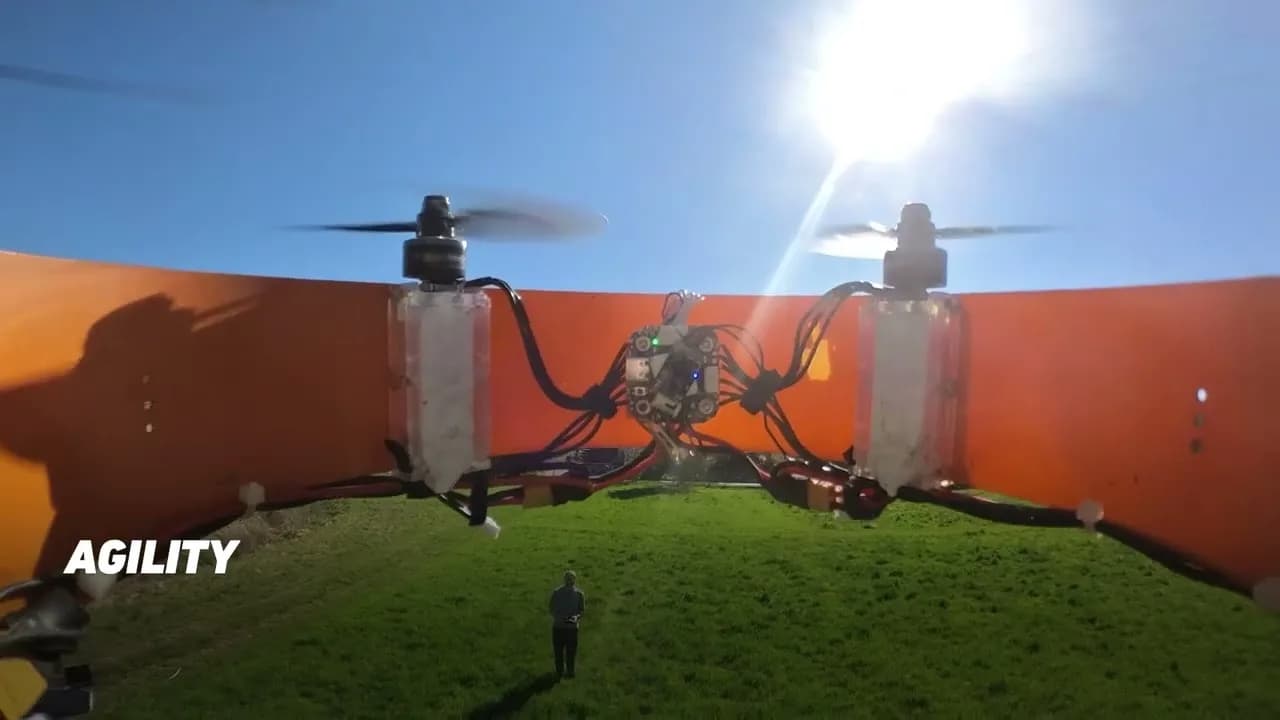
ETH Zurich researchers have developed FlexiQuad, a flexible four-rotor drone designed to withstand collisions while staying airborne.
Unlike conventional drones that rely on rigid frames, the new design uses a deformable structure that absorbs impacts by changing shape.
Despite its flexible body, FlexiQuad can maintain stable flight, reach high speeds, and perform agile maneuvers.
The design could eventually support applications such as infrastructure inspections, rescue operations, and environmental monitoring in confined spaces and challenging environments.
Collision-resistant drone
FlexiQuad is a flexible four-rotor drone designed to withstand collisions without losing flight capability. Unlike conventional quadcopters with rigid frames and four arms extending from a central body, the new drone features a deformable, ring-shaped structure that absorbs impact forces.
The design lets FlexiQuad briefly change shape when it strikes an obstacle, reducing the forces on its frame and onboard components. Despite its flexible structure, the drone can fly at speeds up to 49 mph (80 km/h) and achieve acceleration levels comparable to conventional rigid drones.
According to ETH Zurich, the drone’s main innovation lies in how its frame combines flexibility with structural stiffness. Its ring-shaped body has no central fuselage, with the four rotors, batteries, and flight-control module distributed along the frame. This arrangement allows the structure to deform laterally when it encounters an obstacle while remaining stiff in the vertical direction.
The researchers drew inspiration from birds and insects, whose wings can bend in certain directions while remaining relatively rigid in others. With this principle, FlexiQuad absorbs collision energy without compromising the force transmission needed to keep its rotors operating effectively.
Tackles tight spaces
In collision tests, the researchers flew the drone into obstacles at speeds of up to around 15.5 mph (25 km/h). Its frame temporarily deformed on impact, reducing the forces acting on the structure and allowing it to continue flying. The researchers said the test speed was limited mainly by the available space needed to accelerate the drone before collision.
According to Girardi, FlexiQuad can also reach linear and angular acceleration levels comparable to rigid drones. The flexible structure can also be used to grasp and transport objects. During demonstrations, the drone picked up, carried, and set down a soft first-aid kit. It also lifted a payload heavier than its own weight.
The design could support operations in confined or cluttered environments, including inspections of ship ballast tanks, search-and-rescue missions inside collapsed buildings, and environmental measurements in dense forests. Its ability to tolerate physical contact could also help it navigate obstacles that might otherwise interrupt a mission.
Another proposed application involves fitting a net inside the hollow center of the frame to capture unwanted or rogue drones. The deformable design lets heavy-duty drones squeeze through narrow gaps, carry extra sensors, and extend flight time.
FlexiQuad has a modular design intended to simplify transportation and assembly. Its airframe materials cost less than 15 Swiss francs, with potential for further reductions. The frame can also be opened and folded into a compact form that fits inside a medium-sized suitcase. Quick-release fasteners and slide-in batteries could eventually allow operators to assemble the drone rapidly on-site.
However, autonomous operation remains a technical challenge. Following a collision, vibrations in the flexible frame can blur camera images and interfere with navigation. Researchers are using reinforcement learning to teach the drone to stabilize itself after impact using onboard motion sensors, then resume autonomous flight. They are also investigating whether measurements of frame deformation and vibration could provide additional information for flight control.
Source: https://interestingengineering.com/innovation/soft-drone-bends-on-impact
Get the latest news delivered to your inbox.
Related articles