
New six-legged, 3D-printed, air-powered robot moves 5 yards per second with no electricity
UC San Diego engineers have built the fastest entirely soft robot yet, a six-legged runner...
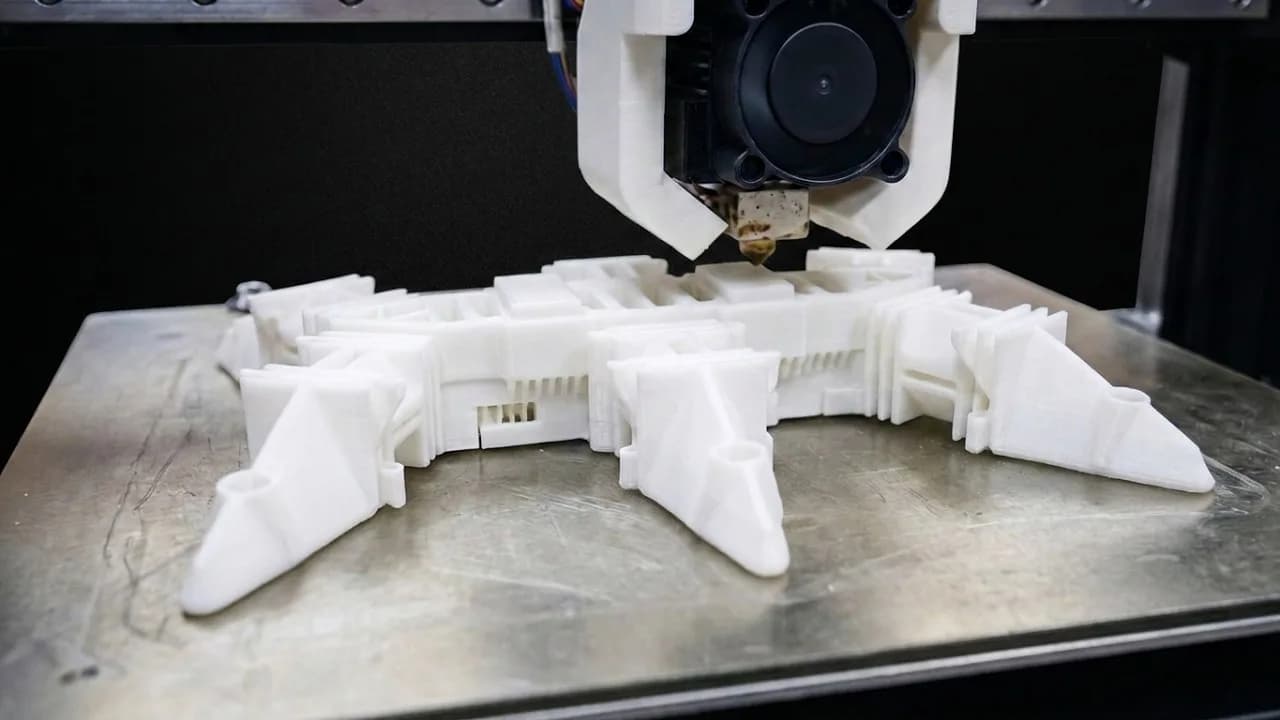
UC San Diego engineers have built the fastest entirely soft robot yet, a six-legged runner that reaches 10.6 mph (4.72 meters per second) without electronics. That is a little more than 5 yards per second. It runs on sand, mulch, and concrete, swims in water, and walks underwater, and it is 3D-printed in one go from a single material.
The team, led by Yichen Zhai, a former postdoctoral researcher, and Professor Michael T. Tolley, works in the Bioinspired Robotics and Design Laboratory at UC San Diego.
A hundredfold speed jump
The team built on its first 3D-printed, air-powered soft robot from 2022, which managed only about 1.5 inches (4 centimeters) per second, limited by air pressure and airflow.
Inside, a connected series of chambers, valves, and tubes drives the legs once pressurized air passes through. The best way to go faster is to raise the pressure, so the researchers made the robot and its internal structures bigger and stronger.
Higher pressure brings a problem, though. The robot can move so fast that it becomes inefficient, exhausting high-pressure air that still holds a lot of energy.
A steam engine trick
To fix that, the team borrowed from the compound steam engine, which lets steam expand through several chambers to extract more of its energy. In a compound engine, steam that has already pushed on a small piston expands again in a larger cylinder, so less energy is wasted. The robot’s chambers and valves let air circulate twice.
Air first flows through smaller, high-pressure chambers that power the valves, then through larger, low-pressure chambers that move the legs. The result is a robot that runs more than 100 times faster than the 2022 version.
Zhai said the first walking robot was too slow, and the team was fortunate to find a way to “make the new robot 100 times faster.”
Tested on rough ground
The researchers tested the robot on concrete, gravel, lawn, mulch, and sand. They also showed it could run down stairs, swim in water, and still function underwater.
The team sees the work as a step toward complex, powerful robots that could be printed on a desktop using inexpensive materials. The challenge, the researchers said, was fitting a time-tested solution into a soft running robot printed in one piece from one material.
Tethers and next steps
For now, the robot works only while tethered to a source of compressed air, such as a traditional air compressor. The team plans to explore designs that use less air, so the robot could run untethered on a portable source such as a compressed-air cartridge.
Researchers also envision designs capable of more complex motions, including steering and object manipulation.
Such electronics-free robots could eventually work where electronics cannot function, including scientific reconnaissance in high-radiation or magnetic-field areas, disaster response and space exploration.
Earlier UC San Diego work printed electronics-free soft grippers and a walking robot that earlier reporting said cost about $20 to build. Air-powered robots from AMOLF in the Netherlands have reached 30 body lengths per second without electronics, according to earlier reporting.
The research was published in the Nov. 18 issue of Science Robotics.
Source: https://interestingengineering.com/ai-robotics/fastest-electronics-free-soft-robot-ucsd
Get the latest news delivered to your inbox.
Related articles