China’s LineShine supercomputer with 13 million CPU cores retains top global spot
China’s LineShine held its place as the world’s fastest supercomputer, posting 2.198 exaflops in the...
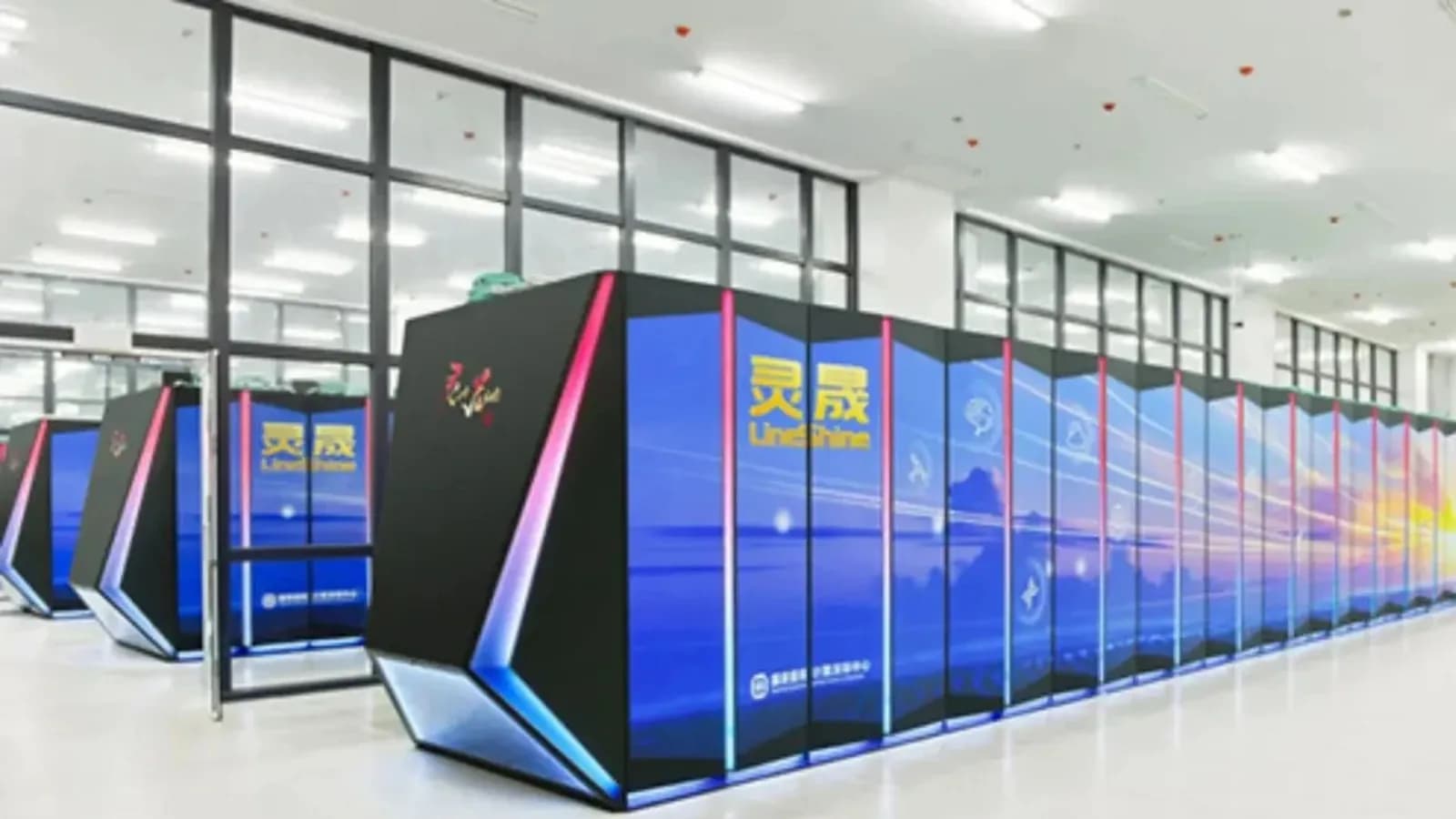
China’s LineShine held its place as the world’s fastest supercomputer, posting 2.198 exaflops in the latest TOP500 rankings announced at the SC26 computing conference in Chicago.
The machine, installed at the National Supercomputing Center in Shenzhen, finished about 21 percent ahead of the US Department of Energy’s El Capitan on the High Performance Linpack benchmark.
LineShine also retained first place on the separate High Performance Conjugate Gradient (HPCG) benchmark, scoring 22 petaflops to El Capitan’s 17.41.
The results extend a lead LineShine first took in June, when it displaced El Capitan and became the first Chinese system to top the TOP500 since Sunway TaihuLight in 2017.
How LineShine passed two exaflops
An exaflop represents a quintillion floating-point operations per second. LineShine’s June debut marked the first time a TOP500 system had sustained more than two exaflops in double precision using only central processing units, according to the organization.
The system runs on nearly 13.8 million CPU cores. Its domestically developed LX2 processors incorporate matrix acceleration units and high-bandwidth memory, while a proprietary network connects the processors so they can work on different parts of the same problem. The processors have 304 cores each.
“LineShine shows that world-class supercomputing performance can be achieved without relying on high-end GPU accelerators,” Ma Jihua, a telecom industry analyst, told the Global Times.
What the two rankings measure
Linpack measures how quickly a machine solves a dense system of linear equations. The benchmark rewards a computer’s ability to perform large volumes of arithmetic and provides the score used to order the TOP500 list.
HPCG uses a different set of operations that places more emphasis on moving data through memory and communicating between processors.
It reflects some of the constraints that real scientific applications encounter, where how quickly processors can access and exchange data can matter as much as how fast they perform calculations. El Capitan finished second in both tests.
The top five systems all recorded at least one exaflop on Linpack, and the order of the top 10 remained unchanged from the June rankings.
From silicon crystals to solid-state batteries
Researchers have already used LineShine to model a silicon crystal containing 200 million atoms and to simulate the electronic structure of solid-state battery interfaces involving more than 10 million atoms.
The work used XLSDFT, a software package designed to make quantum simulations feasible at scales that are difficult to reach with conventional methods.
The team’s work was named a finalist for the 2026 ACM Gordon Bell Prize, which recognizes advances in high-performance computing.
LineShine has also been adapted to run more than 220 specialized applications, spanning fields such as weather forecasting, materials science and drug discovery.
Lu Yutong, LineShine’s chief designer and director of the Shenzhen center, said the facility plans to develop tools that combine supercomputing with artificial intelligence and expand support for researchers using the system.
The battery study offers one example of what researchers can do with that computing power.
By modeling how electrons behave where solid materials meet, they can investigate one of the factors that influence how a solid-state battery performs.
Source: https://interestingengineering.com/science/china-lineshine-worlds-fastest-supercomputer
Get the latest news delivered to your inbox.
Related articles